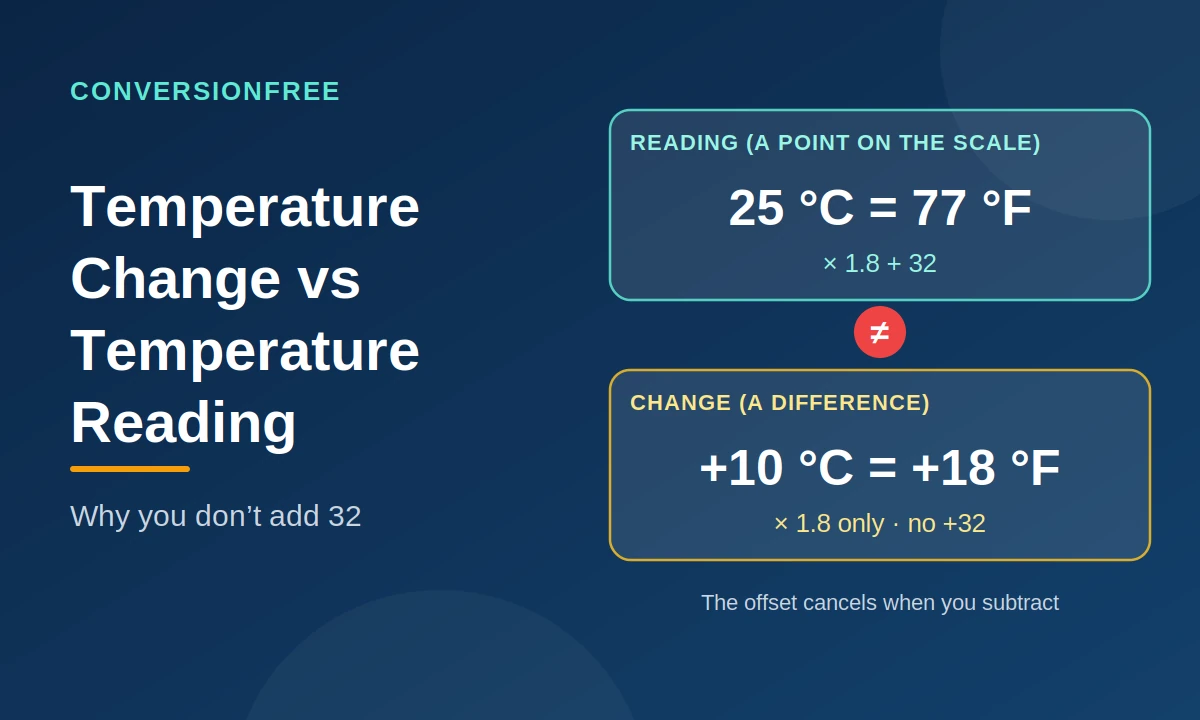
Quick answer: A temperature reading (a point on the scale, like “25 °C”) converts with × 1.8 + 32. A temperature change (a difference, like “a rise of 10 °C”) converts with × 1.8 only. There is no +32. So a rise of 10 °C is a rise of 18 °F, and a drop of 20 °C is a drop of 36 °F.
The standard temperature converter is built for readings. This guide covers the other case, which trips up cooking, science and news headlines.
Key takeaways
- Reading to reading: °F = °C × 1.8 + 32.
- Change to change: Δ°F = Δ°C × 1.8, with no +32.
- A change of 1 K equals a change of 1 °C, and equals a change of 1.8 °F.
- The “+32” cancels out when you subtract two readings.
- Only kelvin lets you say “twice as hot”. Celsius and Fahrenheit don’t.
What Is the Difference Between a Reading and a Change?
- A temperature reading says where you are on a scale: 20 °C, 68 °F, 293.15 K.
- A temperature change (or temperature difference, or interval) says how far apart two readings are: a rise of 5 °C, a fall of 9 °F, a gap of 10 K.
Scientists often write a change with the Greek letter delta: ΔT (read “delta T”). So ΔT = 10 °C means “a change of 10 °C”. A “delta T” is common in physics, HVAC and cooking.
Why does it matter? Because the two scales start at different places, a point needs a shift to match, but a distance doesn’t.
Why You Don’t Add 32 to a Change
The “+32” in °F = °C × 1.8 + 32 shifts the starting point. When you subtract two readings, the shift cancels.
Take two readings in Celsius, C₁ and C₂. In Fahrenheit they are:
- F₁ = 1.8 × C₁ + 32
- F₂ = 1.8 × C₂ + 32
Now subtract:
F₁ − F₂ = (1.8 × C₁ + 32) − (1.8 × C₂ + 32) = 1.8 × (C₁ − C₂)
The 32s disappear. So ΔF = 1.8 × ΔC.
The same thing happens with Kelvin: K = °C + 273.15, so K₁ − K₂ = C₁ − C₂. That’s why a change of 1 K is exactly a change of 1 °C.
How to Convert a Temperature Change
| From | To | Formula |
|---|---|---|
| Δ°C | Δ°F | Δ°F = Δ°C × 1.8 |
| Δ°F | Δ°C | Δ°C = Δ°F ÷ 1.8 (or × 5/9) |
| Δ°C | ΔK | ΔK = Δ°C (no change) |
| Δ°F | ΔK | ΔK = Δ°F ÷ 1.8 |
Quick reference: Celsius change to Fahrenheit change
| Δ °C | Δ °F |
|---|---|
| 1 | 1.8 |
| 5 | 9 |
| 10 | 18 |
| 15 | 27 |
| 20 | 36 |
| 25 | 45 |
| 50 | 90 |
Quick reference: Fahrenheit change to Celsius change
| Δ °F | Δ °C |
|---|---|
| 1 | 0.56 |
| 9 | 5 |
| 10 | 5.56 |
| 18 | 10 |
| 36 | 20 |
| 90 | 50 |
Memory aid: every 5 °C is 9 °F, and every 9 °F is 5 °C.
Worked Examples
Example 1: A weather swing
The morning is 8 °C and the afternoon reaches 22 °C.
- Change: 22 − 8 = 14 °C
- In Fahrenheit: 14 × 1.8 = 25.2 °F
Check using readings: 8 °C = 46.4 °F and 22 °C = 71.6 °F. 71.6 − 46.4 = 25.2 ✔
The common mistake: 14 × 1.8 + 32 = 57.2 °F. That’s more than double the real change.
Example 2: A fan oven
Many recipes suggest setting a fan oven about 20 °C lower than a conventional oven. (This is a general guideline, and ovens vary.) If a recipe says 180 °C (356 °F):
- A reduction of 20 °C is a reduction of 20 × 1.8 = 36 °F.
- New setting: 356 − 36 = 320 °F (160 °C).
The common mistake: 20 × 1.8 + 32 = 68 °F, giving 356 − 68 = 288 °F, which is far too cool.
For more oven conversions, see our oven temperature chart (planned).
Example 3: A fever
A temperature rises from 37 °C to 39 °C.
- Change: 2 °C
- In Fahrenheit: 2 × 1.8 = 3.6 °F
- Check: 98.6 °F + 3.6 = 102.2 °F ✔ (and 39 °C = 102.2 °F)
Example 4: Climate headlines
“The world has warmed by 1.5 °C” is a change, not a reading.
- 1.5 °C × 1.8 = 2.7 °F
Writing it as 34.7 °F (1.5 × 1.8 + 32) would be wrong.
Example 5: Heating water
You heat 1 kg of water from 20 °C to 100 °C.
- ΔT = 80 °C = 80 K = 80 × 1.8 = 144 °F
- Heat needed: Q = m × c × ΔT, with c ≈ 4.186 kJ per kg per K
- Q = 1 × 4.186 × 80 ≈ 335 kJ
Because specific heat is given “per kelvin”, you can use the Celsius change directly (80 °C = 80 K). If someone gives you the change in Fahrenheit (144 °F), convert it first: 144 ÷ 1.8 = 80.
Example 6: Rate of change
A room warms at 2 °C per hour.
- In Fahrenheit: 2 × 1.8 = 3.6 °F per hour
Rates are changes over time, so they follow the same rule.
Mixing Readings and Changes
Sometimes you have a starting reading and a change, and you need the result in the other scale.
Rule: convert the reading with the full formula, convert the change with × 1.8, then add.
Example: start at 20 °C and rise by 15 °C.
- In Celsius: 20 + 15 = 35 °C (= 95 °F)
- In Fahrenheit: 20 °C = 68 °F, and 15 °C change = 27 °F → 68 + 27 = 95 °F ✔
Both routes give the same answer, which is a good way to check your work.
Why Kelvin Lets You Say “Twice as Hot”
Celsius and Fahrenheit are interval scales: their zero points are conventions. Kelvin is a ratio scale: its zero is absolute zero.
That means ratios only make sense in kelvin.
- 40 °C is not “twice as hot” as 20 °C.
- In kelvin: 313.15 K ÷ 293.15 K = 1.07. It’s about 7% higher on the absolute scale.
Likewise, a negative Celsius reading doesn’t mean “less than nothing”. It just means below the freezing point of water.
For the full comparison of the three scales, see Celsius vs Fahrenheit vs Kelvin.
How to Write a Temperature Change Clearly
To avoid confusion, say what you mean:
- Write “a rise of 10 °C”, "ΔT = 10 °C" or “a difference of 10 K”.
- For differences, kelvin and degrees Celsius are interchangeable. The SI system allows either, so “10 K” and “10 °C” mean the same interval. (Verify the SI wording for your use.)
- Some texts use “C°” or “deg C” for intervals, but it isn’t universal. State “difference” or “change” in words if there’s any doubt.
Spreadsheets and Code
For a temperature change (cell A1 holds Δ°C):
- Δ°C to Δ°F:
=A1*9/5 - Δ°F to Δ°C:
=A1*5/9
Warning about CONVERT: a spreadsheet function such as =CONVERT(A1,"C","F") treats the value as a reading, so it adds the 32. Using it on a temperature change gives the wrong answer. (Verify this in your own spreadsheet software.)
Python:
python
delta_f = delta_c * 9/5      # change: no +32
f = c * 9/5 + 32             # reading: with +32
Common Mistakes
- Adding 32 to a change. A rise of 10 °C is 18 °F, not 50 °F.
- Dropping the 32 from a reading. 25 °C is 77 °F, not 45 °F.
- Using the reading formula on a rate such as “2 °C per hour”.
- Mixing up “°F change” and “°F reading” in a recipe or report.
- Saying “twice as hot” for Celsius or Fahrenheit values.
- Using an online reading converter for a difference. Multiply by 1.8 instead.
- Forgetting that K and °C intervals match, and converting between them anyway.
Quick Test: Reading or Change?
| Phrase | Reading or change? | Convert with |
|---|---|---|
| “It’s 25 °C outside” | Reading | × 1.8 + 32 |
| “It rose by 5 °C” | Change | × 1.8 |
| “Set the oven to 180 °C” | Reading | × 1.8 + 32 |
| “Reduce by 20 °C” | Change | × 1.8 |
| “Fever of 38.5 °C” | Reading | × 1.8 + 32 |
| “Fever rose 1.5 °C” | Change | × 1.8 |
| “Warming of 2 °C” | Change | × 1.8 |
If the phrase contains words such as rise, drop, difference, increase, per hour or warmer by, it’s usually a change.
Temperature Change vs Reading: FAQs
How do I convert a temperature difference from Celsius to Fahrenheit?
Multiply by 1.8. A difference of 10 °C is 18 °F.
Do I add 32 when converting a temperature change?
No. The 32 only applies to readings.
Is a change of 1 K the same as 1 °C?
Yes. The two scales have the same step size.
Is a change of 1 °C the same as 1 °F?
No. 1 °C is a change of 1.8 °F.
What does delta T mean?
Delta T (ΔT) is a change or difference in temperature.
How do I convert a Fahrenheit change to Celsius?
Divide by 1.8 (or multiply by 5/9). A change of 18 °F is 10 °C.
Why does the formula use +32 for readings?
Because 0 °C equals 32 °F. The scales start at different points.
Can I say 40 °C is twice as hot as 20 °C?
No. Only the Kelvin scale has a true zero, so ratios only make sense there.
Is a temperature change the same in Celsius and Kelvin?
Yes. A 5 °C change is a 5 K change.
How do I convert a rate like °C per hour?
Multiply by 1.8 for °F per hour.
Convert Readings and Changes Correctly
For readings, use the ConversionFree temperature converter. For changes, multiply by 1.8 (or divide by 1.8 for the reverse). Want the formulas for readings? See how to convert Celsius to Fahrenheit. You can also explore more measurement conversion tools, or visit the ConversionFree for other free tools.