Quick answer: 180 °C is 356 °F, which recipes round to 350 °F, and it’s gas mark 4. In a fan oven, set it about 20 °C lower, so 160 °C. 180 °C is gas mark 4 and 200 °C is gas mark 6.
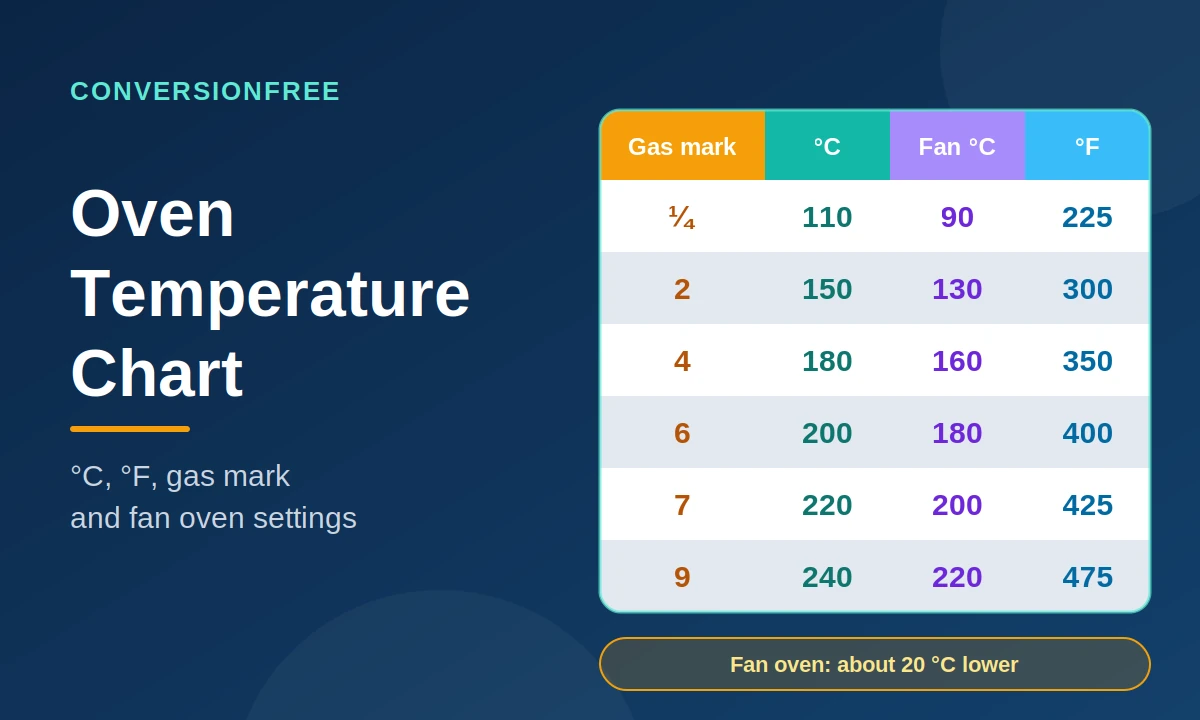
The chart below covers gas marks ¼ to 9 in Celsius, fan Celsius and Fahrenheit. For any other temperature, use the temperature converter.
Key takeaways
- Gas marks are a UK-style setting for gas ovens, from ¼ (very cool) to 9 (very hot).
- Fahrenheit for marks 1–9: °F = 25 × gas mark + 250.
- Fan oven temperatures are typically around 20 °C lower than conventional ovens.
- Recipe charts round converted temperatures, so 356 °F becomes 350 °F.
- Ovens can run hotter or cooler than the dial. An oven thermometer shows the truth.
Oven Temperature Conversion Chart
| Gas mark | °F | °C (conventional) | °C (fan) | °F (fan) | Description |
|---|---|---|---|---|---|
| ¼ | 225 | 110 | 90 | 194 | Very cool |
| ½ | 250 | 120 | 100 | 212 | Very cool |
| 1 | 275 | 140 | 120 | 248 | Cool |
| 2 | 300 | 150 | 130 | 266 | Cool |
| 3 | 325 | 160 | 140 | 284 | Moderate |
| 4 | 350 | 180 | 160 | 320 | Moderate |
| 5 | 375 | 190 | 170 | 338 | Moderately hot |
| 6 | 400 | 200 | 180 | 356 | Moderately hot |
| 7 | 425 | 220 | 200 | 392 | Hot |
| 8 | 450 | 230 | 210 | 410 | Hot |
| 9 | 475 | 240 | 220 | 428 | Very hot |
Which?’s chart gives the same pairings for marks 1 to 9, including fan temperatures 20 °C below the conventional setting. The “fan (°F)” column is the fan °C value converted exactly. which
How to read it: find the temperature your recipe uses in the column that matches (°F, °C, gas mark), then read across to your oven’s setting.
Common Oven Conversions
| Recipe says | In °F | In °C | Gas mark | Fan |
|---|---|---|---|---|
| 160 °C | 320 | 160 | 3 | 140 °C |
| 180 °C | 356 (350) | 180 | 4 | 160 °C |
| 190 °C | 374 (375) | 190 | 5 | 170 °C |
| 200 °C | 392 (400) | 200 | 6 | 180 °C |
| 220 °C | 428 (425) | 220 | 7 | 200 °C |
| 350 °F | 350 | 177 (180) | 4 | 160 °C |
| 400 °F | 400 | 204 (200) | 6 | 180 °C |
| 425 °F | 425 | 218 (220) | 7 | 200 °C |
Numbers in brackets are what recipes usually print after rounding.
Why Do the Chart Values Differ From the Exact Conversion?
The Celsius-to-Fahrenheit formula is exact: °F = °C × 1.8 + 32. But oven charts round to convenient settings, so the chart and the formula differ slightly.
| °F | Exact °C | Chart °C | Gap |
|---|---|---|---|
| 275 | 135.0 | 140 | +5 |
| 300 | 148.9 | 150 | +1 |
| 325 | 162.8 | 160 | −3 |
| 350 | 176.7 | 180 | +3 |
| 375 | 190.6 | 190 | −1 |
| 400 | 204.4 | 200 | −4 |
| 425 | 218.3 | 220 | +2 |
| 450 | 232.2 | 230 | −2 |
| 475 | 246.1 | 240 | −6 |
A gap of 3 to 6 °C is well within normal oven variation, so using the chart’s rounded values is fine for cooking. For the formula and its derivation, see how to convert Celsius to Fahrenheit.
How to Convert Gas Mark to Fahrenheit and Celsius
Gas mark to Fahrenheit (marks 1 to 9):
°F = 25 × gas mark + 250
| Gas mark | Calculation | °F |
|---|---|---|
| 3 | 25 × 3 + 250 | 325 |
| 4 | 25 × 4 + 250 | 350 |
| 6 | 25 × 6 + 250 | 400 |
| 9 | 25 × 9 + 250 | 475 |
Fahrenheit to gas mark: gas mark = (°F − 250) ÷ 25. For 400 °F: (400 − 250) ÷ 25 = 6.
Gas mark to Celsius: there’s no tidy formula. Use the chart above, or convert the Fahrenheit value to Celsius and round to the nearest 10.
How to Convert Between Fan and Conventional Ovens
Fan to conventional: add about 20 °C.
Conventional to fan: subtract about 20 °C.
The fan circulates hot air around the oven and into the food, giving a more even temperature and quicker cooking. which
Example: a recipe says 200 °C (conventional).
- Fan oven: 200 − 20 = 180 °C
Example: a TV recipe says 180 °C fan.
- Conventional oven: 180 + 20 = 200 °C, which is 400 °F and gas mark 6.
Why is the fan adjustment a change, not a reading?
“20 °C lower” is a temperature change. In Fahrenheit it’s 36 °F, not 68 °F (which is what you’d get by adding 32). So a 356 °F conventional setting becomes about 320 °F for a fan oven. For why, see temperature change vs temperature reading.
Some US recipes suggest dropping convection temperatures by about 25 °F (about 14 °C) instead. Follow your oven manual if it gives specific advice. (Verify this convention before publishing.)
What Temperature for What? (General Guide)
These are typical ranges, not rules. Always follow your recipe.
| Range | °C | Typical uses |
|---|---|---|
| Very cool to cool | 110–150 | Meringues, slow drying, slow-cooked dishes |
| Moderate | 160–180 | Cakes, sponges, many biscuits and cookies |
| Moderately hot | 190–200 | Muffins, roast vegetables, pastry, bread |
| Hot | 220–230 | Bread crusts, puff pastry, high-heat roasting |
| Very hot | 240 | Pizza and some bread, up to the oven’s limit |
(Check each against your recipe. These are general baking conventions, and I haven’t sourced them.)
Is Your Oven Really at the Temperature on the Dial?
Not always. Ovens can run hotter or cooler than the setting, and temperatures can swing during cooking. A few tips:
- Use an oven thermometer. Hang one on the middle rack and compare it with the dial.
- Preheat fully, and don’t rely on the first beep.
- Rotate trays if your oven has hot spots.
- Adjust to your oven. If it runs 10 °C hot, set it 10 °C lower.
Gas Oven, Electric Oven, Fan Oven: What’s the Difference?
- Gas ovens use gas marks, mostly in UK recipes and appliances.
- Electric conventional ovens use °C (or °F in the US), heated by top and bottom elements.
- Fan or convection ovens add a fan, so food cooks faster at a lower temperature.
If a recipe doesn’t say which type it assumes, treat it as conventional, and apply the fan adjustment if you have a fan oven.
Common Mistakes
- Using the fan temperature in a conventional oven (or the reverse). It’s a 20 °C difference.
- Adding 32 to the fan adjustment. The adjustment is a change: 20 °C = 36 °F.
- Assuming 350 °F equals exactly 180 °C. It’s 177 °C. The chart rounds.
- Mixing up gas marks. Gas mark 3 is 160 °C on current charts. Some older charts say 170 °C.
- Skipping preheating.
- Trusting the dial without checking.
Oven Temperature Conversion: FAQs
What is 180 °C in Fahrenheit?
356 °F, usually rounded to 350 °F.
What gas mark is 180 °C?
Gas mark 4.
What is 180 °C in a fan oven?
160 °C.
What is 350 °F in Celsius?
About 177 °C, usually rounded to 180 °C.
What gas mark is 200 °C?
Gas mark 6.
What is gas mark 6 in Fahrenheit?
400 °F.
How do I convert gas mark to Fahrenheit?
°F = 25 × gas mark + 250 (for marks 1 to 9).
How do I convert a recipe for a fan oven?
Subtract about 20 °C from the conventional temperature.
What is 400 °F in Celsius?
About 204 °C, usually rounded to 200 °C.
Do US ovens have gas marks?
No. US ovens use °F. Gas marks are mainly a UK setting.
Why is my cake burning at the recipe temperature?
Your oven may run hot, or you may need the fan-oven adjustment. Check with an oven thermometer.
Convert Any Oven Temperature in Seconds
For temperatures that aren’t on the chart, use the ConversionFree temperature converter, and use the weight converter for baking weights. You can also browse our online unit converters, or visit the ConversionFree for other free tools.