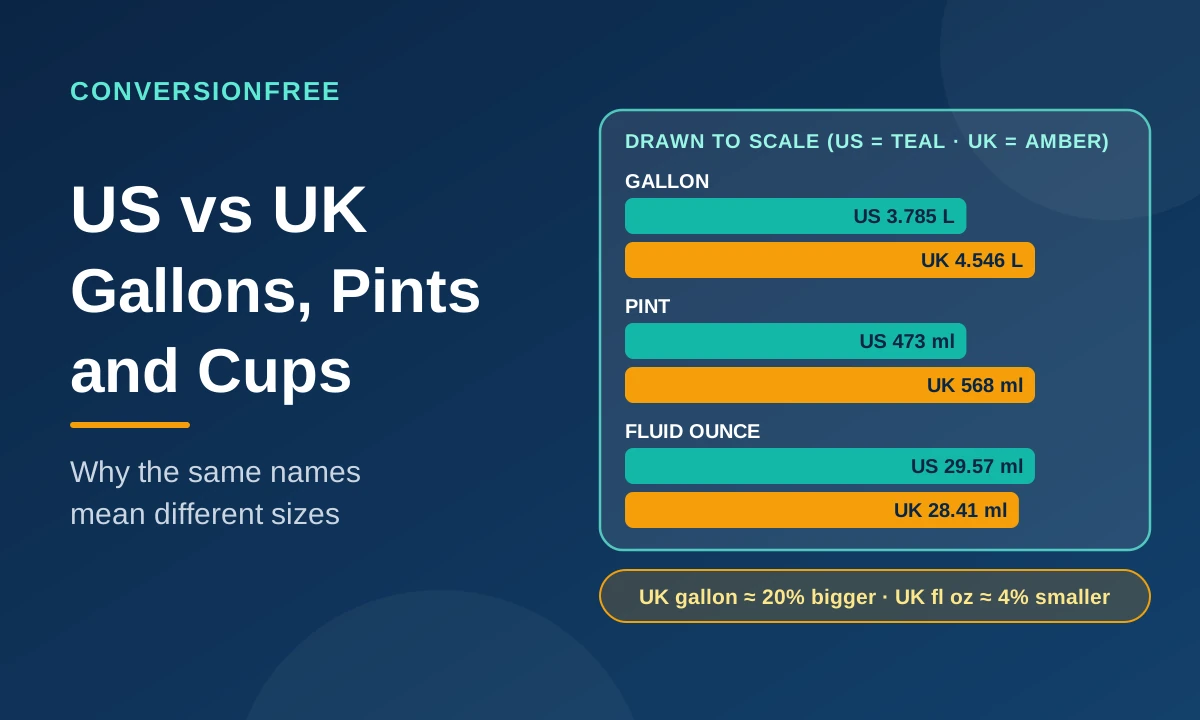
Quick answer: A US gallon is 3.785 litres and a UK (imperial) gallon is 4.546 litres, so the UK gallon is about 20% bigger. The same goes for the pint and quart: a US pint is 473 ml and a UK pint is 568 ml. The fluid ounce goes the other way: a UK fluid ounce (28.41 ml) is about 4% smaller than a US one (29.57 ml). The names match, but the sizes don’t.
For exact conversions, use the volume converter. This guide puts every size in one place, explains why they differ, and shows where the mix-ups happen (recipes, fuel economy and pubs).
Key takeaways
- 1 US gallon = 3.785 L. 1 UK gallon = 4.546 L. 1 UK gallon = 1.2009 US gallons.
- The pint, quart and gallon are all about 20% bigger in the UK system.
- The fluid ounce is the exception: UK 28.41 ml, US 29.57 ml.
- A US pint has 16 fl oz. A UK pint has 20 fl oz.
- “Cup” isn’t one unit. It can be 236.6, 240, 250 or 284 ml depending on the source.
Why Do the US and UK Use Different Gallons?
Both systems come from the same old English units, but they split apart. The two systems of gallon, pint and cup are not the same size, and the UK imperial versions are larger. krisyotam
- The US gallon is based on an older English wine gallon, defined as 231 cubic inches.
- The imperial gallon was standardised in Britain in 1824, originally tied to the volume of 10 pounds of water, and is now defined exactly as 4.54609 litres.
(Verify both historical statements before publishing.)
The US kept the older definition, while Britain adopted the new one. That’s why the same word names two different volumes. Today, both are defined exactly in litres, so there’s no rounding in the conversion factor.
US vs UK Volume Units at a Glance
| Unit | US customary | UK (imperial) | UK vs US |
|---|---|---|---|
| Fluid ounce | 29.5735 ml | 28.4131 ml | −3.9% |
| Pint | 473.176 ml (16 US fl oz) | 568.261 ml (20 UK fl oz) | +20.1% |
| Quart | 946.353 ml | 1,136.52 ml | +20.1% |
| Gallon | 3.78541 L (128 US fl oz) | 4.54609 L (160 UK fl oz) | +20.1% |
The structure:
- US: 1 gallon = 4 quarts = 8 pints = 16 cups = 128 fluid ounces
- UK: 1 gallon = 4 quarts = 8 pints = 160 fluid ounces
The gallon, quart and pint have the same structure in both systems. The sizes differ because the UK pint holds 20 fluid ounces and the US pint holds 16.
The conversion factors
| From | To | Multiply by |
|---|---|---|
| US gallon | UK gallon | 0.832674 |
| UK gallon | US gallon | 1.200950 |
| US pint | UK pint | 0.832674 |
| UK pint | US pint | 1.200950 |
| Litre | US gallon | 0.264172 |
| Litre | UK gallon | 0.219969 |
Examples:
- 5 US gallons = 18.93 L = 4.16 UK gallons
- 5 UK gallons = 22.73 L = 6.00 US gallons
For more on litres and gallons, see our guide to litres to gallons (planned).
US vs UK Gallons
| US gallon | UK gallon | |
|---|---|---|
| Litres | 3.785 | 4.546 |
| Millilitres | 3,785.4 | 4,546.1 |
| Cubic inches | 231 | about 277.4 |
| In fluid ounces | 128 US fl oz | 160 UK fl oz |
Rule of thumb: a US gallon is about 3.8 litres and a UK gallon is about 4.5 litres.
A quirk of percentages: the UK gallon is 20% bigger than the US gallon, but the US gallon is only 17% smaller than the UK one. Both statements are true. The percentage depends on which one you start from.
US vs UK Pints
| US pint | UK pint | |
|---|---|---|
| Millilitres | 473.2 | 568.3 |
| Fluid ounces | 16 US fl oz | 20 UK fl oz |
| Cups | 2 US cups | about 2 old UK cups |
Where it matters: a pint of beer. A UK pint is 568 ml, while a US pint is 473 ml, about 95 ml (17%) less. A US “pint” of beer in a US bar is a smaller glass than a pint in a UK pub. (Pour sizes vary by venue, so treat these as nominal values.)
Milk and recipes: UK recipes may call for “1 pint of milk” meaning 568 ml. Using a US pint (473 ml) would leave you 17% short.
A memory aid (a folk saying, not a standard): “A pint’s a pound the world around” for the US pint, which holds about 1.04 lb of water. For the UK, a pint of water weighs about 1¼ pounds.
US vs UK Fluid Ounces
| US fl oz | UK fl oz | |
|---|---|---|
| Millilitres | 29.5735 | 28.4131 |
| Difference | UK is 3.9% smaller |
This is the odd one out. The UK fluid ounce is slightly smaller than the US one, but the UK pint contains more of them (20 instead of 16), so the UK pint ends up bigger.
Fluid ounce vs ounce
A fluid ounce measures volume. An ounce (oz) measures weight. They aren’t the same thing, though the imperial system was designed so they come close for water.
- UK: 1 imperial fl oz of water weighs about 1.002 oz, so they’re almost equal.
- US: 1 US fl oz of water weighs about 1.043 oz.
For everything except water, the two differ, because liquids have different densities. We cover that in litres to kg and ml to grams (planned).
What About Cups?
A cup isn’t one standard size. There’s a US customary cup of 236.588 ml, a US legal cup of 240 ml used for nutrition labelling, a metric cup of 250 ml, and an old UK imperial cup of 284.131 ml.
| Cup | Millilitres | Where it’s used |
|---|---|---|
| US customary cup | 236.588 | US recipes (8 US fl oz, ½ US pint) |
| US legal cup | 240 | US nutrition labels |
| Metric cup | 250 | Australia, New Zealand, Canada, and modern UK recipes |
| UK imperial cup (old) | 284.131 | Older UK recipes (10 imperial fl oz, ½ pint). Now rare. |
| Japanese cup | 200 | Japan and Korea (some contexts) |
How different are they? Compared with a US customary cup, the metric cup is 5.7% larger (250 ÷ 236.588), the US legal cup is 1.4% larger, and the old UK cup is 20% larger.
Our converter: the ConversionFree volume converter lists a US cup (236.588 ml) and a UK cup. [Editor: state the UK cup value your tool uses, and say whether it’s 250 ml or 284.131 ml, before publishing.]
Practical advice: for modern UK, Australian or New Zealand recipes, assume a 250 ml cup. For old UK cookbooks, an imperial cup could be 284 ml. When in doubt, use millilitres or grams.
Tablespoons and Teaspoons Also Differ
| Spoon | US | Metric (UK, most countries) | Australia | Old UK imperial |
|---|---|---|---|---|
| Tablespoon | 14.787 ml | 15 ml | 20 ml | about 17.76 ml |
| Teaspoon | 4.929 ml | 5 ml | 5 ml | about 5.92 ml |
One reference lists a UK tablespoon as 17.758 ml and an Australian one as 20 ml. But another says the US and UK use a 15 ml tablespoon. The difference is between the old imperial spoon (17.76 ml) and the modern metric spoon (15 ml), so check which one a recipe means. pages
The Australian trap: an Australian tablespoon holds about 35% more than a US one. In a recipe that calls for 2 tablespoons, that’s 40 ml instead of about 30 ml.
For a full kitchen chart, see our guide to cooking measurement conversions (planned).
What About US Dry Measures?
In the US, dry pints, quarts and gallons are a different size from liquid ones.
| Unit | US liquid | US dry |
|---|---|---|
| Pint | 473.176 ml | 550.610 ml |
| Quart | 946.353 ml | 1,101.22 ml |
| Gallon | 3,785.41 ml | 4,404.88 ml |
Dry measures are used for things like berries and grain. If a label says “dry pint”, don’t use the liquid figure. (Verify these values before publishing.)
Why It Matters: Fuel Economy
This difference is the reason US and UK miles per gallon can’t be compared directly. A UK (imperial) gallon is 20% bigger, so the same car gets 20% more “miles per gallon” in the UK figure.
| UK mpg | US mpg | L/100 km |
|---|---|---|
| 36.0 | 30 | 7.85 |
| 40 | 33.3 | 7.06 |
| 50 | 41.6 | 5.65 |
Example: a car rated at 40 mpg in the UK is about 33.3 mpg in US terms. Both mean the same real efficiency, about 7 litres per 100 km.
To compare fuel economy fairly, convert both to L/100 km. Use the fuel economy converter, and see kilometres to miles for the distance side.
Fuel tanks: a 15 US gallon tank holds about 56.8 L. A 12.5 UK gallon tank holds about 56.8 L as well. Same tank, different numbers.
Where Is Each System Used?
- United States: gallons for fuel, milk, paint and other liquids; cups, tablespoons and fluid ounces in recipes.
- United Kingdom: pints for beer and milk and gallons in mpg, while most packaged goods and fuel are sold in litres or millilitres.
- Canada, Australia, New Zealand and most others: litres and millilitres, with metric cups and spoons in recipes.
(Usage varies by product and context. Verify against current sources before publishing.)
Common Mistakes
- Assuming a gallon is a gallon. The UK gallon is 20% bigger.
- Comparing UK and US mpg directly. Convert to L/100 km.
- Using a US pint for a UK recipe. You’ll be 17% short.
- Mixing up fluid ounces and ounces.
- Using a 15 ml tablespoon for an Australian recipe. It needs 20 ml.
- Assuming a cup is always 240 ml.
- Using liquid values for US dry measures.
- Rounding too early. Keep the exact factor until the end.
US vs UK Gallons, Pints and Cups: FAQs
Is a UK gallon bigger than a US gallon?
Yes. A UK (imperial) gallon is 4.546 L and a US gallon is 3.785 L. The UK gallon is about 20% bigger.
How many US gallons are in a UK gallon?
1.2009.
How many UK gallons are in a US gallon?
0.8327.
How many ml is a UK pint?
568.261 ml.
How many ml is a US pint?
473.176 ml.
How many fluid ounces are in a UK pint?
20
How many fluid ounces are in a US pint?
16
Is a UK fluid ounce the same as a US fluid ounce?
No. A UK fluid ounce is 28.41 ml and a US one is 29.57 ml. The UK ounce is about 4% smaller.
How many ml are in a cup?
It depends: 236.588 ml (US customary), 240 ml (US legal), 250 ml (metric) or 284.131 ml (old UK imperial).
How many tablespoons are in a cup?
16 US tablespoons in a US cup. In a 250 ml metric cup, about 16⅔ tablespoons of 15 ml.
Why are UK and US mpg different?
Because the gallons differ. 1 UK mpg is about 1.2 US mpg.
Which gallon does my car use?
It depends on the country where the figure was published. Check whether it says “imperial” or “US”, or convert to L/100 km.
Convert Any US or UK Volume in Seconds
To switch between litres, millilitres, cups, pints, quarts and gallons, use the ConversionFree volume converter. You can also browse our unit conversion tools, or visit the ConversionFree for other free tools.