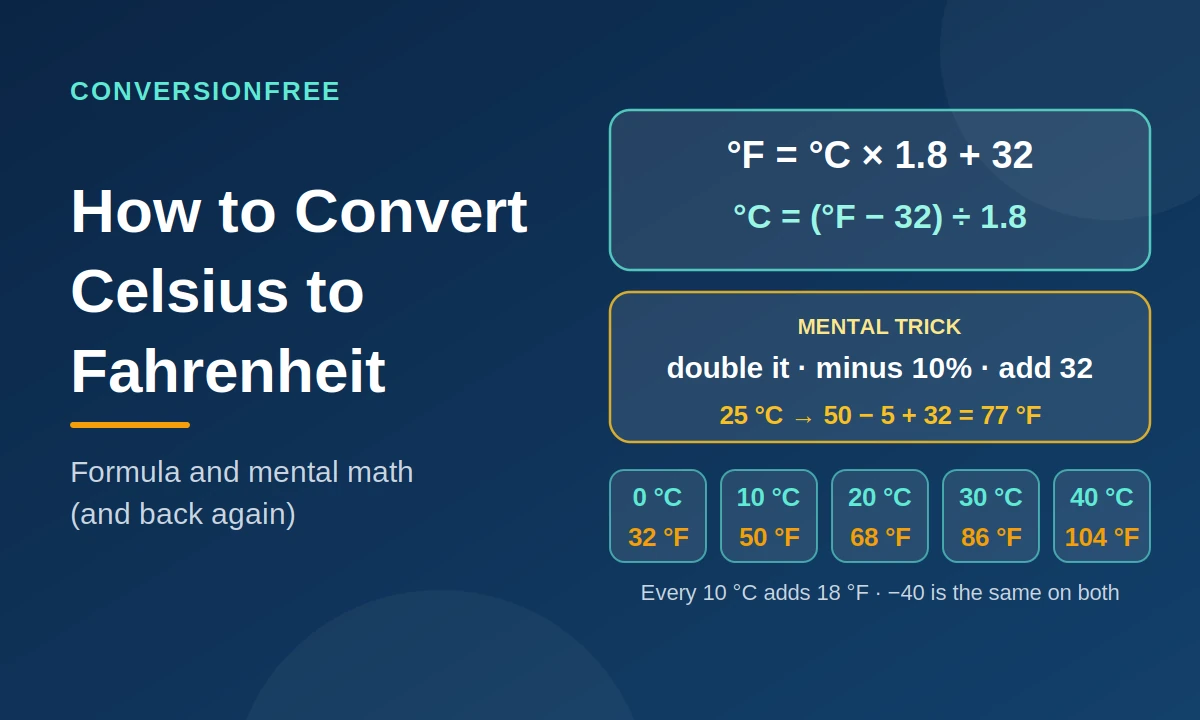
Quick answer: To convert Celsius to Fahrenheit, multiply by 1.8 and add 32. To convert Fahrenheit to Celsius, subtract 32 and divide by 1.8. For example, 25 °C × 1.8 + 32 = 77 °F, and 77 °F − 32 = 45, 45 ÷ 1.8 = 25 °C.
For a quick answer, use the temperature converter. This guide shows the formulas, why the “32” is there, and a mental trick that’s exact, not just close.
Key takeaways
- °F = °C × 1.8 + 32 (or °C × 9/5 + 32).
- °C = (°F − 32) ÷ 1.8 (or (°F − 32) × 5/9).
- Mental trick: double it, take off 10% of that, add 32. It gives the exact answer.
- The popular “double it and add 30” is only right at 10 °C and is off by 4 °F at 30 °C.
- Every 10 °C adds 18 °F. −40 is the same on both scales.
The Formulas
Celsius to Fahrenheit: °F = °C × 1.8 + 32
Fahrenheit to Celsius: °C = (°F − 32) ÷ 1.8
You’ll often see 1.8 written as 9/5, and dividing by 1.8 written as multiplying by 5/9. They’re the same thing.
- °F = °C × 9/5 + 32
- °C = (°F − 32) × 5/9
The order matters. For °F to °C, subtract 32 first, then divide. Writing it as °F − 32 ÷ 1.8 gives a wrong answer.
How to Convert Celsius to Fahrenheit Step by Step
- Take the temperature in °C. Example: 25 °C.
- Multiply by 1.8. 25 × 1.8 = 45.
- Add 32. 45 + 32 = 77 °F.
More examples:
| °C | × 1.8 | + 32 = °F |
|---|---|---|
| 0 | 0 | 32 |
| 20 | 36 | 68 |
| 37 | 66.6 | 98.6 |
| 100 | 180 | 212 |
| −10 | −18 | 14 |
For negative temperatures, multiply first, keeping the sign, then add 32. So −10 × 1.8 = −18, and −18 + 32 = 14.
How to Convert Fahrenheit to Celsius Step by Step
- Take the temperature in °F. Example: 77 °F.
- Subtract 32. 77 − 32 = 45.
- Divide by 1.8. 45 ÷ 1.8 = 25 °C.
| °F | − 32 | ÷ 1.8 = °C |
|---|---|---|
| 32 | 0 | 0 |
| 68 | 36 | 20 |
| 98.6 | 66.6 | 37 |
| 212 | 180 | 100 |
| 0 | −32 | −17.8 |
| 350 | 318 | 176.7 |
Why Is There a 32 in the Formula?
The two scales start in different places and have different step sizes. You can see both by looking at two points: where water freezes and where it boils.
| Water freezes | Water boils | Steps between | |
|---|---|---|---|
| Celsius | 0 | 100 | 100 |
| Fahrenheit | 32 | 212 | 180 |
- The 1.8 (or 9/5) comes from the step size. There are 180 Fahrenheit steps in the same range as 100 Celsius steps: 180 ÷ 100 = 1.8.
- The 32 comes from the starting point. 0 °C already equals 32 °F, so after scaling you shift everything up by 32.
Put together: °F = 1.8 × °C + 32. That’s a straight line through the two points (0, 32) and (100, 212).
Why −40 Is the Same on Both Scales
Set the two readings equal and solve:
°C = 1.8 × °C + 32
−0.8 × °C = 32
°C = −40
So −40 °C = −40 °F. It’s the only temperature where the two scales agree.
Mental Math: The Exact Trick (Double It, Minus 10%, Add 32)
Multiplying by 1.8 is the same as doubling and then taking off 10% of the doubled number:
2 − 10% of 2 = 2 − 0.2 = 1.8
So the steps are:
- Double the Celsius number.
- Subtract 10% of that doubled number.
- Add 32.
Example: 25 °C
- Double: 50
- Subtract 10% (5): 45
- Add 32: 77 °F ✔ (exact)
Example: 18 °C
- Double: 36
- Subtract 10% (3.6): 32.4
- Add 32: 64.4 °F ✔ (exact)
Example: −10 °C
- Double: −20
- Subtract 10%: −18
- Add 32: 14 °F ✔
This trick is exact because it’s the formula, rearranged for mental arithmetic.
The Common Shortcut (“Double It and Add 30”) and Its Error
Many people use “double it and add 30”. It’s fast, but it’s only exact at one temperature.
| °C | Exact °F | Double + 30 | Error | Double − 10% + 32 | Error |
|---|---|---|---|---|---|
| −10 | 14 | 10 | −4 | 14 | 0 |
| 0 | 32 | 30 | −2 | 32 | 0 |
| 10 | 50 | 50 | 0 | 50 | 0 |
| 20 | 68 | 70 | +2 | 68 | 0 |
| 25 | 77 | 80 | +3 | 77 | 0 |
| 30 | 86 | 90 | +4 | 86 | 0 |
| 35 | 95 | 100 | +5 | 95 | 0 |
| 40 | 104 | 110 | +6 | 104 | 0 |
Why it drifts: double + 30 is really °C × 2 + 30, but the true line is °C × 1.8 + 32. The gap grows by 0.2 °F for every °C away from 10 °C.
When it’s fine: weather between about 5 °C and 15 °C. When it’s not: hot days, fever readings and cooking, where 5–6 °F matters.
Even Easier: Memorise the Anchor Points
Because 10 °C is 18 °F apart, you can chain anchors:
| °C | °F |
|---|---|
| 0 | 32 |
| 10 | 50 |
| 20 | 68 |
| 30 | 86 |
| 40 | 104 |
Every 10 °C adds 18 °F, and every 5 °C adds 9 °F. To find 25 °C, start at 20 °C = 68 °F and add 9 → 77 °F. To find 17 °C, start at 15 °C = 59 °F and add 2 × 1.8 = 3.6 → 62.6 °F.
Mental Math for Fahrenheit to Celsius
Reverse the steps:
- Subtract 32.
- Halve it.
- Add 10% of the halved number. (Dividing by 1.8 is about the same as halving and adding a tenth.)
Example: 77 °F
- 77 − 32 = 45
- Half: 22.5
- Add 10% (2.25): 24.75 → about 25 °C (exact: 25.0)
This one is a very close estimate rather than exact: the error stays under 0.5 °C in everyday ranges.
| °F | Exact °C | Halve + 10% | Error | “Subtract 30, halve” | Error |
|---|---|---|---|---|---|
| 50 | 10.0 | 9.9 | −0.1 | 10.0 | 0.0 |
| 68 | 20.0 | 19.8 | −0.2 | 19.0 | −1.0 |
| 77 | 25.0 | 24.8 | −0.3 | 23.5 | −1.5 |
| 86 | 30.0 | 29.7 | −0.3 | 28.0 | −2.0 |
| 98.6 | 37.0 | 36.6 | −0.4 | 34.3 | −2.7 |
| 104 | 40.0 | 39.6 | −0.4 | 37.0 | −3.0 |
The common “subtract 30 and halve” shortcut is only accurate near 50 °F, and it underestimates a fever by almost 3 °C.
Common Temperatures in Both Scales
| What | °C | °F |
|---|---|---|
| Absolute zero | −273.15 | −459.67 |
| Very cold day | −20 | −4 |
| Water freezes | 0 | 32 |
| Cool day | 10 | 50 |
| Room temperature | 20 | 68 |
| Warm day | 30 | 86 |
| Normal body temperature | 37 | 98.6 |
| Hot day | 40 | 104 |
| Water boils | 100 | 212 |
For the full picture of how the scales compare, see Celsius vs Fahrenheit vs Kelvin.
Converting Oven Temperatures
Recipes often round converted oven temperatures to the nearest 25 °F.
| °C | Exact °F | Typical recipe |
|---|---|---|
| 160 | 320 | 325 |
| 180 | 356 | 350 |
| 190 | 374 | 375 |
| 200 | 392 | 400 |
| 220 | 428 | 425 |
So 180 °C is exactly 356 °F, but a recipe written in Fahrenheit will say 350 °F. For the full chart, including gas marks and fan-oven adjustments, see our oven temperature chart (planned).
Converting in a Spreadsheet or Code
Spreadsheet formulas (cell A1 holds the temperature):
- °C to °F:
=A1*9/5+32 - °F to °C:
=(A1-32)*5/9 - Or the built-in function:
=CONVERT(A1,"C","F")
Python:
python
f = c * 9/5 + 32
c = (f - 32) * 5/9
(Verify the CONVERT function unit names in your spreadsheet software.)
Common Mistakes
- Forgetting the parentheses. °C = (°F − 32) ÷ 1.8, not °F − 32 ÷ 1.8.
- Adding 32 before multiplying. Multiply by 1.8 first, then add 32.
- Using the “double and add 30” shortcut for hot temperatures or fevers. It’s 4 °F off at 30 °C.
- Losing the sign on negative temperatures.
- Applying the formula to a temperature change. A rise of 10 °C is a rise of 18 °F, with no +32. See temperature change vs temperature reading (planned).
- Rounding too early. Keep one decimal until the final step.
Celsius to Fahrenheit: FAQs
What is the formula to convert Celsius to Fahrenheit?
°F = °C × 1.8 + 32.
What is the formula to convert Fahrenheit to Celsius?
°C = (°F − 32) ÷ 1.8.
What is 20 °C in Fahrenheit?
68 °F.
What is 37 °C in Fahrenheit?
98.6 °F.
What is 100 °F in Celsius?
37.8 °C.
What is the easiest way to convert Celsius to Fahrenheit in your head?
Double it, subtract 10% of the doubled number, then add 32.
Is “double and add 30” accurate?
Only near 10 °C. By 30 °C it’s 4 °F too high.
Why do you add 32?
Because 0 °C is 32 °F: the scales start at different points.
Why do you multiply by 1.8?
Because 100 Celsius steps cover the same range as 180 Fahrenheit steps.
At what temperature are Celsius and Fahrenheit equal?
−40.
How do I convert Celsius to Kelvin?
Add 273.15. See Celsius vs Fahrenheit vs Kelvin for all three scales.
Convert Any Temperature in Seconds
Mental tricks are great for quick estimates. For exact results in either direction, use the ConversionFree temperature converter to convert Celsius, Fahrenheit and Kelvin. You can also browse our online unit conversion tools, or visit the ConversionFree for other free tools.