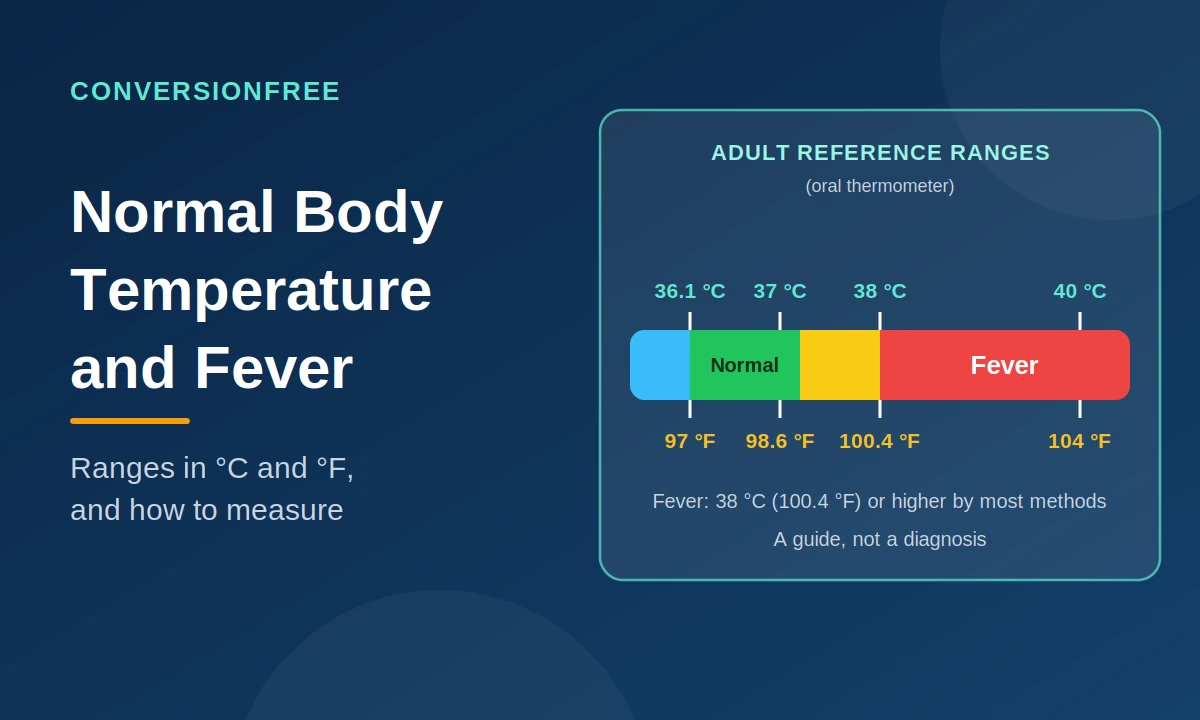
Quick answer: Normal body temperature for most adults is about 37 °C (98.6 °F), but it varies. Typical body temperature can range from 97 °F (36.1 °C) to 99 °F (37.2 °C) or more. A fever is generally a reading of 38 °C (100.4 °F) or higher, though the exact threshold depends on how the temperature was taken.
To convert any thermometer reading, use the temperature converter. This guide explains the ranges, how different thermometers compare, and why you should be careful with “mental math” shortcuts here.
This article is general information. It isn’t medical advice and can’t diagnose anything. If you’re worried about a temperature, contact a healthcare professional.
Key takeaways
- 37 °C is exactly 98.6 °F, but “normal” is a range, not one number.
- Adults: about 36.1–37.2 °C (97–99 °F) is a typical range.
- Fever: usually 38 °C (100.4 °F) or higher. Armpit readings use a lower threshold.
- Age, time of day, activity and thermometer type all change the reading.
- Don’t use “double and add 30” shortcuts for fever readings. They can be off by about 5 °F.
What Is Normal Body Temperature?
The number most people know is 37 °C = 98.6 °F. It comes from the 19th century. In 1851 a German doctor, Carl Wunderlich, took the temperatures of some 25,000 patients in Leipzig and concluded the average was 37 °C, or 98.6 °F. Smithsonian Magazine
Today we treat “normal” as a range. Body temperature can vary with how active you are, your age and the time of day, and older people most often have lower temperatures than younger people.
And the average may be a little lower than 37 °C now. A 2017 study of about 35,000 British patients found a mean oral temperature of 36.6 °C (97.9 °F). A large study of more than 126,000 adults at Stanford Health Care found an average oral temperature of around 97.9 °F, and found that women ran warmer than men and older people cooler than younger people.
So 98.6 °F isn’t wrong as a rule of thumb. It’s just not a target.
Normal Body Temperature Chart: °C and °F
| Reading | °C | °F | What it usually means |
|---|---|---|---|
| Lower end of normal | 36.1 | 97.0 | Typical lower range |
| Often-quoted average | 37.0 | 98.6 | Rule of thumb |
| Upper end of normal | 37.2 | 99.0 | Typical upper range |
| Fever threshold | 38.0 | 100.4 | Generally considered a fever |
Ranges by age (adults): One Cleveland Clinic source gives 97.6–99.6 °F (36.4–37.6 °C) for ages 11 to 65, and 96.4–98.5 °F (35.8–36.9 °C) for people over 65. Sources differ slightly, so treat these as guides.
Time of day: temperature tends to be lower in the early morning and higher later in the day. Exercise, hot drinks, clothing and room temperature also change readings.
°C to °F Conversion Table for Body Temperature
| °C | °F |
|---|---|
| 35.0 | 95.0 |
| 35.5 | 95.9 |
| 36.0 | 96.8 |
| 36.5 | 97.7 |
| 37.0 | 98.6 |
| 37.5 | 99.5 |
| 38.0 | 100.4 |
| 38.5 | 101.3 |
| 39.0 | 102.2 |
| 39.5 | 103.1 |
| 40.0 | 104.0 |
| 40.5 | 104.9 |
| 41.0 | 105.8 |
°F to °C:
| °F | °C |
|---|---|
| 96.4 | 35.8 |
| 97.0 | 36.1 |
| 97.9 | 36.6 |
| 98.6 | 37.0 |
| 99.0 | 37.2 |
| 99.5 | 37.5 |
| 100.0 | 37.8 |
| 100.4 | 38.0 |
| 101.0 | 38.3 |
| 102.0 | 38.9 |
| 103.0 | 39.4 |
| 104.0 | 40.0 |
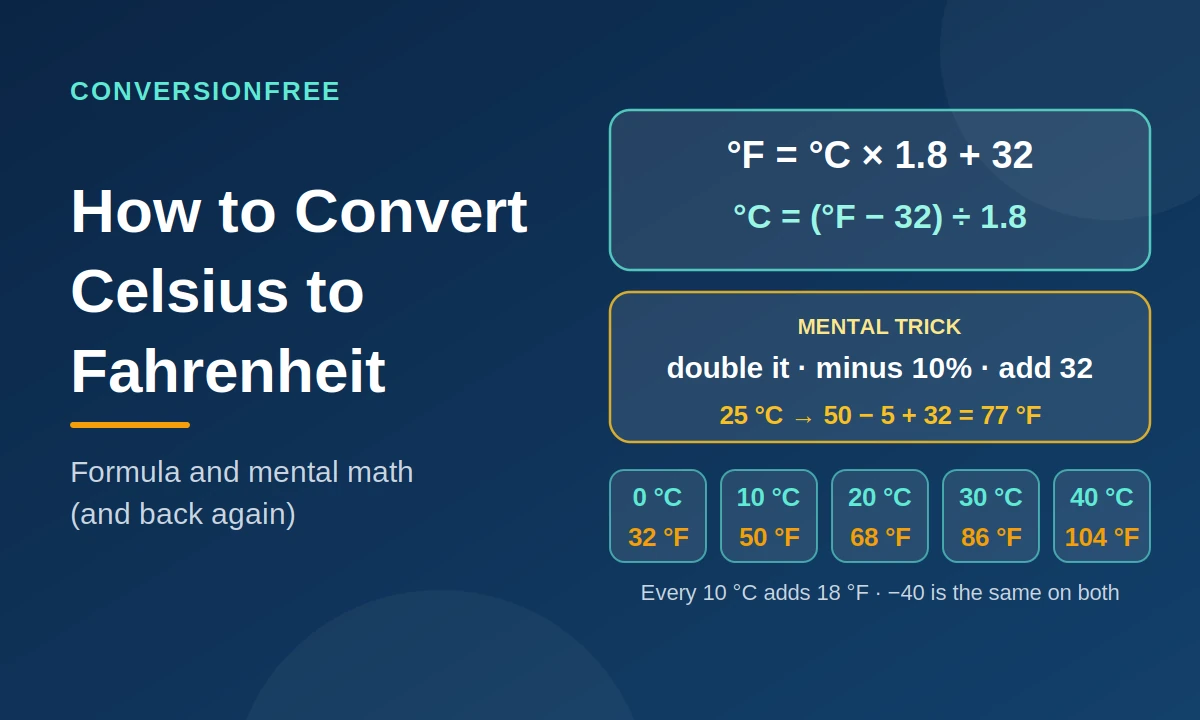
The formulas are °F = °C × 1.8 + 32 and °C = (°F − 32) ÷ 1.8. For the full method, see how to convert Celsius to Fahrenheit (planned).
What Temperature Counts as a Fever?
A fever is a body temperature higher than your normal. In practice, doctors use a threshold. Healthcare providers most often say a fever temperature is 100.4 °F (38 °C) when measured orally.
The threshold depends on where the temperature is taken. Mayo Clinic lists these readings as a fever: rectal, ear or temporal artery 100.4 °F (38 °C) or higher; oral 100.4 °F (38 °C) or higher; and armpit 99 °F (37.2 °C) or higher.
| Method | Fever threshold (°C) | Fever threshold (°F) |
|---|---|---|
| Rectal, ear or forehead (temporal) | 38.0 | 100.4 |
| Oral (by mouth) | 38.0 | 100.4 |
| Armpit (axillary) | 37.2 | 99.0 |
Some sources give slightly different numbers, especially for children. One summary of Cleveland Clinic guidance gives 99.5 °F for oral, 100.4 °F for rectal and 99 °F for underarm readings in children. Follow the advice that comes with your thermometer and from your doctor.
How Do Thermometer Types Compare?
| Method | Typical notes |
|---|---|
| Oral | Common for adults and older children. Wait after eating, drinking or exercise before taking a reading. |
| Rectal | Often used for babies. Usually reads higher than the armpit. |
| Ear (tympanic) | Quick. Results depend on correct placement. |
| Forehead (temporal) | Quick and non-contact for some devices. Can be affected by sweat or the environment. |
| Armpit (axillary) | Easy, but generally the least precise, so thresholds are lower. |
Tips:
- Use the same method each time when you’re tracking changes.
- Follow your device’s instructions, and clean it between uses.
- Don’t compare an armpit reading directly with an oral one.
- A single reading doesn’t tell the whole story. Look at trends and symptoms.
Convert Carefully: Don’t Use Shortcuts for Fever Readings
The popular shortcut “double it and add 30” is fast, but it’s badly off at body temperatures.
| °C | Exact °F | “Double + 30” | Error |
|---|---|---|---|
| 37.0 | 98.6 | 104 | +5.4 |
| 38.0 | 100.4 | 106 | +5.6 |
| 38.5 | 101.3 | 107 | +5.7 |
| 39.0 | 102.2 | 108 | +5.8 |
| 40.0 | 104.0 | 110 | +6.0 |
And going the other way, “subtract 30 and halve” underestimates a fever:
| °F | Exact °C | “Subtract 30, halve” | Error |
|---|---|---|---|
| 99.0 | 37.2 | 34.5 | −2.7 |
| 100.4 | 38.0 | 35.2 | −2.8 |
| 102.0 | 38.9 | 36.0 | −2.9 |
| 104.0 | 40.0 | 37.0 | −3.0 |
A true fever could look normal after the second shortcut. For body temperatures, use the exact formula or the converter. If you want a mental method that’s exact, double the Celsius number, subtract 10% of that, and add 32. That’s covered in our Celsius to Fahrenheit guide (planned).
A Rise in Temperature Is Not the Same as a Reading
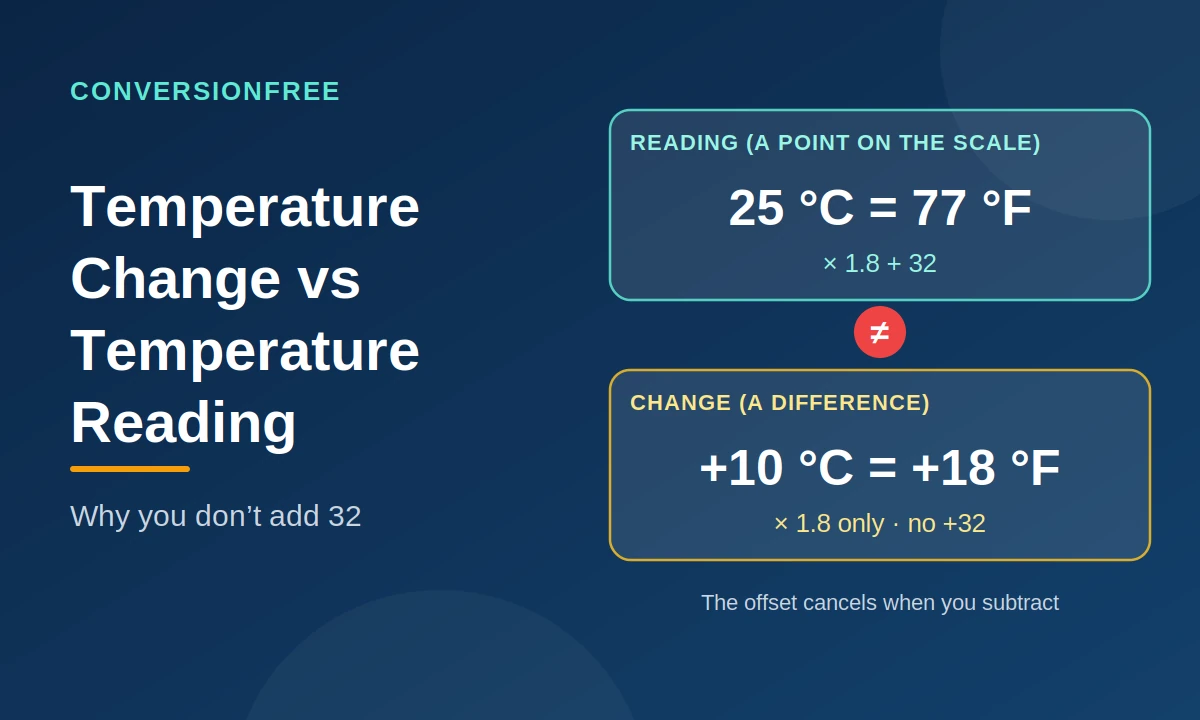
If your temperature goes from 37 °C to 39 °C, that’s a rise of 2 °C, which is a rise of 3.6 °F, not 2 × 1.8 + 32. In Fahrenheit: 98.6 °F to 102.2 °F. For why, see temperature change vs temperature reading (planned).
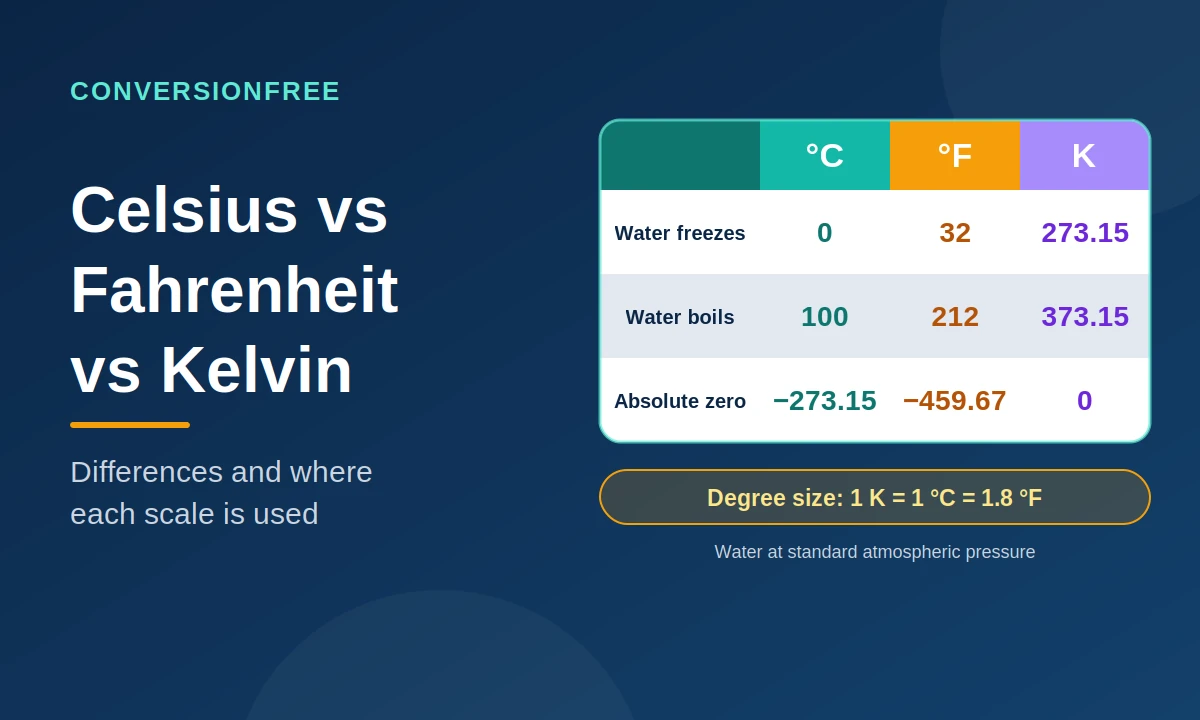
A handy rule: 1 °C is 1.8 °F, and 0.1 °C is about 0.2 °F.
What About Low Body Temperature?
A body temperature that’s too low can also be a concern. Doctors use the term hypothermia for a dangerously low body temperature, commonly described as below about 35 °C (95 °F). (Verify this threshold with a medical source before publishing.)
Older adults can have lower baselines, which is why a “normal-looking” reading can hide an infection. A medical professional can interpret an individual’s readings.
When Should You Seek Medical Advice?
This is general guidance, not a substitute for a doctor or emergency services.
- Babies: Mayo Clinic’s advice is to call the baby’s doctor if a child younger than 3 months has a rectal temperature of 100.4 °F (38 °C) or higher.
- Fever that lingers: A temperature above 100.4 °F (38 °C) is usually something to bring to your doctor’s attention, especially if it lingers for more than two days. clevelandclinic
- Very high temperatures (about 40 °C or 104 °F and above) or a fever with severe symptoms such as confusion, trouble breathing, a stiff neck or a rash need urgent medical care. (Verify the exact wording against a medical source before publishing.)
- Older adults and people with health conditions: talk to a doctor early, because baseline temperatures differ.
If you’re unsure, contact a healthcare professional or your local emergency service.
Common Mistakes
- Treating 98.6 °F as the only normal. It’s an average, not a rule.
- Comparing readings from different methods.
- Using a mental-math shortcut for a fever reading.
- Taking an oral reading right after a hot drink or exercise.
- Adding 32 to a temperature change.
- Rounding too early. Keep one decimal place when converting.
- Ignoring symptoms because the number looks “normal”.
Normal Body Temperature and Fever: FAQs
What is normal body temperature in Celsius?
About 37 °C, with a typical range of 36.1–37.2 °C.
What is normal body temperature in Fahrenheit?
About 98.6 °F, with a typical range of 97–99 °F.
What is 37 °C in Fahrenheit?
98.6 °F.
What is 98.6 °F in Celsius?
37.0 °C.
What temperature is a fever?
Generally 38 °C (100.4 °F) or higher. For armpit readings, 37.2 °C (99 °F) or higher.
Is 37.5 °C a fever?
Usually not by the standard 38 °C threshold, but it may be slightly raised. It depends on your normal temperature, the method used and any symptoms.
Is 99 °F a fever?
Not by an oral reading, where the usual threshold is 100.4 °F. For an armpit reading, 99 °F is often used as a fever threshold.
Why is my temperature below 98.6 °F?
Many healthy people run slightly below it. Large studies find averages around 97.9 °F, and older people tend to run lower.
How do I convert my thermometer reading?
Use the formula °F = °C × 1.8 + 32, or the converter.
Do babies have a different normal temperature?
Ranges and thresholds differ for infants and children. Ask your child’s doctor, and follow your thermometer’s instructions.
Convert Your Reading in Seconds
If your thermometer shows °F and your doctor uses °C (or the other way round), use the ConversionFree temperature converter for an exact result. You can also browse our unit converters, or visit the ConversionFree for other free tools.
This article is for general information and isn’t medical advice.