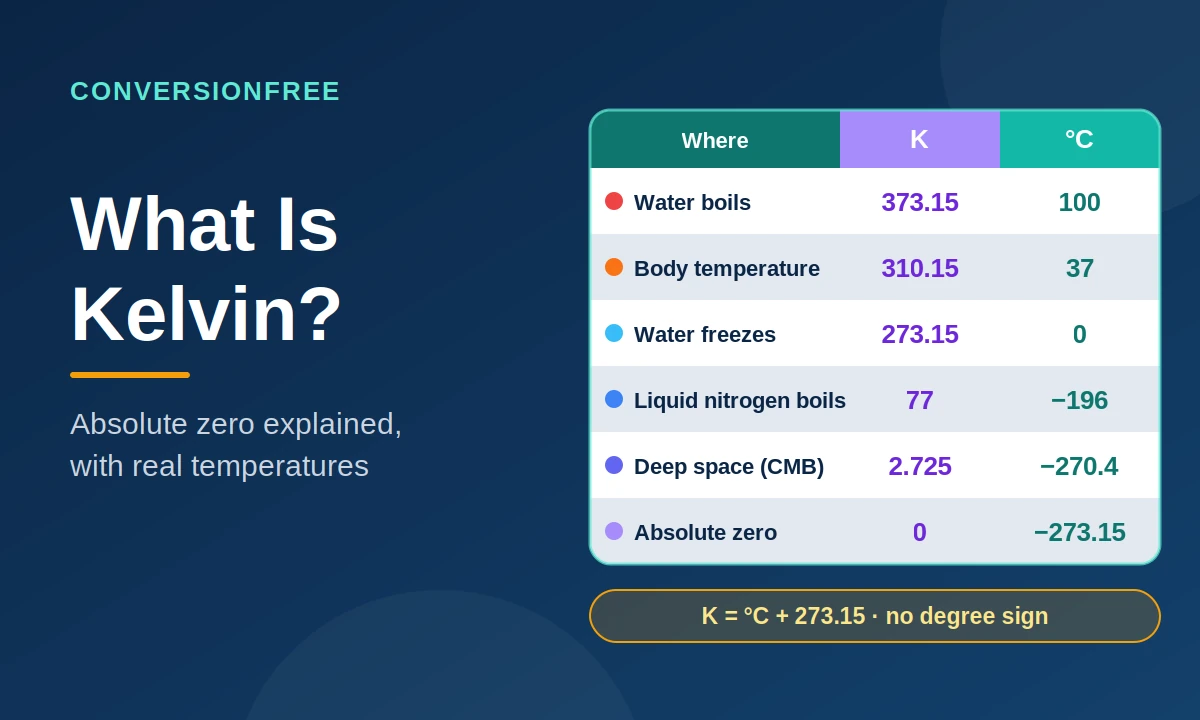
Quick answer: Kelvin (K) is the SI unit of temperature. Its scale starts at absolute zero, the lowest possible temperature, at 0 K = −273.15 °C = −459.67 °F. One kelvin is the same size as one degree Celsius, so to convert you add 273.15: 20 °C = 293.15 K.
For quick conversions, use the temperature converter. This guide explains what the kelvin measures, why absolute zero matters, and where you’ll meet kelvins outside a physics class.
Key takeaways
- K = °C + 273.15, and °C = K − 273.15.
- 0 K is absolute zero. Kelvin has no negative values for ordinary temperatures.
- The unit is “kelvin” (K), not “degrees Kelvin”.
- Since 2019, the kelvin is defined by fixing the Boltzmann constant.
- Scientists can get extremely close to absolute zero, but can’t reach it.
What Does Kelvin Measure?
Kelvin measures temperature, which describes how much thermal energy the particles in something have. Hot things have particles that move faster and carry more thermal energy. Cold things have less.
The kelvin, symbol K, is the SI unit of thermodynamic temperature. “Thermodynamic temperature” just means temperature measured from the true bottom of the scale, absolute zero. nist
That’s what makes kelvin different from Celsius and Fahrenheit. They start at convenient reference points (the freezing point of water, and an older brine-based mark). Kelvin starts at nature’s own zero. For the full comparison of the three scales, see Celsius vs Fahrenheit vs Kelvin.
What Is Absolute Zero?
Absolute zero is the lowest possible temperature. It’s 0 K, which is exactly −273.15 °C and −459.67 °F.
In the classical picture, absolute zero is where particles have as little thermal motion as they can have. (Quantum physics adds that particles still keep a tiny, unavoidable amount of motion, so “everything stops” is a simplification.)
Two things are worth knowing:
- You can’t go below it for ordinary matter. There’s no colder temperature to reach.
- You can’t quite reach it. The third law of thermodynamics states that absolute zero cannot be attained in a finite number of steps. Scientists can only get closer and closer.
How Cold Has Anyone Gotten?
Very close. In a 2021 experiment, scientists cooled a cloud of rubidium atoms to 38 picokelvins, which is 38 trillionths of a kelvin, and held it there for about 2 seconds. Science Alert
That’s 0.000000000038 K, or 3.8 × 10⁻¹¹ K. Record-breaking experiments like this use special setups, such as dropping the atoms in a tower so that gravity doesn’t interfere.
Nature itself is much warmer. The cosmic microwave background, the leftover glow of the Big Bang, sets a temperature of about 2.725 K across space. The Boomerang Nebula is colder, at about 1 K, and is the coldest known natural place in the universe.
How to Convert Kelvin
| From | To | Formula |
|---|---|---|
| °C | K | K = °C + 273.15 |
| K | °C | °C = K − 273.15 |
| K | °F | °F = 1.8 × K − 459.67 |
| °F | K | K = (°F + 459.67) ÷ 1.8 |
Why 273.15? Water freezes at 0 °C, which is 273.15 K above absolute zero. The Celsius scale is now defined from kelvin, so the offset is exact.
Worked examples
| Situation | K | °C | °F |
|---|---|---|---|
| Absolute zero | 0 | −273.15 | −459.67 |
| Liquid helium boils (about) | 4.2 | −268.95 | −452.11 |
| Liquid nitrogen boils (about) | 77 | −196.15 | −321.07 |
| Water freezes | 273.15 | 0 | 32 |
| Room temperature | 293.15 | 20 | 68 |
| Normal body temperature | 310.15 | 37 | 98.6 |
| A “standard” lab temperature | 300 | 26.85 | 80.33 |
| Water boils | 373.15 | 100 | 212 |
Example: 300 K to Celsius
- 300 − 273.15 = 26.85 °C
- In Fahrenheit: 26.85 × 1.8 + 32 = 80.33 °F
The liquid helium and nitrogen values are rounded boiling points at normal pressure.
Kelvin and Celsius Are the Same Size
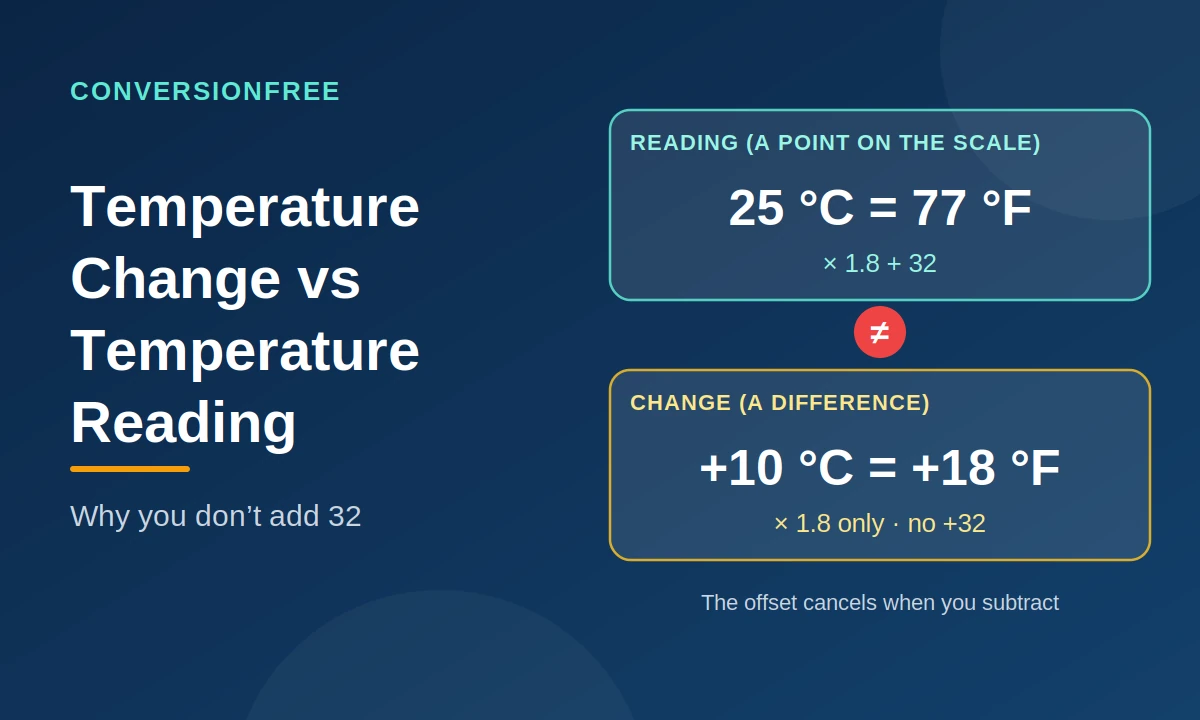
A change of one kelvin is the same amount of temperature change as one degree Celsius. Only the starting point differs.
That means a change in temperature has the same number in both units: heating something by 10 K is heating it by 10 °C. But a reading needs the 273.15 shift. We cover that difference in temperature change vs temperature reading (planned).
Why Is It Called “Kelvin,” Not “Degrees Kelvin”?
The unit is named after William Thomson, Lord Kelvin, a 19th-century physicist. Unlike Celsius and Fahrenheit, it’s written without a degree sign:
- Correct: 300 K, “300 kelvin”
- Not standard: 300 °K, “300 degrees Kelvin”
The wording was dropped when kelvin was formally adopted as an SI unit in the 20th century. (Verify the exact year before publishing.)
How Is the Kelvin Defined Today?
The definition changed in 2019. Before May 2019, the kelvin was defined by fixing the temperature of the triple point of water at exactly 273.16 K. Now its size is set by fixing the numerical value of the Boltzmann constant at exactly 1.380649 × 10⁻²³ joules per kelvin.
In plain language: temperature is now tied directly to energy, not to a particular substance. The total kinetic energy is related to temperature by E = kBT. One kelvin corresponds to a change in thermal energy of exactly 1.380649 × 10⁻²³ joules.
Does this change anything for everyday conversions? No. K = °C + 273.15 still works. The new definition mainly improves how precisely scientists can measure very high and very low temperatures.
Why Do Scientists Use Kelvin?
Because many physical laws need an absolute temperature, where zero means zero thermal energy.
Example: the ideal gas law
The ideal gas law is PV = nRT, and T must be in kelvin.
Worked example: the volume of 1 mole of an ideal gas at 273.15 K (0 °C) and 101.325 kPa:
- V = nRT ÷ P = 1 × 8.314 × 273.15 ÷ 101,325 = 0.02241 m³ = 22.41 litres
If you used 0 for the temperature (because it’s 0 °C), you’d get a volume of zero, which is nonsense.
Example: “twice as hot”
Kelvin is a ratio scale, so ratios mean something:
- 40 °C is not twice as hot as 20 °C.
- In kelvin: 313.15 ÷ 293.15 = 1.07, about 7% higher.
Example: thermal energy
The typical thermal energy of a particle is about kB × T. At 300 K, that’s 1.38 × 10⁻²³ × 300 ≈ 4.14 × 10⁻²¹ joules, or about 0.026 electron-volts. The more you cool something, the smaller that number becomes.
Where Do You See Kelvin in Everyday Life?
Colour temperature. Light bulbs, photography and screens use kelvin to describe how warm or cool the light looks. Lower numbers are warmer, more orange light, and higher numbers are cooler, bluer light. Typical examples:
| Light | Approximate colour temperature |
|---|---|
| Warm white bulb | 2,700–3,000 K |
| Neutral white | 3,500–4,500 K |
| Daylight | 5,000–6,500 K |
(These are common product ranges. Verify before publishing.)
Stars. Astronomers describe star surfaces in kelvin. Empty intergalactic space is 2.725 K. By comparison, the Sun’s surface is about 5,800 K (often given as 5,772 K, about 5,500 °C or 9,930 °F). (Verify the exact figure.)
Science and engineering. Cryogenics, superconductors, material science, gas laws and thermodynamics all use kelvin.
What Is the Rankine Scale?
Rankine (°R) is to Fahrenheit what Kelvin is to Celsius. It starts at absolute zero, but uses Fahrenheit-sized steps: °R = °F + 459.67 = 1.8 × K. Absolute zero is 0 °R, and water freezes at 491.67 °R. It’s used in some engineering fields, mostly in the United States.
Common Mistakes
- Writing “°K” or “degrees Kelvin”. Use “K” or “kelvin”.
- Using Celsius in gas-law and thermodynamics formulas. Convert to kelvin first.
- Forgetting that the offset is 273.15, not 273 (use 273 only for rough work).
- Adding 273.15 to a temperature change. Changes are identical in K and °C.
- Saying “twice as hot” about Celsius values.
- Thinking absolute zero is achievable. It’s a limit.
- Thinking kelvin can be negative for ordinary matter.
What Is Kelvin? FAQs
What is kelvin in simple terms?
It’s the SI unit of temperature. The scale starts at absolute zero, the lowest possible temperature.
What is 0 K in Celsius and Fahrenheit?
−273.15 °C and −459.67 °F.
How do you convert Celsius to Kelvin?
Add 273.15.
How do you convert Kelvin to Celsius?
Subtract 273.15.
What is 300 K in Celsius?
26.85 °C.
What is 0 °C in Kelvin?
273.15 K.
What is 100 °C in Kelvin?
373.15 K.
Is Kelvin the same as Celsius?
They have the same step size, but different zero points.
Why isn’t there a degree symbol with Kelvin?
Kelvin is an absolute unit, and the standard form is just “K”.
Can anything reach absolute zero?
No. The third law of thermodynamics says it can’t be attained in a finite number of steps, though scientists have come within trillionths of a kelvin.
Why do scientists prefer Kelvin?
It starts at absolute zero, so physical formulas work correctly with it.
What is the Kelvin scale used for in daily life?
Mainly colour temperature for lights and screens.
Convert Kelvin in Seconds
To switch between Kelvin, Celsius, and Fahrenheit, use the ConversionFree temperature converter. You can also browse our unit converters, or visit the ConversionFree for other free tools.