Is BMI Accurate? Limits, Muscle, and Better Alternatives
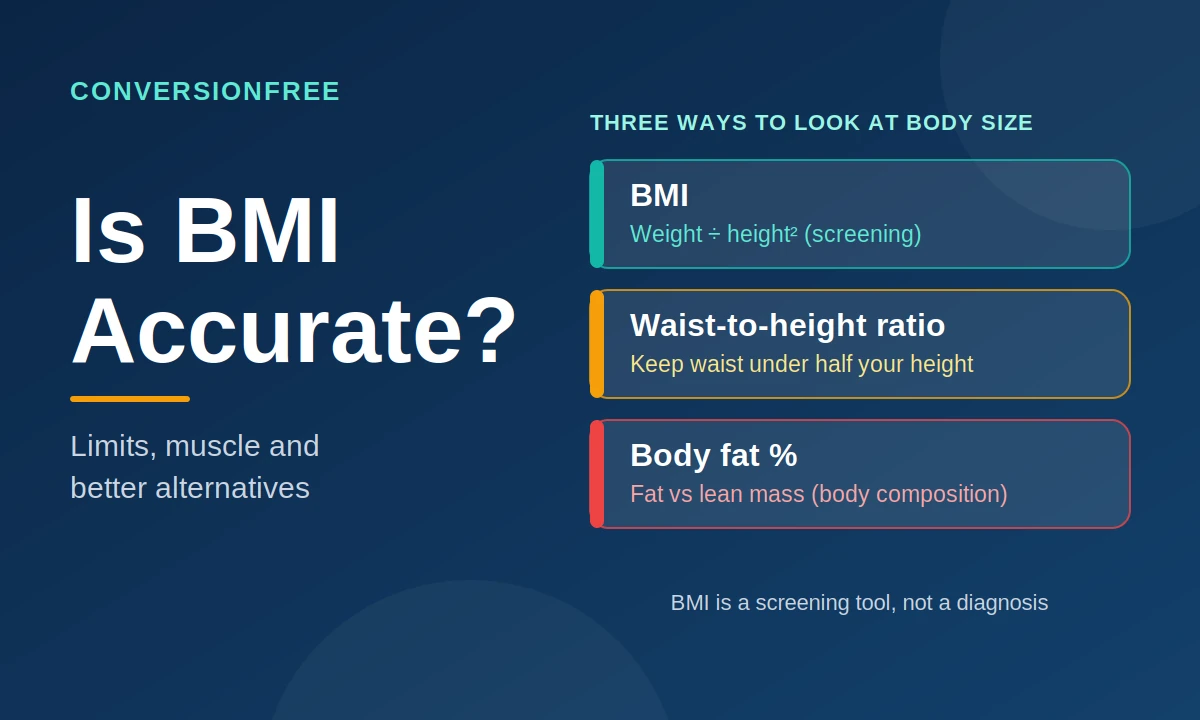
Quick answer: BMI is a quick, useful screening tool, but it isn’t a precise measure of health or body fat for every person. It can’t tell body fat from muscle, and it can’t show where fat is stored. That’s why doctors use it as a starting point and combine it with other measures, such as waist-to-height ratio.
If you just got a result from a BMI calculator and it feels wrong, you’re not alone. This guide explains when BMI works well, when it doesn’t, and what to check next.
Key takeaways
- BMI (body mass index) is a screening tool, not a diagnosis.
- It can overestimate fat in muscular people and underestimate it in others.
- Waist-to-height ratio is a simple add-on: keep your waist under half your height.
- Body fat percentage measures body composition more directly.
- A healthcare professional can put all the numbers in context.
What BMI Actually Measures
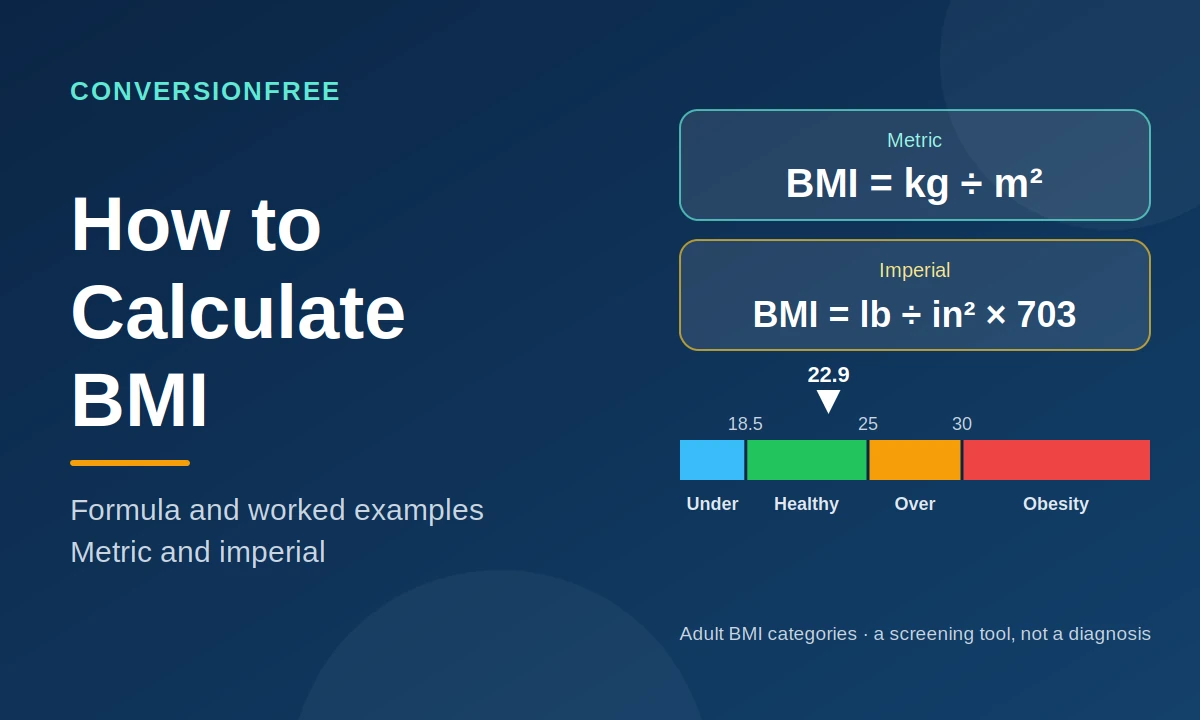
BMI compares your weight with your height. That’s all. It uses no information about muscle, fat, bone, age or how your body shape is distributed. If you want to see how the number is worked out, read how to calculate BMI, and check where your result sits on the healthy weight by height BMI chart.
Because it only needs two measurements, it’s cheap, fast and easy to compare across large groups. That’s its strength. It’s also its weakness.
So, Is BMI Accurate?
It depends on what you ask it to do.
- For groups of people: BMI is a reasonable screening tool. It’s been used widely for decades and it’s linked to health risks at a population level.
- For one person: BMI is a rough guide. It can point in the right direction, but it can also mislead.
Some researchers describe BMI as a good indicator for excess fat when the number is high, but a poor one for spotting people whose BMI looks normal but who carry a lot of fat. One commentary on the new Lancet criteria notes that recent work has found BMI alone to be a highly specific measure of fatness. In plain words: a high BMI often does mean extra fat, but a normal BMI doesn’t prove there isn’t any.
Seven Limits of BMI
1. BMI can’t tell muscle from fat
A person with a lot of muscle may have a BMI that says “overweight” even though they carry little body fat. Athletes and people who lift weights are common examples.
Illustrative example (hypothetical): two people are both 1.80 m tall and weigh 87.5 kg (about 193 lb), so both have a BMI of 27.0. One trains with weights four times a week. The other has a desk job and little muscle. The BMI is identical, but their body fat and health risks could be very different. (You can convert kg to pounds if your scale uses a different unit.)
2. BMI doesn’t show where fat is stored
BMI can’t separate fat under the skin from fat deep inside the abdomen. Fat around the middle (visceral fat) is linked to higher health risk than fat on the hips or thighs. Two people with the same BMI can carry fat in very different places.
3. A “normal” BMI can still hide extra body fat
Someone with low muscle and a healthy BMI can have a high body fat percentage. Researchers sometimes call this “normal-weight obesity”. It’s one reason a healthy BMI doesn’t guarantee good health.
4. Age changes what the number means
Older people tend to have more fat and less muscle than younger adults. A stable weight can hide muscle loss. NICE’s draft guidance says BMI should be interpreted with caution in adults with high muscle mass and in people older than 65. You can read more in BMI by Age and Sex.
5. Sex matters too
Women generally carry more body fat than men at the same BMI. That’s why a BMI calculator for women and a BMI calculator for men give the same formula but may need different interpretation.
6. Ethnicity can change the risk
Health risks can rise at different BMI values in different populations. In Singapore and Hong Kong, a BMI of 23 is treated as overweight, compared with 25 in the United States. If this applies to you, ask your doctor which cut-offs are right for you.
7. Children, teens and pregnancy need different methods
The adult BMI chart doesn’t apply to children and teens, who use age- and sex-specific percentiles. BMI is also not a good guide to weight during pregnancy, so talk to your care team.
Why Do Doctors Still Use BMI?
Because it’s simple, free and consistent, and it works as a first filter. A high BMI is a sign to look more closely, not a conclusion. The Lancet Commission said that BMI is useful for screening, but can both underestimate and overestimate body fat.
What the 2025 Lancet Commission Changed
In January 2025, a Lancet Diabetes & Endocrinology commission of international experts proposed a new way to diagnose obesity. It said BMI alone is not enough to define clinical obesity and that other measures of body fat are needed.
Its definition adds a measure such as waist circumference, waist-to-hip ratio or waist-to-height ratio alongside BMI. For people with a BMI above 40, excess body fat can be assumed without further tests.
The commission also separated two stages. “Preclinical” obesity means excess body fat with organ function still preserved, while “clinical” obesity involves signs of organ dysfunction or limits on daily living.
This is a proposal from expert bodies, and it isn’t yet used everywhere. Critics note that important questions remain before the criteria can be widely implemented. The practical takeaway for readers is the same: BMI is a starting point.
Better Alternatives and Add-Ons to BMI
| Measure | What it shows | How to do it | Pros | Limits |
|---|---|---|---|---|
| Waist-to-height ratio | Fat around the middle | Waist ÷ height (same units) | Simple, free, no equipment beyond a tape | Less useful in some older adults |
| Waist circumference | Abdominal fat | Tape measure at the waist | Easy | Cut-offs differ by sex and population |
| Waist-to-hip ratio | Fat distribution | Waist ÷ hip | Shows shape | Needs two measurements |
| Body fat percentage | Fat vs lean mass | Scans (DEXA), smart scales, skinfold calipers | Closer to body composition | Accuracy varies by method; home scales vary with hydration |
| Health markers | Real risk factors | Blood pressure, blood sugar, cholesterol | Measures health itself | Needs a clinician |
Waist-to-height ratio: the easiest add-on
NICE advises adults with a BMI under 35 to measure their waist-to-height ratio, and gives 0.4 to 0.49 as the range showing no increased health risk. A ratio of 0.5 or more suggests increased risk and is a reason to seek advice from a healthcare professional. The rule of thumb: keep your waist to less than half your height.
How to calculate it
- Measure your height and waist in the same unit (cm or inches).
- Divide waist by height.
Example 1: height 175 cm, waist 85 cm → 85 ÷ 175 = 0.49 (below 0.5)
Example 2: height 175 cm, waist 92 cm → 92 ÷ 175 = 0.53 (0.5 or above, worth discussing with a doctor)
Your waist target: half your height. For 175 cm that’s 87.5 cm. For 69 inches, it’s 34.5 inches. To change between centimeters and inches, use our unit conversion tools.
Body fat percentage
Body fat percentage shows how much of your weight is fat. Methods include DEXA scans (a type of X-ray), smart scales (which send a small electrical current through the body), and skinfold calipers. Results differ between methods, so use the same method over time and compare trends, not single readings. Healthy ranges differ by age and sex, so a healthcare professional can interpret yours.
How to Use BMI and Waist-to-Height Ratio Together
This table is a rough guide, not a diagnosis.
| BMI | Waist-to-height | What it may suggest |
|---|---|---|
| Healthy (18.5–24.9) | Below 0.5 | Reassuring on both measures |
| Healthy | 0.5 or above | Possible extra belly fat, so it’s worth a check-up |
| Overweight (25–29.9) | Below 0.5 | May reflect muscle, though it’s worth confirming |
| Overweight or higher | 0.5 or above | Worth discussing with a doctor |
Remember that these are screening tools. Blood pressure, blood sugar, cholesterol, fitness, diet and family history all matter too.
How to Use Your BMI Result Sensibly
- Treat BMI as a first check. Don’t use it as a verdict.
- Add a waist measurement. It takes a minute.
- Consider your context. Muscle, age, sex and ethnicity all matter.
- Track trends. A steady change over months says more than one reading.
- Talk to a professional if you’re concerned, or before making major health changes.
When Should You Talk to a Doctor?
Speak with a healthcare professional if your BMI or waist-to-height ratio is outside the healthy range, if your weight changes without explanation, or if you have a family history of heart disease or diabetes. They can look at the full picture and suggest next steps.
Is BMI Accurate? FAQs
Is BMI accurate for athletes?
Often not. Muscle adds weight, so athletes can have a BMI in the overweight range while having low body fat.
Is BMI accurate for women?
The formula is the same for men and women, but women generally carry more body fat than men at the same BMI, so the number can mean different things.
Is BMI accurate for older adults?
It’s less reliable, because muscle loss can hide extra fat. NICE advises caution above age 65.
What is better than BMI?
Nothing replaces it entirely, but waist-to-height ratio and body fat percentage give extra information. Doctors often combine several measures.
What waist-to-height ratio is healthy?
NICE gives 0.4 to 0.49 as the range with no increased health risk. A ratio of 0.5 or higher suggests increased risk.
Can I have a healthy BMI and still be unhealthy?
Yes. A healthy BMI can coexist with extra body fat, poor fitness or other risk factors.
Can I have a high BMI and be healthy?
It’s possible, particularly for muscular people. A doctor can assess your overall health.
Why do doctors still use BMI?
It’s simple, free and useful as a screening step. They combine it with other measures.
Check Your BMI, Then Look Deeper
BMI is a good place to start. To see your number, use the free BMI calculator. Then add your waist-to-height ratio and talk with a professional if anything looks off. For more free tools, browse our unit conversion tools or visit the ConversionFree.
This article is for general information and isn’t medical advice. Last updated: [Monday, October 12, 2026]. Reviewed by: [Uzair Moatasim].