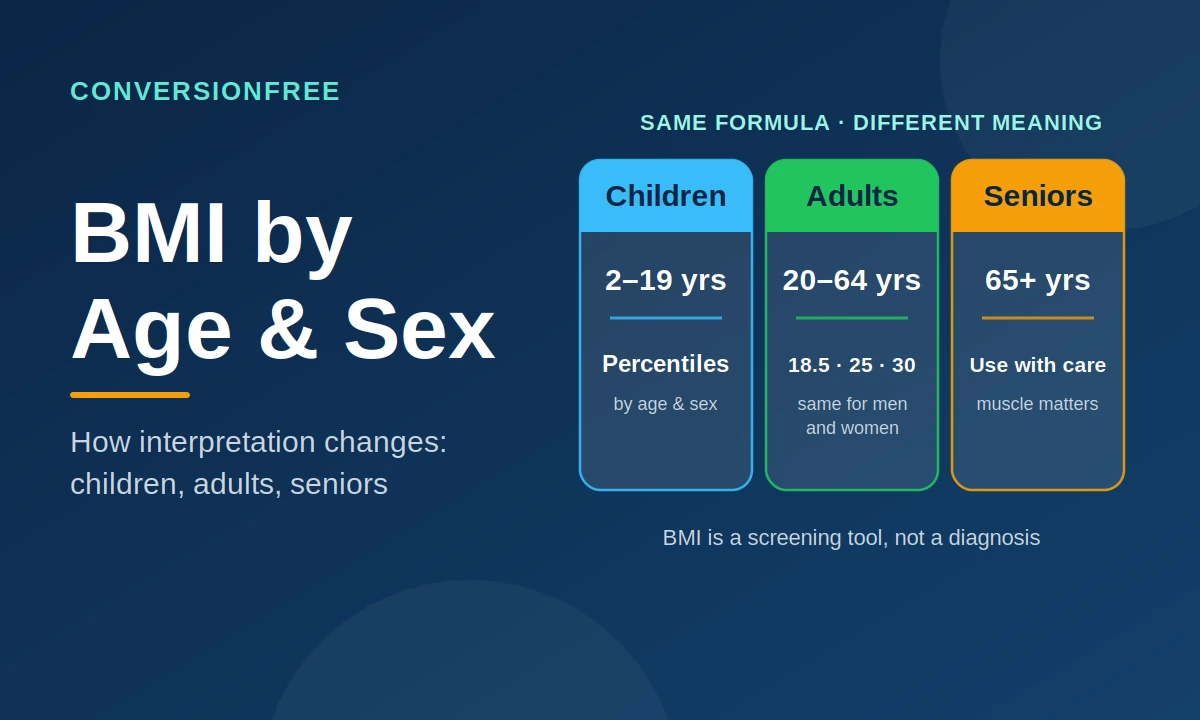
Quick answer: The BMI formula is the same at every age, but what the number means is not. For adults, BMI categories don’t depend on sex or age, but for children the same BMI can mean different things depending on age and sex. Children and teens aged 2 to 19 use percentiles, adults 20 and over use fixed categories, and adults over 65 need extra care in interpretation.
You can work out the number with our BMI calculator. This guide explains what it means for your stage of life.
Key takeaways
- Children and teens (2–19) are judged by BMI-for-age percentiles, not adult cut-offs.
- Adults 20 and over use the same categories for men and women.
- Women and men can have different body fat at the same BMI.
- After 65, BMI is less reliable, and muscle matters more than the scale.
- BMI is a screening tool. A healthcare professional should interpret it.
Why Does Age Change What BMI Means?
BMI only uses weight and height. But bodies change over a lifetime. Children are growing, so height and weight shift quickly. Adults tend to be stable, but muscle and fat slowly rebalance. Older adults often lose muscle even when their weight stays the same.
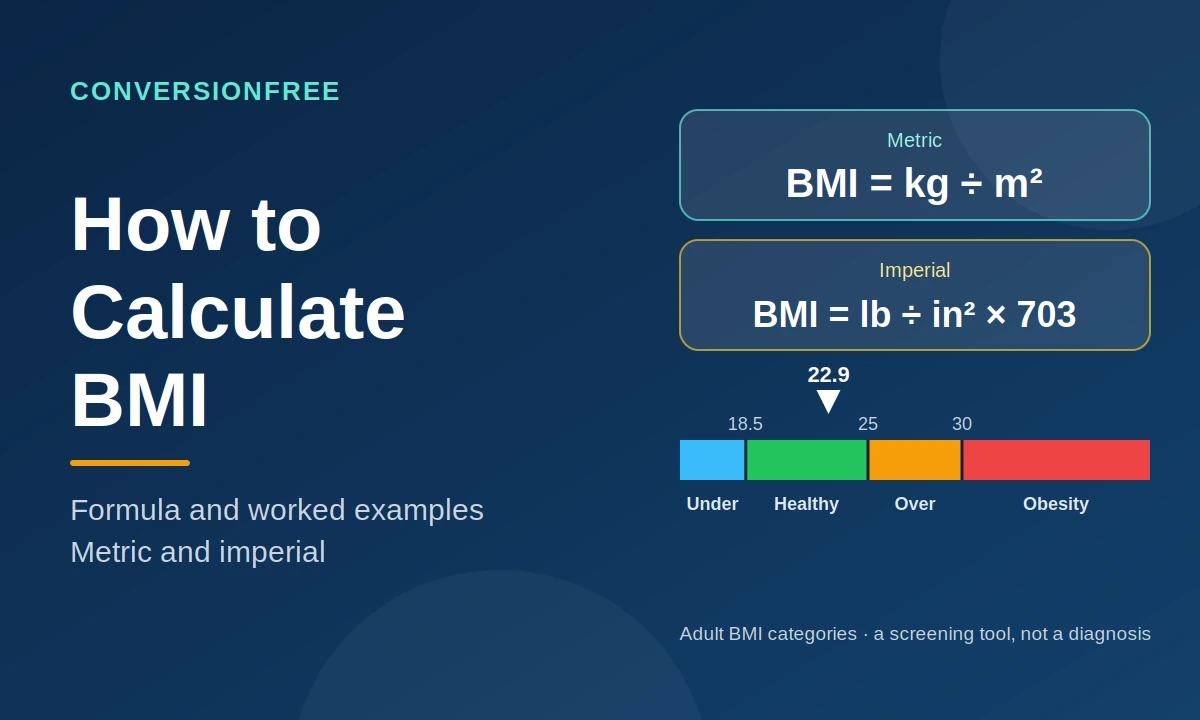
So the same number can point to different things at different ages. If you need a refresher on the formula first, read how to calculate BMI.
BMI by Life Stage at a Glance
| Life stage | Age | How BMI is interpreted | Main caution |
|---|---|---|---|
| Babies and toddlers | Under 2 | Growth charts (weight-for-length), not BMI categories | Ask your pediatrician |
| Children and teens | 2–19 | BMI-for-age percentile, by sex | Still growing; one reading isn’t a diagnosis |
| Adults | 20–64 | Fixed adult categories (18.5, 25, 30) | Muscle, fat distribution, ethnicity |
| Older adults | 65+ | Adult categories with caution | Muscle loss; weight loss can be a warning sign |
BMI for Children and Teens (Ages 2–19)
Why children use percentiles
Percentiles are used for children because they are still growing. A BMI that is normal for a 16-year-old could be high for a 7-year-old, and boys and girls grow differently.
A BMI percentile shows how a child’s measurements compare with other children of the same sex and age. A child at the 75th percentile has a BMI higher than 75% of children the same age and sex.
Child and teen BMI categories
The CDC’s categories are: below the 5th percentile is underweight, 5th to below 85th is healthy weight, 85th to below 95th is overweight, and 95th or above is obesity. Severe obesity is defined as 120% of the 95th percentile or more, or a BMI of 35 or above.
| BMI-for-age percentile | Category |
|---|---|
| Below 5th | Underweight |
| 5th to below 85th | Healthy weight |
| 85th to below 95th | Overweight |
| 95th or above | Obesity |
| 120% of the 95th percentile or more, or BMI of 35+ | Severe obesity |
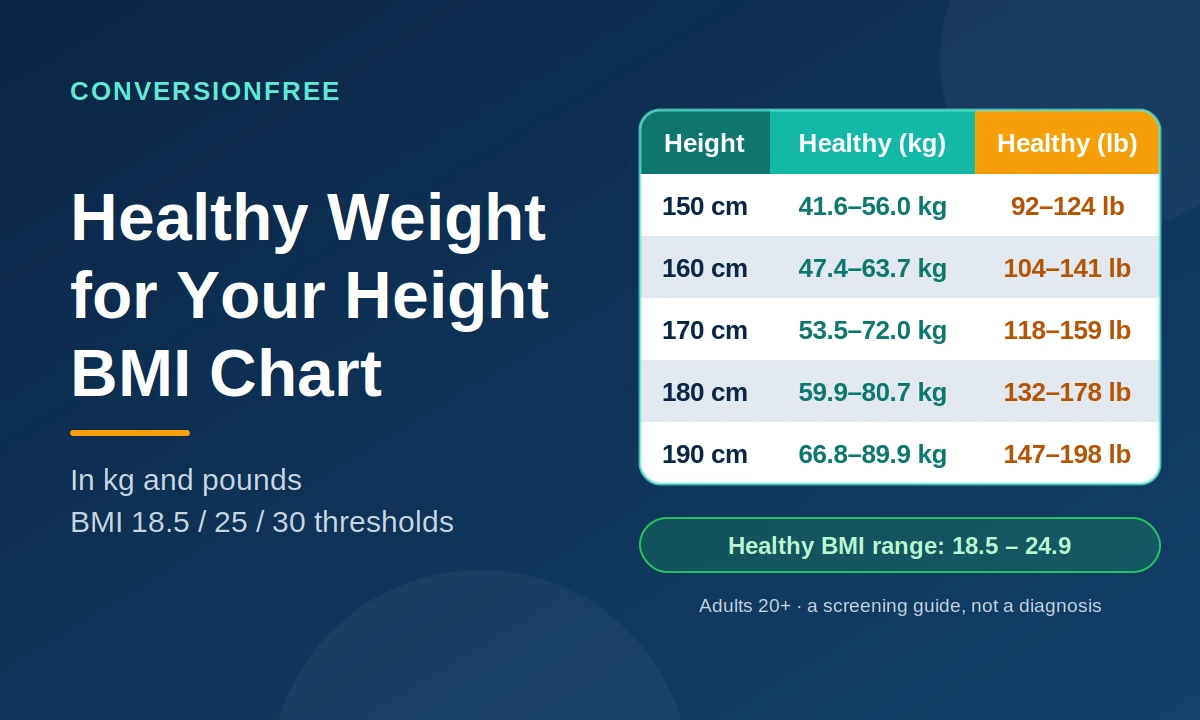
You can’t use the adult chart for children. Our healthy weight by height BMI chart is for adults only.
How to calculate a child’s BMI percentile
- Measure height and weight. If you have pounds, convert them to kilograms with the kg to pound converter first.
- Calculate BMI with the usual formula.
- Find the exact age in years and months. Our age calculator does this from a date of birth.
- Plot it on the CDC BMI-for-age chart for boys or girls, or use the CDC child and teen calculator.
Example (hypothetical): a child born on 14 March 2016 and measured on 10 October 2026 is 10 years, 6 months and 26 days old. That exact age matters, because a few months can shift the percentile.
What parents should know
- One reading is a snapshot. Growth is uneven, so doctors look at the trend over time.
- Percentile is not a grade. A child at the 70th percentile isn’t “better” than one at the 40th.
- BMI is a screening step. A high BMI-for-age means a health care provider needs to do further assessment to find out if excess fat is a problem.
- Check-ups matter. Health care providers can assess height, weight and BMI percentile at least annually for all children.
Please talk to your child’s doctor about any concerns, and avoid talking about weight in ways that make a child feel judged.
BMI for Teens and Young Adults (18–19)
This is a detail most pages miss. The CDC’s child and teen categories cover ages 2 through 19. The adult categories apply from age 20. So an 18- or 19-year-old is technically still in the percentile system, even though they may feel like an adult. If you’re 18 or 19, check with a doctor which method to use.
BMI for Adults (20–64)
Same categories at every adult age
For adults 20 and older, the CDC’s BMI categories are the same regardless of age, sex or race. cdc
| BMI | Category |
|---|---|
| Below 18.5 | Underweight |
| 18.5 – 24.9 | Healthy weight |
| 25.0 – 29.9 | Overweight |
| 30.0 and above | Obesity |
Use our BMI calculator to find yours, then see where you fall on the BMI chart by height.
Men and women: same formula, different bodies
A BMI calculator for women and a BMI calculator for men use the same formula and the same categories. The difference lies in body composition.
- Women generally have more body fat than men with the same BMI.
- Men tend to carry more muscle, and are more likely to store fat around the abdomen.
- Hormonal changes, such as pregnancy and menopause, can change weight and where fat is stored. BMI isn’t designed to judge weight during pregnancy, so talk to your care team.
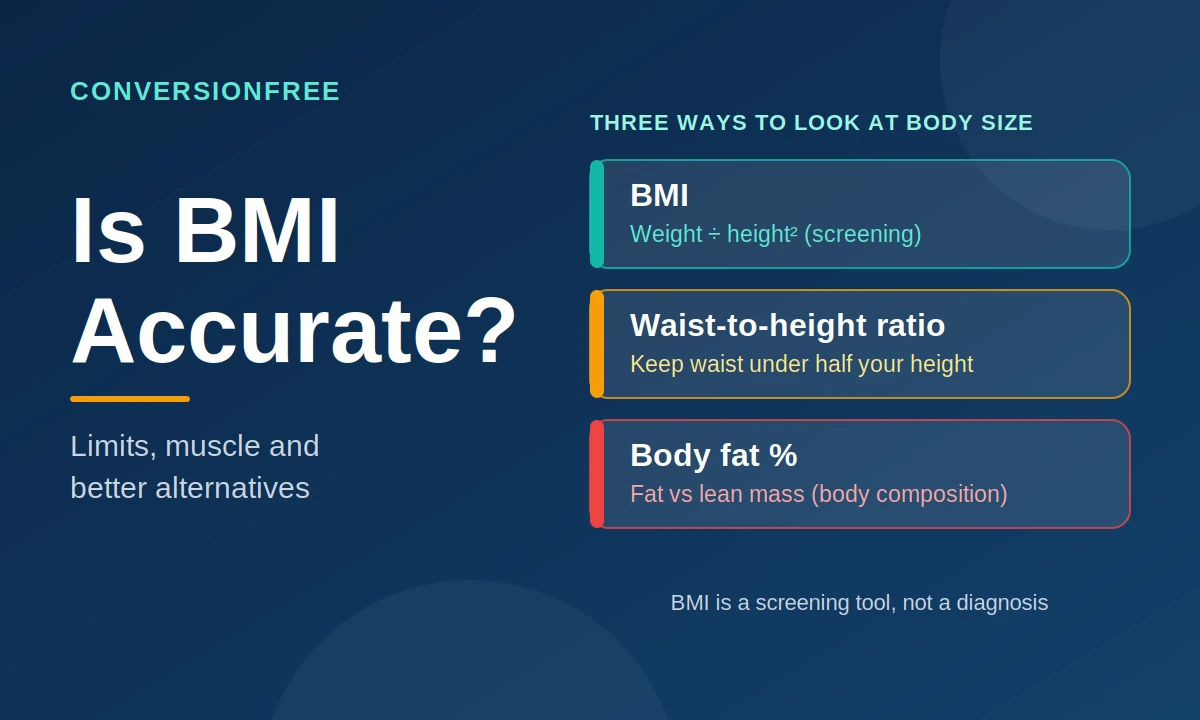
So two adults with the same BMI can have different body fat and different risks. Waist measurements help show the difference. We cover them in Is BMI Accurate? Limits and Better Alternatives.
Same BMI, different people (hypothetical)
A 30-year-old and a 75-year-old are both 1.70 m tall and weigh 78 kg, so both have a BMI of 27.0. On the adult chart, both are “overweight”. But the 30-year-old may be perfectly healthy if they’re muscular, while the 75-year-old’s doctor might see the same number as reassuring, if their muscle is strong and their weight is stable. The number is identical. The context is not.
BMI for Older Adults (65 and Over)
Why BMI is less reliable after 65
BMI is often less accurate for adults over 65 because it doesn’t reflect age-related changes in muscle and fat. NICE’s draft guidance says BMI should be interpreted with caution in people older than 65. hopkinsmedicinethepharmacist
Is a higher BMI sometimes better for seniors?
Research points that way, though the details are debated. One review of 32 studies covering nearly 200,000 people aged 65 and older found lower mortality at BMIs of about 24 to 31. Some doctors call this the “obesity paradox”, and why it happens isn’t fully understood.
This does not mean that gaining weight is a goal for older adults. Experts caution that the pattern may partly reflect illness: people often lose weight when they become seriously unwell, which can make lower body weight look riskier than it really is. Weight carried around the waist (visceral fat) was linked in one study to a higher risk of death in men.
What matters more than the number
- Muscle and strength. Maintaining muscle to ward off frailty (sarcopenia) may matter more to length and quality of life than counting pounds.
- Unplanned weight loss. After 70, doctors worry about rapid weight loss, being underweight, and muscle loss.
- Waist-to-height ratio. It can add information, but NICE notes limits in older people.
- Function. Walking, standing from a chair and climbing stairs are practical health markers.
If you’re over 65, don’t aim for a number from a chart. Talk to your doctor about what’s right for you.
Does Ethnicity Change the Picture Too?
It can. In Singapore and Hong Kong, a BMI of 23 is considered overweight, compared with 25 in the United States. If this applies to you, ask your doctor which cut-offs are best.
How to Check Your BMI Correctly at Any Age
- Choose the right method for your age. Percentiles for ages 2–19, the adult chart from 20.
- Calculate BMI with a trusted BMI calculator.
- Add context. Muscle, activity, age and health conditions matter.
- Look at trends over months, not single readings.
- Talk to a professional if the result concerns you.
When Should You Talk to a Doctor?
- Your child’s BMI percentile changes sharply between check-ups.
- Your child is below the 5th or at or above the 85th percentile, or you’re worried about eating habits.
- You’re an adult with a BMI outside the healthy range and other risk factors.
- You’re over 65 and losing weight without trying, or noticing weaker strength.
BMI by Age and Sex FAQs
Is BMI different for men and women?
Not for adults. The formula and categories are the same, but women tend to carry more body fat at the same BMI.
Is BMI different for children?
Yes. Children aged 2 to 19 use age- and sex-specific percentiles.
What is a healthy BMI percentile for a child?
The 5th to below the 85th percentile is classed as healthy weight.
What BMI is healthy for a 60-year-old?
The adult categories apply to adults 20 and over, so a BMI of 18.5 to 24.9 is classed as healthy. A doctor can tell you what’s right for you.
What is a normal BMI for a 70-year-old?
The adult chart still applies on paper, but research suggests slightly higher BMIs may not carry the same risk in older adults. Muscle and stable weight matter more.
Does BMI change with age?
Your BMI can change as weight changes, but the formula doesn’t. What changes is the interpretation.
Can I use an adult BMI calculator for my child?
Not the adult chart. Calculate the BMI, then compare it with a BMI-for-age percentile chart.
Is BMI reliable for seniors?
Less so. It misses muscle loss and fat distribution.
Find Your BMI, Then Put It in Context
Start with the number: use our free BMI calculator. For a child’s percentile, find the exact age with the age calculator. More free tools are in our unit conversion tools and on the ConversionFree.
This article is for general information and isn’t medical advice. Last updated: [Monday, October 12, 2026]. Reviewed by: [Uzair Moatasim].