Quick answer: For adults, a healthy weight is the range that gives a BMI between 18.5 and 24.9. For someone 175 cm (5'9") tall, that’s about 56.7 to 76.3 kg (125 to 168 lb). Find your height in the charts below to see your own range.
The CDC and WHO both use BMI ranges to evaluate the weight of adults aged 20 and over. These ranges are a screening guide, not a verdict on your health. A doctor can look at the whole picture.
If you want your exact number, use our free BMI calculator. If you want to see your range at a glance, keep reading.
Key takeaways
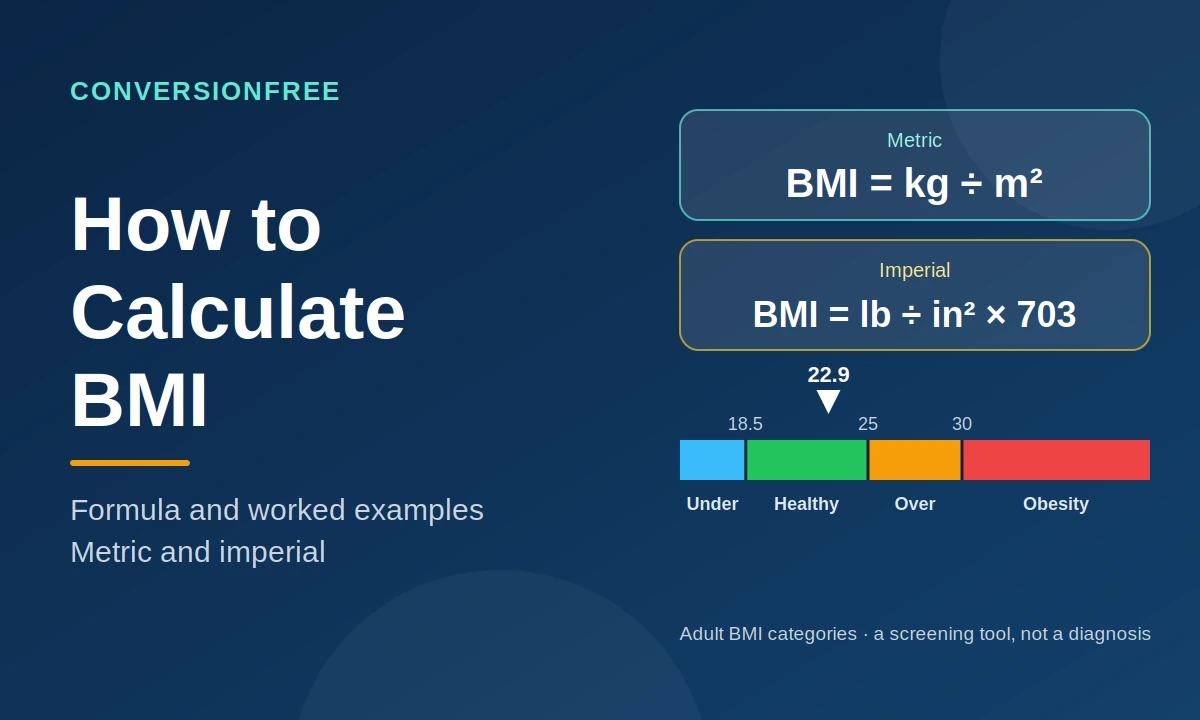
- Healthy BMI for adults is 18.5 to 24.9. Overweight starts at 25 and obesity starts at 30.
- Healthy weight depends on height, so a taller person has a higher healthy range.
- The same chart applies to men and women aged 20 and over.
- Weight range formula: BMI × height² (in meters) = weight in kg.
What Does “Healthy Weight for Your Height” Mean?
It means the weight range where your BMI falls in the healthy category. BMI compares weight with height, so the same weight can be healthy for one person and not for another. If you’re new to BMI itself, start with how to calculate BMI.
People look for this under many names, such as a body index calculator or a BMI chart by height. They all mean the same thing: which weights fit a healthy BMI for a given height.
BMI Categories and Thresholds
The thresholds 18.5, 25 and 30 divide the chart into groups. CDC’s adult categories are underweight, healthy weight, overweight and obesity, with obesity split into three classes. cdc
| BMI | Category |
|---|---|
| Below 18.5 | Underweight |
| 18.5 – 24.9 | Healthy weight |
| 25.0 – 29.9 | Overweight |
| 30.0 and above | Obesity |
Obesity is further split into Class 1 (30–34.9), Class 2 (35–39.9) and Class 3 (40 and above).
BMI Chart in Kilograms: Healthy Weight by Height (cm)
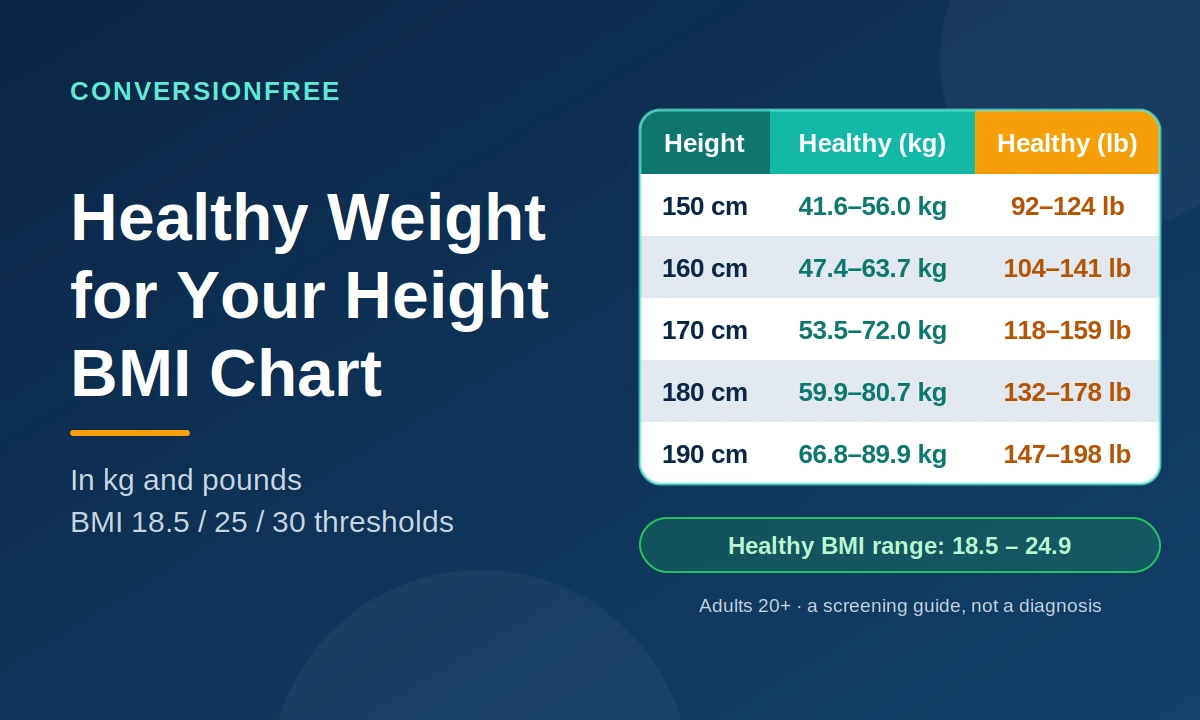
Find your height in centimeters, then read the healthy range in kilograms and pounds.
| Height (cm) | Height (ft/in) | Healthy weight (kg) | Healthy weight (lb) |
|---|---|---|---|
| 145 | 4'9" | 38.9 – 52.4 | 86 – 115 |
| 150 | 4'11" | 41.6 – 56.0 | 92 – 124 |
| 155 | 5'1" | 44.4 – 59.8 | 98 – 132 |
| 160 | 5'3" | 47.4 – 63.7 | 104 – 141 |
| 165 | 5'5" | 50.4 – 67.8 | 111 – 149 |
| 170 | 5'7" | 53.5 – 72.0 | 118 – 159 |
| 175 | 5'9" | 56.7 – 76.3 | 125 – 168 |
| 180 | 5'11" | 59.9 – 80.7 | 132 – 178 |
| 185 | 6'1" | 63.3 – 85.2 | 140 – 188 |
| 190 | 6'3" | 66.8 – 89.9 | 147 – 198 |
| 195 | 6'5" | 70.3 – 94.7 | 155 – 209 |
| 200 | 6'7" | 74.0 – 99.6 | 163 – 220 |
BMI Chart in Pounds: Healthy Weight by Height (ft/in)
If you know your height in feet and inches, use this version.
| Height | Inches | Healthy weight (lb) | Healthy weight (kg) |
|---|---|---|---|
| 4'10" | 58 | 89 – 119 | 40.2 – 54.0 |
| 4'11" | 59 | 92 – 123 | 41.6 – 55.9 |
| 5'0" | 60 | 95 – 128 | 43.0 – 57.8 |
| 5'1" | 61 | 98 – 132 | 44.4 – 59.8 |
| 5'2" | 62 | 101 – 136 | 45.9 – 61.8 |
| 5'3" | 63 | 104 – 141 | 47.4 – 63.8 |
| 5'4" | 64 | 108 – 145 | 48.9 – 65.8 |
| 5'5" | 65 | 111 – 150 | 50.4 – 67.9 |
| 5'6" | 66 | 115 – 154 | 52.0 – 70.0 |
| 5'7" | 67 | 118 – 159 | 53.6 – 72.1 |
| 5'8" | 68 | 122 – 164 | 55.2 – 74.3 |
| 5'9" | 69 | 125 – 169 | 56.8 – 76.5 |
| 5'10" | 70 | 129 – 174 | 58.5 – 78.7 |
| 5'11" | 71 | 133 – 179 | 60.2 – 81.0 |
| 6'0" | 72 | 136 – 184 | 61.9 – 83.3 |
| 6'1" | 73 | 140 – 189 | 63.6 – 85.6 |
| 6'2" | 74 | 144 – 194 | 65.4 – 88.0 |
| 6'3" | 75 | 148 – 199 | 67.1 – 90.4 |
| 6'4" | 76 | 152 – 205 | 68.9 – 92.8 |
The two charts differ by a pound or so at some heights, because feet and inches are rounded versions of centimeters. For example, 175 cm is about 68.9 in, not exactly 69 in.
How to Read the BMI Chart
- Find your height in the first column.
- Read across to your healthy range.
- Compare your weight. If you’re inside the range, your BMI is in the healthy category. Below it means underweight, and above it means overweight or higher.
- Check your exact BMI with the BMI calculator if you want the precise number.
For weights in other units, convert them first. The kg to pound converter works in both directions, and the kg to lbs conversion chart covers values from 1 to 200 kg.
Where Do Overweight and Obesity Start for Your Height?
This table shows the weight at which each BMI category begins, for four sample heights.
| Height | BMI 18.5 (healthy starts) | BMI 25 (overweight starts) | BMI 30 (obesity starts) |
|---|---|---|---|
| 155 cm (5'1") | 44.4 kg (98 lb) | 60.1 kg (132 lb) | 72.1 kg (159 lb) |
| 165 cm (5'5") | 50.4 kg (111 lb) | 68.1 kg (150 lb) | 81.7 kg (180 lb) |
| 175 cm (5'9") | 56.7 kg (125 lb) | 76.6 kg (169 lb) | 91.9 kg (203 lb) |
| 185 cm (6'1") | 63.3 kg (140 lb) | 85.6 kg (189 lb) | 102.7 kg (226 lb) |
Here, “healthy starts” means the lowest weight in the healthy range. The healthy range ends just below the overweight line.
How Is the Healthy Weight Range Calculated?
The charts come from the BMI formula, rearranged to solve for weight.
Metric: weight (kg) = BMI × height (m)²
Imperial: weight (lb) = BMI × height (in)² ÷ 703
Example: 175 cm (1.75 m)
- Height squared: 1.75 × 1.75 = 3.0625
- Lowest healthy weight: 18.5 × 3.0625 = 56.7 kg
- Highest healthy weight: 24.9 × 3.0625 = 76.3 kg
Example: 5'9" (69 in)
- Height squared: 4,761
- Lowest healthy weight: 18.5 × 4,761 ÷ 703 = 125 lb
- Highest healthy weight: 24.9 × 4,761 ÷ 703 = 169 lb
The full step-by-step method is in our guide on how to calculate BMI.
Is the Chart Different for Men and Women?
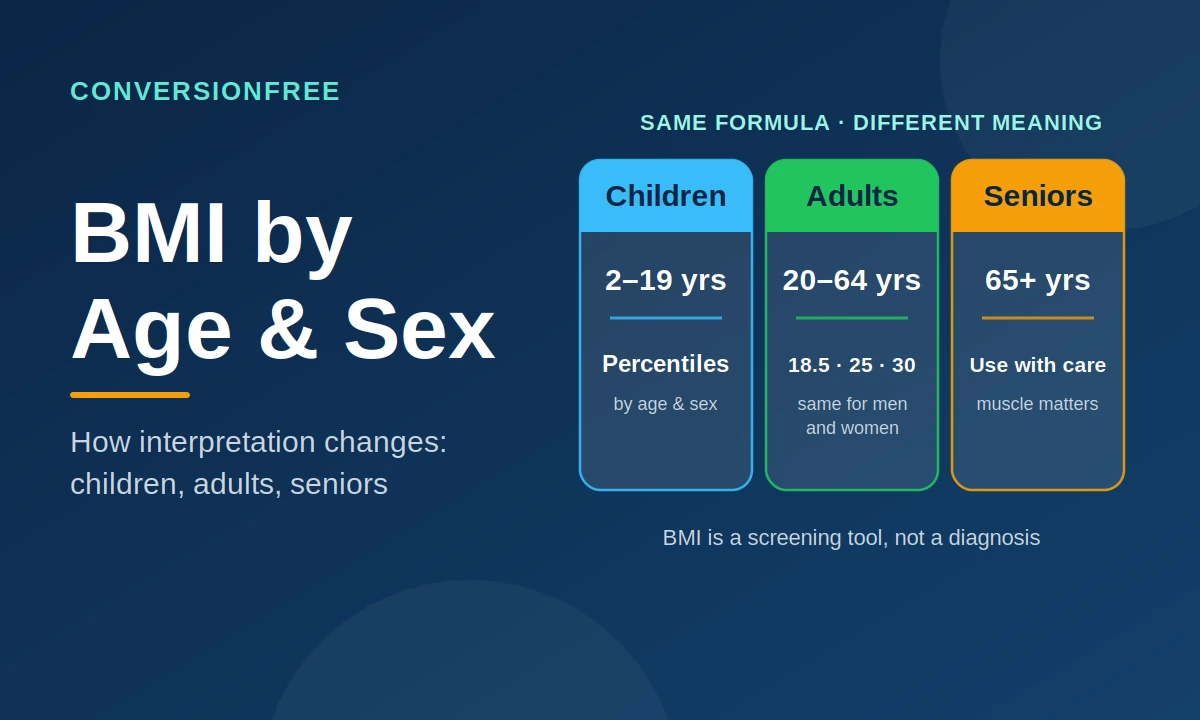
For adults, no. A BMI calculator for women and a BMI calculator for men use the same formula and the same chart. For adults 20 and older, CDC’s categories apply regardless of age, sex or race.
What differs is body composition. On average, women tend to carry more body fat, and men tend to carry more muscle, at the same BMI. So the chart gives a similar range for both, but the same BMI can mean different things for different people. See BMI by Age and Sex for more.
Do Other Countries Use Different Ranges?
Sometimes. In Singapore and Hong Kong, a BMI of 23 is treated as overweight, compared with 25 in the United States. Some health guidance suggests lower cut-offs for people of Asian descent, because health risks can rise at lower BMI values. If that applies to you, ask your doctor which range is right. calculatorsoup
What the Chart Doesn’t Tell You
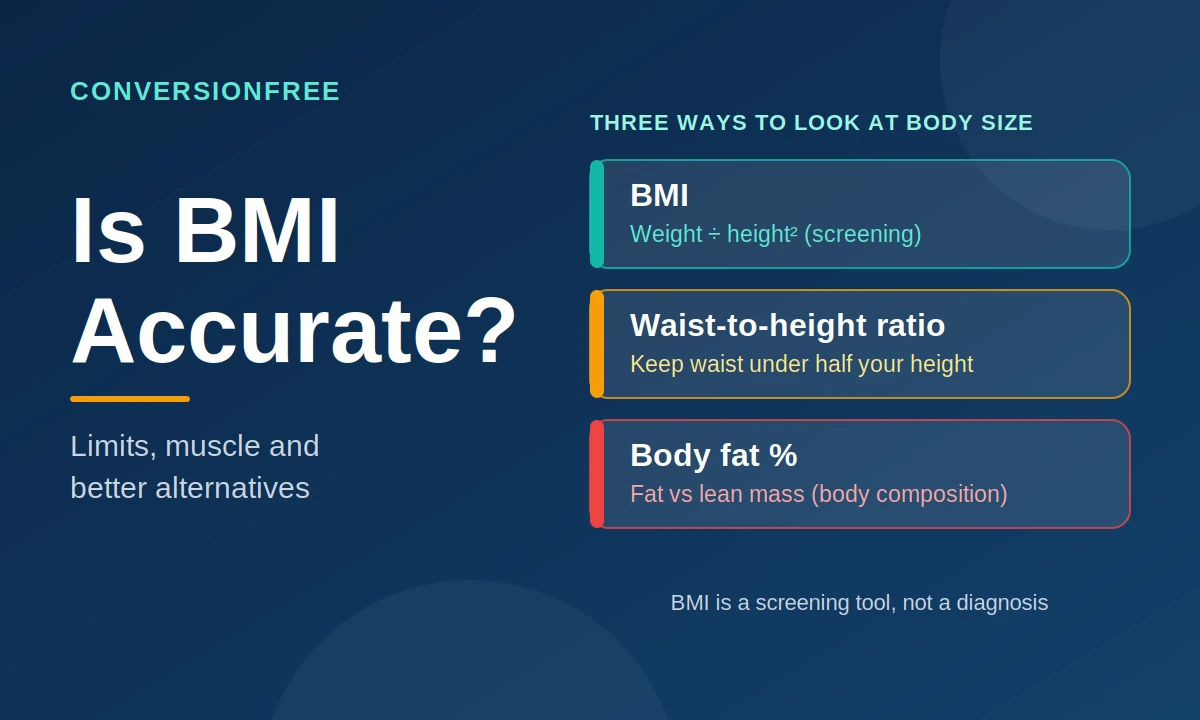
A healthy weight range is a starting point, not a target for everyone. BMI can’t tell muscle from fat, and it doesn’t show where fat is stored. A muscular person may be above the healthy range while healthy, and someone within it may still have health risks. Waist size, fitness, diet, family history and blood tests all matter. We explain more in Is BMI Accurate? Limits and Better Alternatives.
This chart is also for adults only. For ages 2 to 19, the CDC uses BMI percentiles instead of the adult categories. Age can change how results are read as well. You can check your exact age with our age calculator.
What to Do With Your Result
- Inside your range: nothing to fix. Keep up the habits that work for you.
- Above or below: it’s worth a conversation with a doctor, not a panic. One number isn’t a diagnosis.
- Planning a change: set goals with a professional, and focus on habits, not just the scale.
Healthy Weight for Height FAQs
What is a healthy weight for my height?
It’s the weight range that gives a BMI of 18.5 to 24.9. For 175 cm (5'9"), that’s about 56.7–76.3 kg (125–168 lb).
What is a healthy weight for a 5'6" woman?
About 115–154 lb (52.0–70.0 kg), using the adult BMI range.
What is a healthy weight for a 5'10" man?
About 129–174 lb (58.5–78.7 kg).
Is the BMI chart the same for men and women?
Yes, for adults. The formula and categories are the same.
What BMI is overweight?
A BMI of 25.0 to 29.9.
What BMI is obese?
A BMI of 30 or higher.
Does the BMI chart work for children?
No. Children and teens use age- and sex-specific percentiles.
How accurate is the BMI chart?
It’s a screening guide. It doesn’t measure body fat or muscle, so use it alongside other health information.
Check Your Own BMI
Now that you’ve found your range, try the ConversionFree BMI calculator to see your exact number. To convert weights or heights on the way, browse our unit conversion tools, or visit the ConversionFree for more free calculators.
This article is for general information and isn’t medical advice. Last updated: [Saturday, October 10, 2026]. Reviewed by: [Uzair Moatasim].