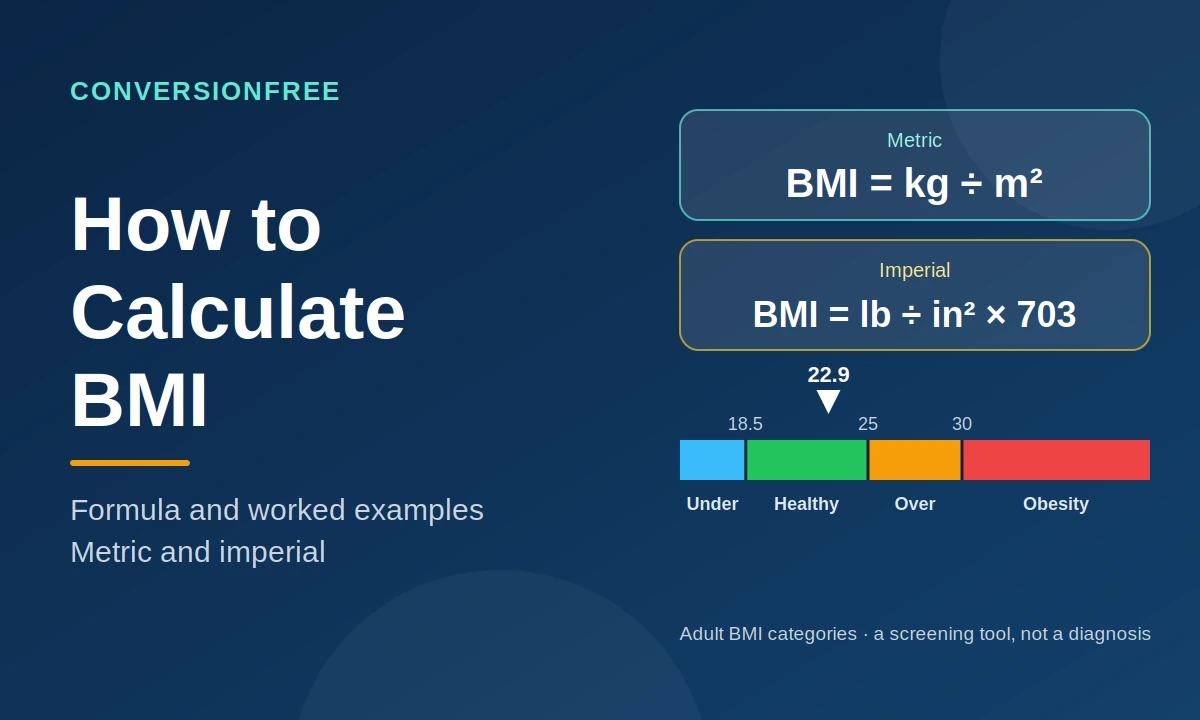
Quick answer: BMI (body mass index) equals your weight in kilograms divided by your height in meters squared. In pounds and inches, multiply weight by 703 and divide by height in inches squared. A 70 kg adult who is 1.75 m tall has a BMI of 22.9.
BMI is a screening measure that relates weight to height. It’s a starting point for a conversation about health, not a diagnosis.
If you’d rather skip the math, our free BMI calculator does it in seconds. If you want to understand the numbers (or check a result), keep reading.
Key takeaways
- Metric formula: BMI = weight (kg) ÷ height (m)²
- Imperial formula: BMI = weight (lb) ÷ height (in)² × 703
- Adult BMI categories: under 18.5, 18.5–24.9, 25–29.9, and 30 or higher
- The adult formula is the same for men and women
- BMI is a screening tool. It doesn’t measure body fat directly.
What Is BMI?
BMI stands for body mass index. It’s a single number that compares your weight with your height. People search for it under different names, such as a body index calculator, a mass index calculator or a body bmi calculator. They all mean the same BMI calculation.
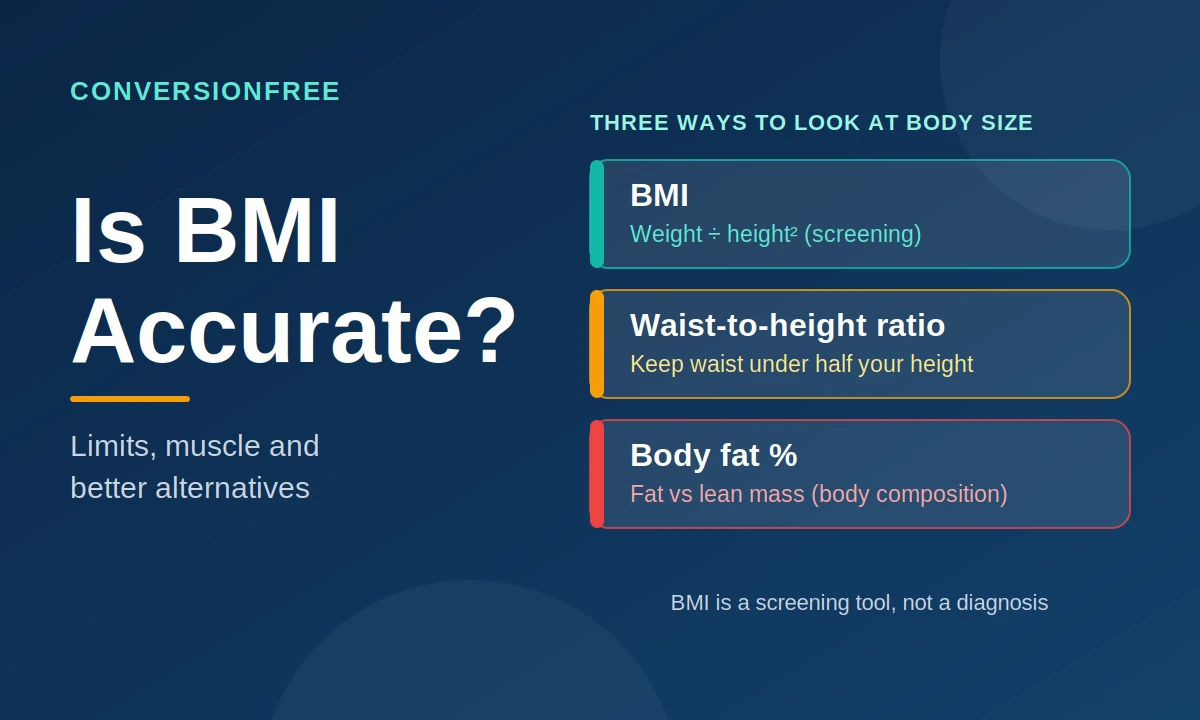
BMI was designed for large groups of people, which is why it’s quick and simple. It can’t tell muscle from fat, so it works best as a first check, not a final answer. We cover that in Is BMI Accurate? Limits and Better Alternatives.
The BMI Formula in Metric Units
BMI = weight (kg) ÷ height (m) × height (m)
You need your weight in kilograms and your height in meters.
The CDC describes BMI as weight in kilograms divided by the square of height in meters.
If your height is in centimeters, you have two options:
- Convert to meters first: divide by 100 (175 cm = 1.75 m).
- Or use the centimeter version: BMI = weight (kg) ÷ height (cm)² × 10,000.
Metric example 1: 70 kg and 175 cm
- Convert height: 175 cm = 1.75 m
- Square it: 1.75 × 1.75 = 3.0625
- Divide: 70 ÷ 3.0625 = 22.9
Metric example 2: 62 kg and 165 cm
- Height: 1.65 m
- Square it: 1.65 × 1.65 = 2.7225
- Divide: 62 ÷ 2.7225 = 22.8
If your weight is in pounds, convert to kilograms first. The kg to pound converter works in both directions, and our guide on how to convert kg to pounds explains the math.
The BMI Formula in Imperial Units (lb, in, ×703)
BMI = weight (lb) ÷ height (in)² × 703
You need your weight in pounds and your height in inches. If you know your height in feet and inches, convert it first: (feet × 12) + inches.
The 703 comes from converting pounds to kilograms and inches to meters, so the imperial result matches the metric one. US units use weight in pounds divided by height in inches squared, multiplied by 703.
Imperial example 1: 154 lb and 5 ft 9 in
- Height in inches: (5 × 12) + 9 = 69 in
- Square it: 69 × 69 = 4,761
- Multiply weight by 703: 154 × 703 = 108,262
- Divide: 108,262 ÷ 4,761 = 22.7
Imperial example 2: 180 lb and 5 ft 9 in
- Height: 69 in, squared = 4,761
- 180 × 703 = 126,540
- 126,540 ÷ 4,761 = 26.6
The small difference between 22.9 and 22.7 in the two first examples comes from rounding when converting between units.
How to Calculate BMI Step by Step
- Measure your weight with a scale, ideally in the morning.
- Measure your height without shoes.
- Pick your units (kg and m, or lb and in).
- Square your height (multiply it by itself).
- Divide weight by squared height (for imperial, multiply weight by 703 first).
- Round to one decimal place.
- Compare the result with a BMI chart.
BMI Chart: What Does Your Number Mean?
A BMI chart sorts results into weight categories. The CDC’s adult chart uses underweight, healthy weight, overweight and obesity, with obesity split into three classes.
| BMI | Category |
|---|---|
| Below 18.5 | Underweight |
| 18.5 – 24.9 | Healthy weight |
| 25.0 – 29.9 | Overweight |
| 30.0 – 34.9 | Class 1 obesity |
| 35.0 – 39.9 | Class 2 obesity |
| 40.0 and above | Class 3 obesity |
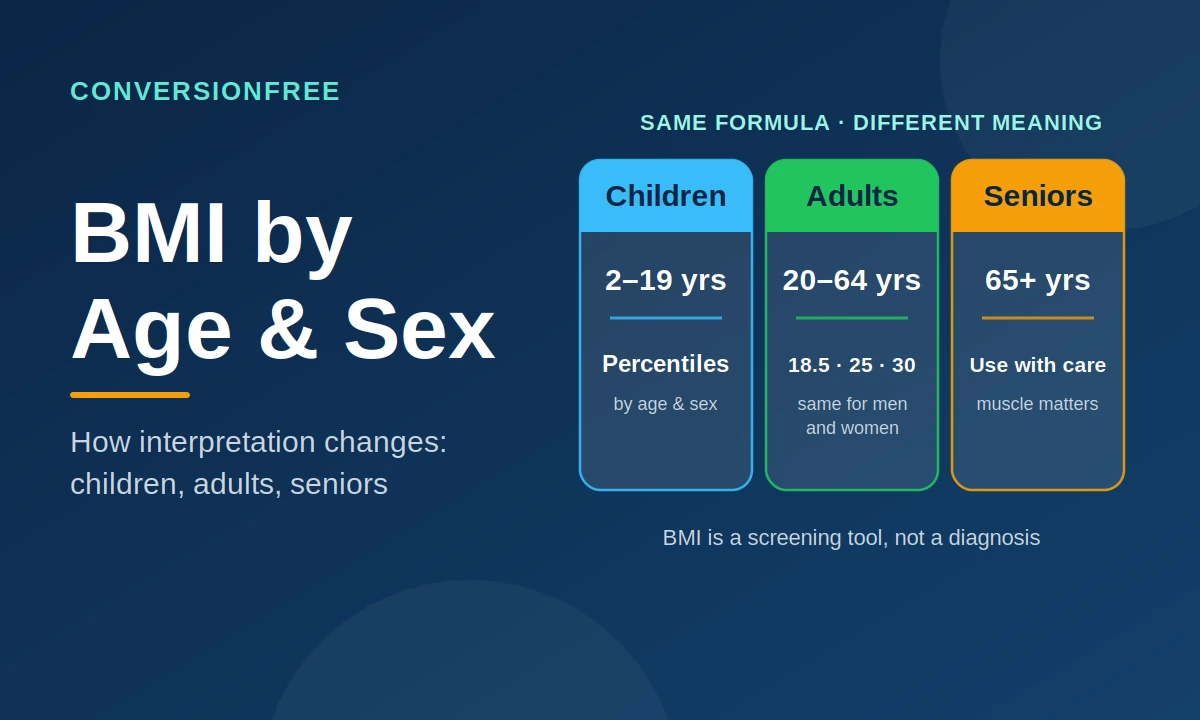
For adults 20 and older, these categories apply regardless of age, sex or race. Some regions use different cut-offs. In Singapore and Hong Kong, for example, a BMI of 23 is considered overweight.
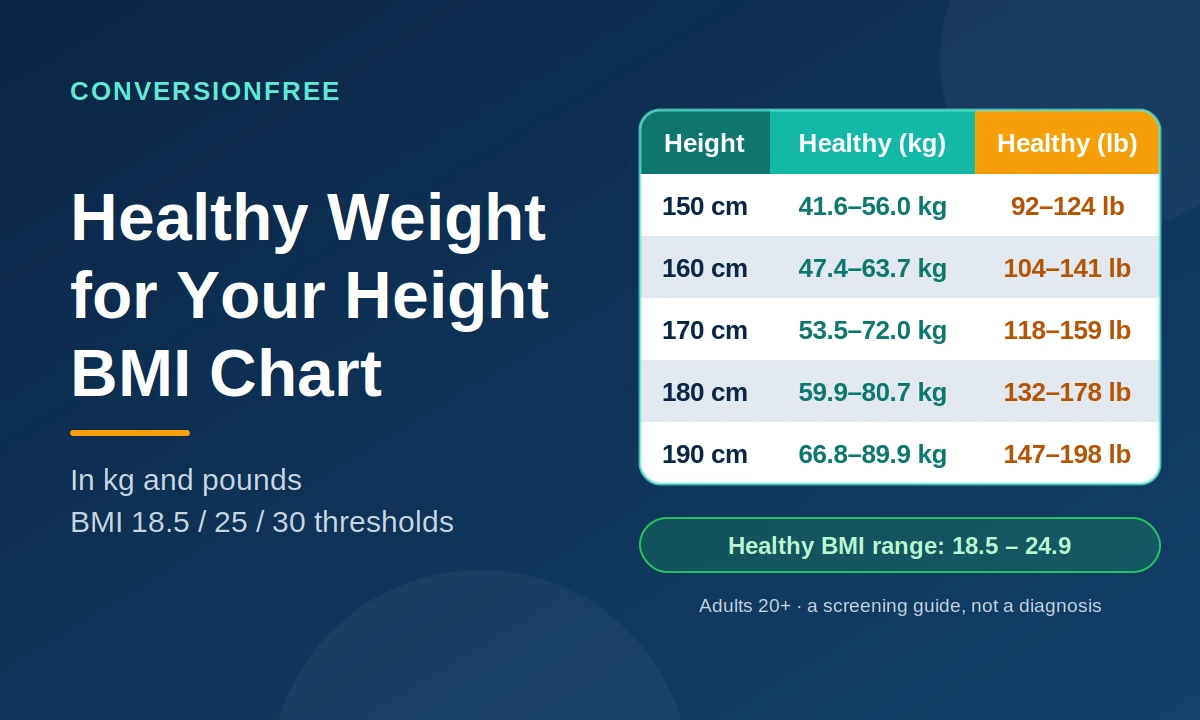
Want to see the healthy weight range for your exact height? That’s covered in our healthy weight by height BMI chart.
Is the BMI Calculator for Women Different From Men?
For adults, no. The formula and the category cut-offs are the same. A bmi calculator for women and a bmi calculator for men use identical math.
What can differ is what the number means. On average, women tend to carry more body fat than men at the same BMI, and men tend to carry more muscle. So two people with the same BMI may have different body compositions. That’s why BMI is a screening tool, not a verdict.
Example for a woman: 140 lb and 5 ft 4 in
- Height: 64 in; 64 × 64 = 4,096
- 140 × 703 = 98,420
- 98,420 ÷ 4,096 = 24.0 (healthy weight, near the top of the range)
Example for a man: 185 lb and 5 ft 10 in
- Height: 70 in; 70 × 70 = 4,900
- 185 × 703 = 130,055
- 130,055 ÷ 4,900 = 26.5 (overweight category)
If you’re curious how BMI changes with age and sex, see BMI by Age and Sex.
How to Work Backward: Find a Weight for a Target BMI
You can rearrange the formula to find a weight range:
Weight (kg) = BMI × height (m)²
For a height of 1.75 m (height squared = 3.0625):
- Lower end of healthy range (BMI 18.5): 18.5 × 3.0625 = 56.7 kg (125 lb)
- Upper end (BMI 24.9): 24.9 × 3.0625 = 76.3 kg (168 lb)
So for someone 1.75 m tall, the healthy weight range is roughly 56.7–76.3 kg (125–168 lb). Convert between kilograms and pounds quickly with this kg to lbs conversion chart.
Common Mistakes When Calculating BMI
- Forgetting to square the height. Dividing by height alone gives a wildly wrong number.
- Using centimeters as meters. 175 cm must become 1.75 m.
- Mixing units. Don’t use pounds with meters.
- Skipping ×703 in the imperial formula.
- Rounding too early. Keep extra decimals until the final step. A result of 29.98 is still in the overweight category, even though it rounds to 30.0.
- Using the adult chart for children. Children and teens aged 2 to 19 use BMI percentiles instead.
BMI Calculator vs Doing It by Hand
Doing the math by hand helps you understand the number. A calculator is faster and avoids rounding slips, and it can handle unit changes for you. Try the ConversionFree BMI calculator with either metric or imperial inputs.
What BMI Can’t Tell You
BMI doesn’t measure body fat, muscle, bone density, or where fat is stored. An athlete with a lot of muscle can have a BMI in the overweight range while being healthy. A person with a normal BMI can still have health risks. If your result concerns you, or you’re making health decisions, speak with a doctor or other qualified professional.
BMI FAQs
What is the formula for BMI?
BMI = weight (kg) ÷ height (m)². In pounds and inches: BMI = weight (lb) ÷ height (in)² × 703.
How do I calculate BMI with pounds and feet?
Convert height to inches ((feet × 12) + inches), square it, multiply your weight in pounds by 703, then divide.
Why do you multiply by 703?
It converts pounds and inches into the kilograms and meters that the original formula uses.
What is a normal BMI?
For adults, a BMI of 18.5 to 24.9 is classed as healthy weight.
Is BMI calculated differently for men and women?
No. The adult formula is the same. The meaning of the number can differ because body composition differs.
Can I calculate BMI from centimeters?
Yes. Use BMI = weight (kg) ÷ height (cm)² × 10,000, or convert centimeters to meters first.
Is BMI the same as body fat percentage?
No. BMI uses only height and weight. Body fat percentage measures the proportion of fat in the body.
Is BMI accurate for children?
Not with the adult chart. Children and teens use age- and sex-specific percentiles.
Calculate Your BMI Now
You now know how to calculate BMI both ways. For a quick answer, use the free ConversionFree BMI calculator. To convert units on the way, browse our unit conversion tools, or head to the ConversionFree for more free calculators.
This article is for general information and isn’t medical advice. Last updated: [Saturday, October 10, 2026]. Reviewed by: [Uzair Moatasim].