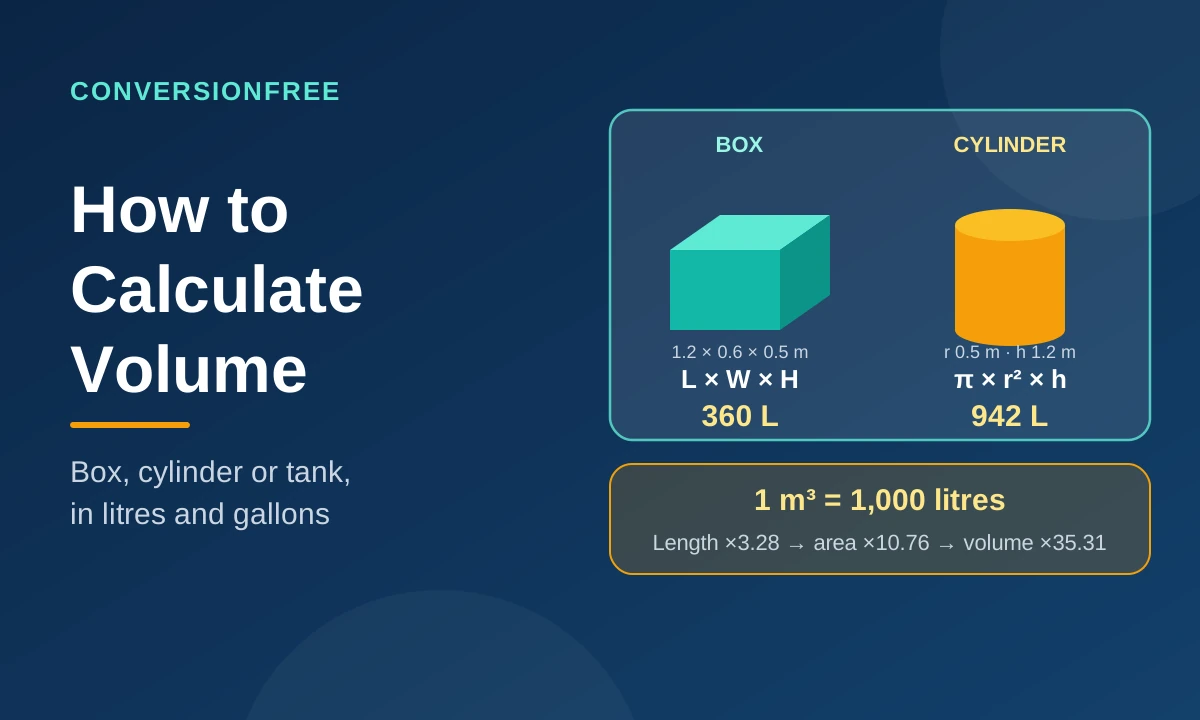
Quick answer: For a box, multiply length × width × height. For a cylinder, use π × radius² × height. Then convert the result: 1 m³ = 1,000 litres, and 1 litre = 1,000 cm³. For example, a box 1.2 × 0.6 × 0.5 m holds 0.36 m³ = 360 litres, and a cylinder of radius 0.5 m and height 1.2 m holds 0.942 m³ = 942 litres.
For the unit conversion step, use the volume converter. This guide shows how to measure, calculate and convert, with worked examples for boxes, tanks, aquariums and pools.
Key takeaways
- Box: V = L × W × H. Cylinder: V = π × r² × h (radius, not diameter).
- 1 m³ = 1,000 L. 1 dm³ = 1 L. 1 cm³ = 1 ml.
- 1 m³ = 264.17 US gallons = 219.97 UK gallons = 35.31 ft³.
- Use inside dimensions for capacity, and keep all lengths in one unit.
- The most common error is using the diameter as the radius, which makes a cylinder's volume 4 times too big.
What Is Volume?
Volume is the amount of space inside something, or the space an object takes up. It's measured in cubic units (m³, cm³, ft³) or in capacity units (litres, gallons) when you're talking about liquids.
Capacity is simply the volume a container can hold. So "tank capacity" and "tank volume" mean the same thing, as long as you measure the inside.
The Basic Formulas
| Shape | Formula | Notes |
|---|---|---|
| Box (rectangular) | L × W × H | A cube is a box with equal sides: s³ |
| Cylinder | π × r² × h | r = radius = half the diameter |
| Sphere | ⁴⁄₃ × π × r³ | A ball or round tank |
| Cone | ⅓ × π × r² × h | A funnel or conical tank |
| Triangular prism | ½ × base × height × length | A trough or wedge |
Remember: the formula gives volume in the cube of the unit you measured in. Lengths in metres give m³. Lengths in centimetres give cm³.
How to Calculate the Volume of a Box
Volume = length × width × height
Example 1: a storage box. 1.2 m × 0.6 m × 0.5 m
- 1.2 × 0.6 × 0.5 = 0.36 m³
- In litres: 0.36 × 1,000 = 360 L
- In US gallons: 360 × 0.264172 = 95.1 US gal
- In UK gallons: 360 × 0.219969 = 79.2 UK gal
Example 2: an imperial tank. 4 ft × 2 ft × 3 ft
- 4 × 2 × 3 = 24 ft³
- In US gallons: 24 × 7.4805 = 179.5 US gal
- In litres: 24 × 28.317 = 679.6 L
How to Calculate the Volume of a Cylinder
Volume = π × radius² × height, where π ≈ 3.14159
If you know the diameter, divide it by 2 to get the radius.
Example: a water tank. Diameter 1.0 m, height 1.2 m
- Radius: 1.0 ÷ 2 = 0.5 m
- Base area: π × 0.5² = π × 0.25 = 0.7854 m²
- Volume: 0.7854 × 1.2 = 0.9425 m³
- In litres: 942.5 L
- In US gallons: 249.0 US gal
Example: a barrel. Diameter 58 cm, height 88 cm
- Radius: 29 cm
- Volume: π × 29² × 88 = 232,503 cm³
- In litres: 232,503 ÷ 1,000 = 232.5 L
Find the height of liquid for a given volume
If you know the volume and want the liquid depth in a standing cylinder:
height = volume ÷ (π × r²)
Example: 300 L (0.3 m³) in the tank above
- 0.3 ÷ 0.7854 = 0.382 m deep (about 38 cm)
How to Calculate Other Shapes
| Shape | Example | Volume |
|---|---|---|
| Sphere (radius 0.3 m) | ⁴⁄₃ × π × 0.3³ | 0.1131 m³ = 113.1 L |
| Cone (radius 0.5 m, height 0.9 m) | ⅓ × π × 0.5² × 0.9 | 0.2356 m³ = 235.6 L |
| Cube (side 0.5 m) | 0.5³ | 0.125 m³ = 125 L |
For an irregular shape, split it into simple shapes, find each volume and add them (as with an L-shaped room in how to calculate room area).
Converting Volume Units
Metric ladder
| Unit | In litres | In other metric units |
|---|---|---|
| 1 cm³ | 0.001 L | = 1 ml |
| 1 dm³ | 1 L | = 1,000 cm³ |
| 1 m³ | 1,000 L | = 1,000 dm³ = 1,000,000 cm³ |
Shortcut: if you measure in decimetres (10 cm), L × W × H is already in litres. A tank 9 dm × 4.5 dm × 4.5 dm is 182.25 litres.
Metric to US and UK
| 1 m³ equals | Value |
|---|---|
| Litres | 1,000 |
| US gallons | 264.172 |
| UK gallons | 219.969 |
| Cubic feet | 35.3147 |
| 1 ft³ equals | Value |
|---|---|
| Litres | 28.317 |
| US gallons | 7.4805 |
| UK gallons | 6.2288 |
| 1 yd³ equals | Value |
|---|---|
| Cubic feet | 27 |
| Litres | 764.6 |
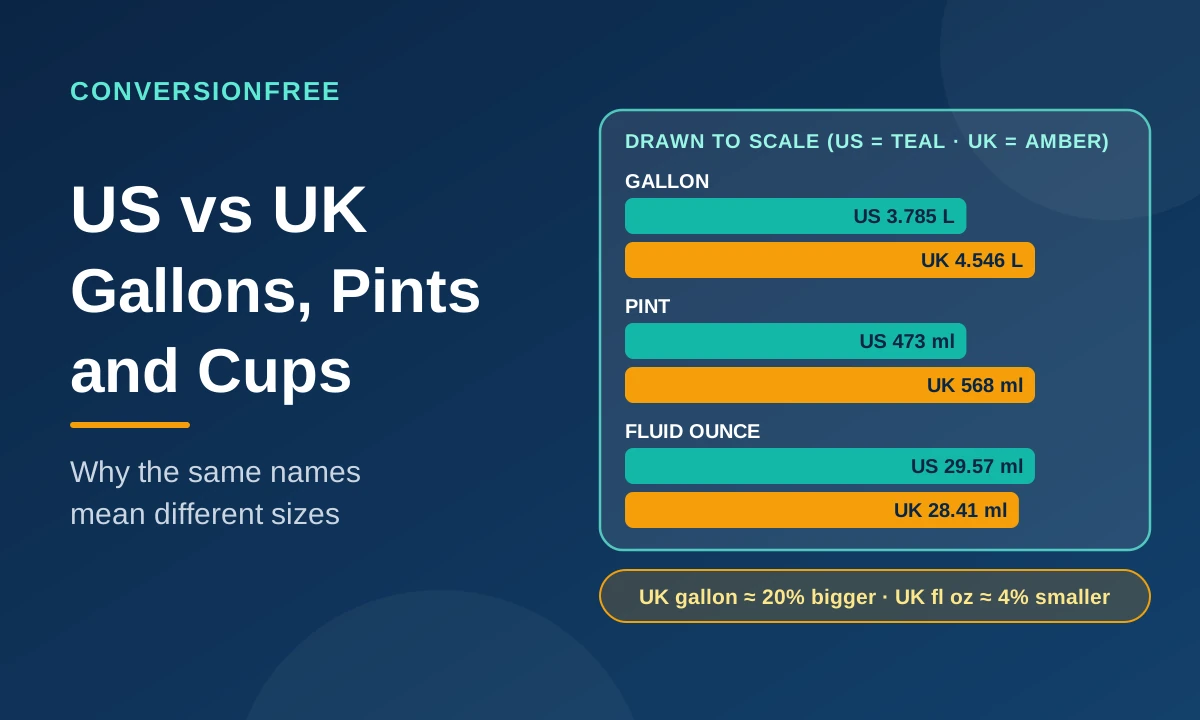
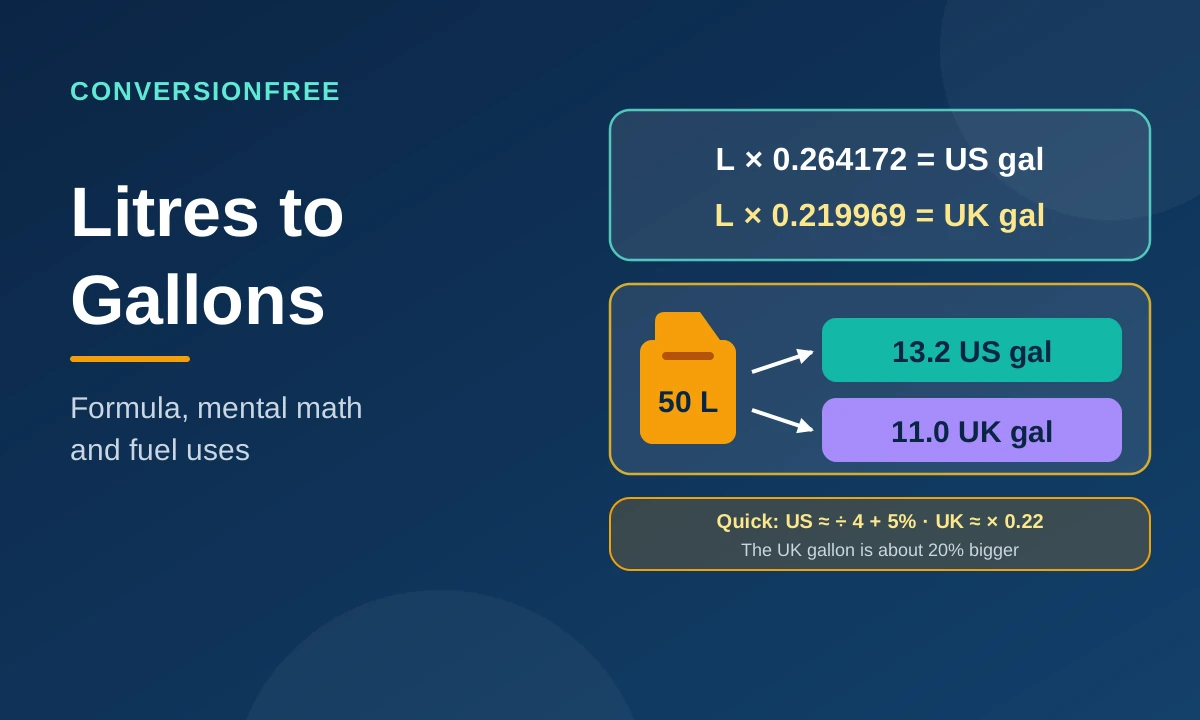
For litres and gallons, see litres to gallons. For why US and UK gallons differ, see US vs UK gallons, pints, cups and fluid ounces.
Why the Conversion Factor Is Cubed
Volume is length × length × length, so the conversion factor is the length factor cubed.
| Quantity | Metres to feet | Factor |
|---|---|---|
| Length | 1 m | 3.28084 |
| Area | 1 m² | 3.28084² = 10.7639 |
| Volume | 1 m³ | 3.28084³ = 35.3147 |
That's why 1 m³ is 35.31 ft³, not 3.28. Using the length factor on a volume would understate it by about 90%. This is the same idea as in how to convert area units, with one more power.
Worked Examples
Example 1: An aquarium
An aquarium measures 90 cm × 45 cm × 45 cm (inside).
Method A: convert to decimetres.
- 9 dm × 4.5 dm × 4.5 dm = 182.25 L
Method B: use cm³.
- 90 × 45 × 45 = 182,250 cm³ ÷ 1,000 = 182.25 L
- In US gallons: 182.25 × 0.264172 = 48.1 US gal
- Filled to 90%: 164 L
- Weight of water: about 182 kg when full (182.25 × 0.998). See litres to kg and ml to grams.
Example 2: A rectangular pool
A pool is 6 m × 3 m, with the shallow end 1.0 m deep and the deep end 1.8 m deep.
- Average depth (for a uniform slope): (1.0 + 1.8) ÷ 2 = 1.4 m
- Volume: 6 × 3 × 1.4 = 25.2 m³
- In litres: 25,200 L
- In US gallons: 25.2 × 264.172 = 6,657 US gal
(The average-depth shortcut works for a floor that slopes evenly. For a pool with a steep drop or a deep-end bowl, split it into sections. Verify the method for your pool shape.)
Example 3: A round pool
Diameter 3 m, depth 1.2 m
- Radius: 1.5 m
- Volume: π × 1.5² × 1.2 = π × 2.25 × 1.2 = 8.48 m³
- In litres: 8,482 L
Example 4: A fuel or water drum
A 200 L drum is full of water.
- Water mass: 200 × 0.998 = 199.6 kg, plus the weight of the drum.
Practical Tips for Measuring a Tank
- Use inside dimensions. Wall thickness reduces capacity.
- Measure at the widest and narrowest points if the sides aren't perfectly straight.
- Don't forget headspace. A tank is rarely filled to the very top, so the usable volume is less than the full capacity.
- Use one unit throughout. Convert all dimensions to metres (or all to centimetres) before multiplying.
- For a horizontal cylinder that isn't full, the formula is more complicated, so use a tank chart or the manufacturer's data.
- Check the manufacturer's stated capacity and compare it with your calculation.
Common Mistakes
- Using the diameter instead of the radius. That makes a cylinder's volume 4 times too big.
- Mixing units (for example centimetres with metres).
- Forgetting to cube the conversion. 1 m³ = 1,000 L, not 100.
- Dividing cm³ by 100 instead of 1,000 to get litres.
- Using outside dimensions for capacity.
- Forgetting π in the cylinder formula.
- Using the area formula for volume (leaving out the height).
- Rounding π too early (use at least 3.1416).
How to Calculate Volume: FAQs
How do I calculate the volume of a box?
Multiply length × width × height, all in the same unit.
How do I calculate the volume of a cylinder?
V = π × r² × h, where r is half the diameter.
How do I convert m³ to litres?
Multiply by 1,000.
How do I convert cm³ to litres?
Divide by 1,000.
How many litres are in a cubic metre?
1,000.
How many litres are in a cubic foot?
28.317.
How do I find the capacity of a tank?
Calculate the volume from its inside dimensions, then convert to litres or gallons.
How many gallons is a 1,000 litre tank?
264.2 US gallons, or 220.0 UK gallons.
What is the volume of a 1 metre cube?
1 m³, which is 1,000 litres.
How do I find the volume if I know the diameter?
Halve the diameter to get the radius, then use V = π × r² × h.
How heavy is a tank of water?
About 1 kg per litre, so a 1,000 L tank holds about 998 kg of water.
How much does a tank hold if it's not full?
Use the depth of the liquid in the formula instead of the full height.
Convert Your Volume in Seconds
Once you've worked out the volume, use the ConversionFree volume converter to switch between m³, litres, gallons and more. To convert your measurements first, use the length converter. You can also browse our unit converters, or visit the ConversionFree for other free tools.