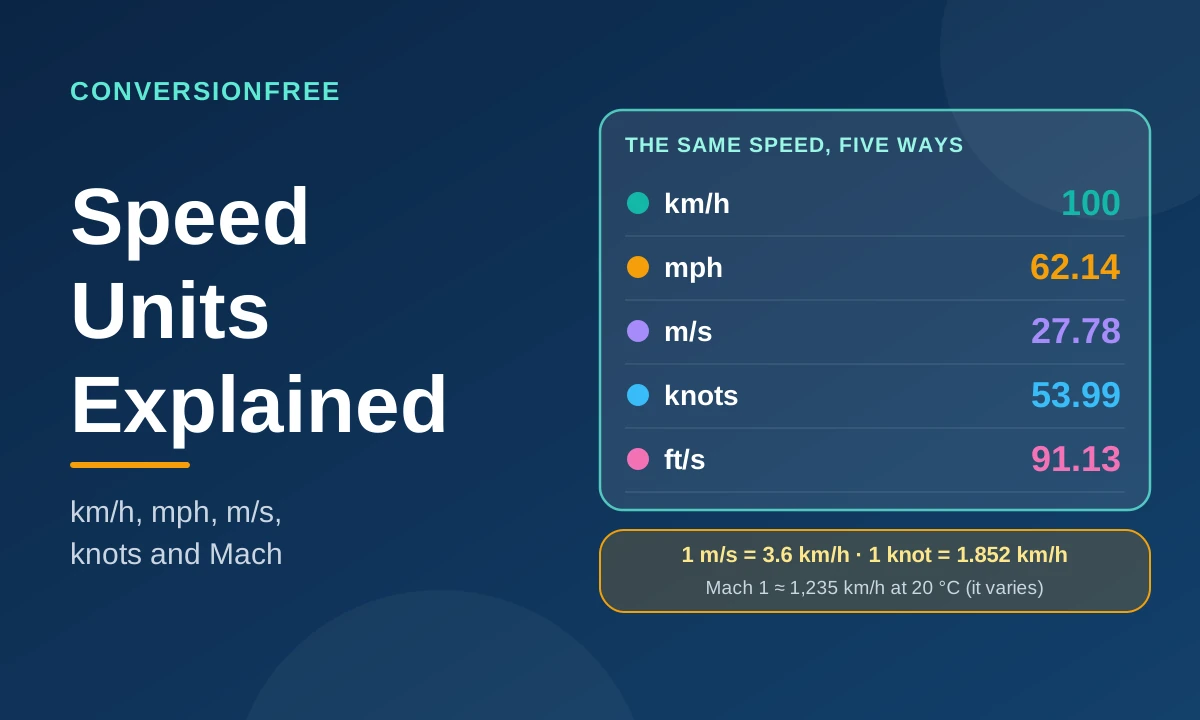
Quick answer: Speed is distance divided by time, so every speed unit is a distance unit over a time unit: kilometres per hour (km/h), miles per hour (mph), metres per second (m/s), knots (nautical miles per hour), feet per second (ft/s). Mach is different: it compares an object's speed with the speed of sound. The key relationships: 1 m/s = 3.6 km/h, 1 mph = 1.609 km/h, and 1 knot = 1.852 km/h.
For an instant conversion, use the speed converter. This guide explains what each unit means, where it's used, and how they all fit together.
Key takeaways
- Speed = distance ÷ time.
- 1 m/s = 3.6 km/h = 2.237 mph = 1.944 knots.
- 1 mph = 1.609344 km/h = 0.44704 m/s (exact).
- 1 knot = 1.852 km/h = 1.151 mph (exact: one nautical mile per hour).
- Mach 1 is the speed of sound, which isn't a fixed number. It's about 343 m/s (1,235 km/h) at 20 °C.
What Is Speed?
Speed tells you how fast something moves: how much distance it covers in a given time.
speed = distance ÷ time
You can rearrange it:
- distance = speed × time
- time = distance ÷ speed
Example: a train covers 120 km at 80 km/h.
- Time = 120 ÷ 80 = 1.5 hours
Speed vs velocity: speed is how fast. Velocity is how fast and in which direction. A car travelling at 60 km/h north has a velocity of 60 km/h north. For everyday conversions, speed is what you need.
Average vs instantaneous speed: your average speed over a trip is total distance ÷ total time. The speedometer shows your instantaneous speed at that moment.
Why Are There So Many Speed Units?
Because each unit grew out of a field with its own distance and time units.
- Roads use a big distance (km or miles) and a big time (hour), so speeds come out as comfortable numbers like 50 or 100.
- Science uses SI base units (metre and second), so speed is in m/s.
- Sea and air use the nautical mile, tied to navigation, so speed is in knots.
- Aircraft at high altitude often compare speed to the speed of sound, so they use Mach.
We cover the length side of these in metric vs imperial length units, and you can convert distances with the length converter.
Speed Units at a Glance
| Unit | Symbol | Meaning | Where it's used | 1 unit in m/s |
|---|---|---|---|---|
| Metres per second | m/s | SI unit of speed | Science, physics, engineering, wind speed | 1 |
| Kilometres per hour | km/h | 1,000 m per hour | Road speed in most countries, general use | 0.27778 |
| Miles per hour | mph | 1 mile per hour | Road speed in the US and UK | 0.44704 |
| Knot | kn (kt) | 1 nautical mile per hour | Shipping, aviation, marine weather | 0.51444 |
| Feet per second | ft/s | 1 foot per second | Some US engineering and ballistics | 0.3048 |
| Mach | Ma | Ratio to the speed of sound | High-speed flight | about 343 at 20 °C |
(Usage varies by country and context. Verify before publishing.)
Metres per Second (m/s)
m/s is the SI unit of speed. One metre per second is the speed that covers 1 metre in 1 second.
It's the standard in physics and engineering, because the metre and the second are SI base units. It's also common in meteorology, where wind speeds are often given in m/s.
Conversions:
- m/s to km/h: multiply by 3.6 (because 1 m/s = 3,600 m per hour = 3.6 km)
- km/h to m/s: divide by 3.6
Example: 25 m/s × 3.6 = 90 km/h
We cover this in more depth in km/h to m/s (planned: /blog/kmh-to-ms/).
Kilometres per Hour (km/h)
km/h is the road-speed unit in most countries. It's a metric unit, based on the kilometre (1,000 m) and the hour.
Examples of what speed limits look like in m/s:
| km/h | m/s | mph |
|---|---|---|
| 30 | 8.33 | 18.6 |
| 50 | 13.89 | 31.1 |
| 100 | 27.78 | 62.1 |
| 120 | 33.33 | 74.6 |
At 100 km/h you cover about 27.8 metres every second.
Miles per Hour (mph)
mph is used on road signs and speedometers in the United States and the United Kingdom.
Exact: 1 mph = 1.609344 km/h = 0.44704 m/s.
| mph | km/h | m/s |
|---|---|---|
| 30 | 48.28 | 13.41 |
| 50 | 80.47 | 22.35 |
| 60 | 96.56 | 26.82 |
| 70 | 112.65 | 31.29 |
For the distance conversion behind this, see kilometres to miles.
Knots (kn)
A knot is one nautical mile per hour. It's used at sea and in the air.
1 knot = 1.852 km/h = 1.15078 mph = 0.51444 m/s
Example: 20 knots = 37.04 km/h = 23.02 mph.
"Knots per hour" is a common mistake. A knot is already a speed. We explain the nautical mile and the knot in nautical mile vs statute mile.
Feet per Second (ft/s)
ft/s appears in some US engineering, construction and ballistics contexts.
1 ft/s = 0.3048 m/s = 1.09728 km/h = 0.68182 mph
A handy fact: 60 mph = 88 ft/s exactly.
Mach: Speed Compared With the Speed of Sound
Mach isn't a distance-over-time unit. It's a ratio: an object's speed divided by the speed of sound in the same air.
- Mach 1 = the speed of sound
- Mach 0.5 = half the speed of sound
- Mach 2 = twice the speed of sound
The catch: Mach 1 isn't a fixed speed. The speed of sound depends on air temperature (and so on altitude). At 20 °C near sea level, it's about:
| Mach 1 at 20 °C | Value |
|---|---|
| m/s | 343 |
| km/h | 1,235 |
| mph | 767 |
| knots | 667 |
At typical airliner cruising altitude, the air is much colder, so the speed of sound is lower, about 295 m/s (1,062 km/h), according to a standard-atmosphere calculation. (Verify before publishing.) That means the same ground speed is a higher Mach number up high.
Mach number = speed ÷ speed of sound
We cover this fully in the speed of sound and Mach number (planned: /blog/speed-of-sound-and-mach-number/).
The Conversion Matrix
Multiply the speed in the row unit by the number to get the column unit.
| From ↓ / To → | m/s | km/h | mph | knots | ft/s |
|---|---|---|---|---|---|
| m/s | 1 | 3.6 | 2.23694 | 1.94384 | 3.28084 |
| km/h | 0.27778 | 1 | 0.62137 | 0.53996 | 0.91134 |
| mph | 0.44704 | 1.60934 | 1 | 0.86898 | 1.46667 |
| knots | 0.51444 | 1.852 | 1.15078 | 1 | 1.68781 |
| ft/s | 0.3048 | 1.09728 | 0.68182 | 0.59248 | 1 |
Worked examples
| Speed | m/s | km/h | mph | knots | ft/s |
|---|---|---|---|---|---|
| 100 km/h | 27.78 | 100 | 62.14 | 53.99 | 91.13 |
| 60 mph | 26.82 | 96.56 | 60 | 52.14 | 88 |
| 20 knots | 10.29 | 37.04 | 23.02 | 20 | 33.76 |
| 10 m/s | 10 | 36 | 22.37 | 19.44 | 32.81 |
| 300 km/h | 83.33 | 300 | 186.41 | 161.99 | 273.40 |
Mental Math Shortcuts
| Conversion | Shortcut | Error |
|---|---|---|
| km/h to mph | × 0.62 | −0.2% |
| km/h to mph | × 0.6 | −3.4% |
| mph to km/h | × 1.6 | −0.6% |
| m/s to km/h | × 3.6 (exact) | 0 |
| m/s to mph | × 2.24 | +0.1% |
| knots to mph | add 15% | −0.07% |
| km/h to knots | × 0.54 | 0.00% |
Using "× 4" for m/s to km/h would be 11% too high, so remember 3.6.
For more on km/h and mph, see kilometres to miles.
How Fast Is Fast? Some Reference Speeds
These are typical approximate values. They vary by person, vehicle and conditions.
| What | km/h | m/s | mph |
|---|---|---|---|
| Walking | about 5 | 1.4 | 3.1 |
| Easy jogging | about 10 | 2.8 | 6.2 |
| City driving | 50 | 13.9 | 31 |
| Motorway driving | 100–120 | 27.8–33.3 | 62–75 |
| High-speed train | 300 | 83.3 | 186 |
| Speed of sound (20 °C) | 1,235 | 343 | 767 |
Beyond the everyday: the speed of light in a vacuum is exactly 299,792,458 m/s (about 1.08 billion km/h). Satellites in low Earth orbit travel at roughly 7.8 km/s (about 28,000 km/h). (Verify these before publishing.)
Which Unit Should You Use?
| Situation | Best unit |
|---|---|
| Driving in most countries | km/h |
| Driving in the US and UK | mph |
| Physics homework and science | m/s |
| Sailing, ships, aviation | knots |
| Supersonic and high-speed flight | Mach |
| Comparing across systems | m/s (the SI unit) |
When in doubt, state the unit, and don't mix them in one calculation.
Common Mistakes
- Mixing up km/h and m/s. The difference is a factor of 3.6.
- Using the km-to-mile ratio for knots. A knot uses nautical miles.
- Saying "knots per hour". A knot is already per hour.
- Treating Mach as a fixed speed. It depends on temperature.
- Mixing units in one formula (for example km with seconds).
- Rounding too early.
- Confusing speed with pace. Pace is time per distance, the inverse of speed.
Speed Units: FAQs
What unit is speed measured in?
The SI unit is metres per second (m/s). Everyday units include km/h and mph.
What is the difference between km/h and mph?
km/h uses kilometres and mph uses miles. 1 mph = 1.609 km/h.
How do I convert m/s to km/h?
Multiply by 3.6.
How do I convert km/h to m/s?
Divide by 3.6.
How do I convert knots to mph?
Multiply by 1.15078, or add about 15%.
Is a knot faster than a mph?
Yes, slightly. 1 knot = 1.151 mph.
What is 100 km/h in m/s?
27.78 m/s.
What is 60 mph in km/h?
96.56 km/h.
What is Mach 1 in km/h?
About 1,235 km/h at 20 °C, but it varies with temperature.
Is Mach a unit of speed?
It's a ratio of an object's speed to the speed of sound, so it's a dimensionless number.
What is the fastest speed possible?
The speed of light in a vacuum, 299,792,458 m/s.
What is the difference between speed and velocity?
Velocity includes direction. Speed doesn't.
Convert Any Speed in Seconds
To switch between m/s, km/h, mph, knots and ft/s, use the ConversionFree speed converter. You can also browse our unit conversion tools, or visit the ConversionFree for other free tools.