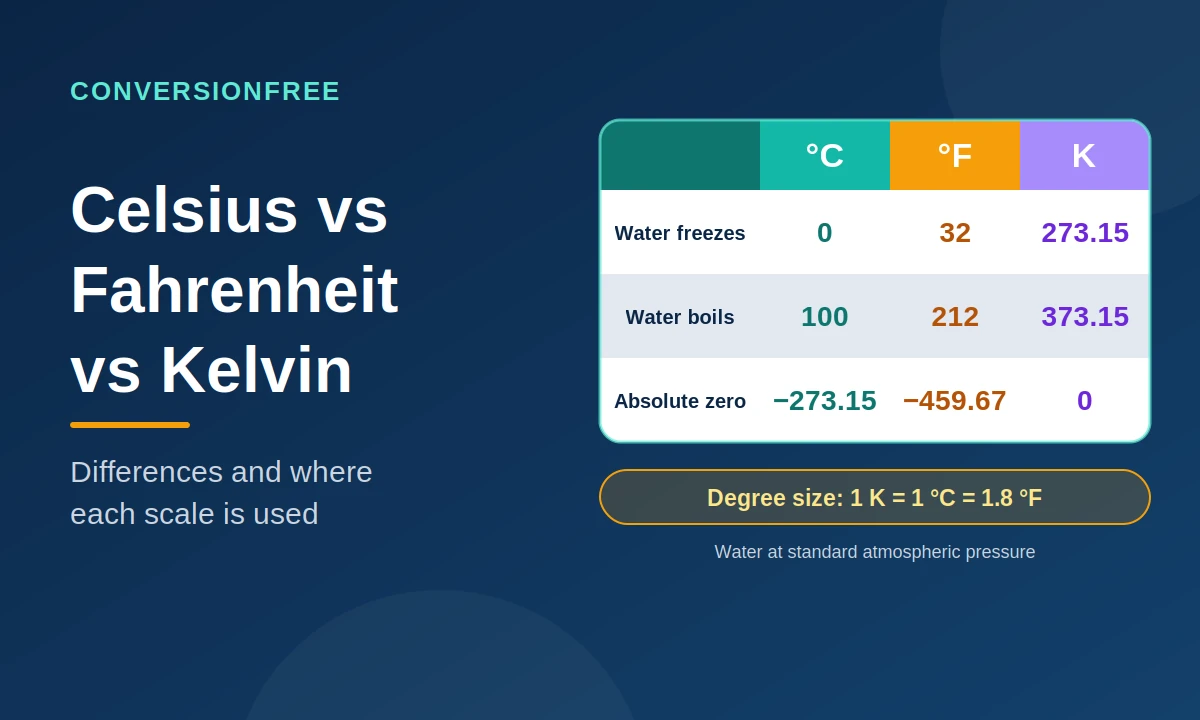
Quick answer: Celsius, Fahrenheit and Kelvin are three ways to measure temperature. On the Celsius scale, water freezes at 0 °C and boils at 100 °C. On the Fahrenheit scale, water freezes at 32 °F and boils at 212 °F. The Kelvin scale starts at absolute zero, so water freezes at 273.15 K and boils at 373.15 K. Celsius is used in daily life in most countries, Fahrenheit in the United States, and Kelvin in science.
To switch between them, use the temperature converter. This guide explains why three scales exist and how to choose the right one.
Key takeaways
- Celsius: 0 °C = water freezes, 100 °C = water boils (at standard pressure).
- Fahrenheit: 32 °F = water freezes, 212 °F = water boils.
- Kelvin: 0 K = absolute zero, the lowest possible temperature. No degree sign.
- A change of 1 K equals a change of 1 °C, and equals a change of 1.8 °F.
- The three scales agree on nothing at one point only: −40 is the same in °C and °F.
Why Are There Three Temperature Scales?
They solve different problems.
- Fahrenheit was one of the first widely used practical thermometer scales, from the early 1700s.
- Celsius came a little later and used a simple 0-to-100 span for water, which made it easy to use with a decimal system.
- Kelvin was built for science. It starts at the lowest temperature that can exist, so it never goes negative, which makes physics and chemistry equations simpler.
Each scale kept its place, which is why you still need to convert between them.
What Is the Celsius Scale?
Celsius (°C) sets water’s freezing point at 0 °C and its boiling point at 100 °C, at standard atmospheric pressure. That’s 100 equal steps between the two points.
The scale is named after the Swedish astronomer Anders Celsius, and was known as “centigrade” until 1948. Today it is defined using the Kelvin scale: °C = K − 273.15.
Where it’s used: daily weather, cooking, and body temperature in most countries, and in much science and engineering.
What Is the Fahrenheit Scale?
Fahrenheit (°F) sets water’s freezing point at 32 °F and its boiling point at 212 °F. That’s 180 steps between the two points, so one Fahrenheit degree is smaller than one Celsius degree.
The scale was proposed in 1724 by the physicist Daniel Gabriel Fahrenheit. It’s now formally defined using the Kelvin scale. aceec
Where it’s used: mainly the United States, for weather, cooking and medicine. Fahrenheit is officially used in the US and its territories, the Pacific states of Palau, Micronesia and the Marshall Islands, and the Cayman Islands. Lists vary by source, and some countries use both scales, so check if you need exact detail for a specific place. wikipedia
What Is the Kelvin Scale?
Kelvin (K) is the SI base unit of temperature. It starts at absolute zero, the lowest temperature possible, where particles have the minimum thermal motion.
- 0 K = absolute zero = −273.15 °C = −459.67 °F
- Kelvin is written without a degree sign: 300 K, not 300 °K.
- A step of 1 K is the same size as a step of 1 °C. Only the starting point differs.
The scale is named after Lord Kelvin. Since 2019, the kelvin is defined by fixing the value of the Boltzmann constant (1.380649 × 10⁻²³ joules per kelvin), rather than by water. (Verify the SI definition before publishing.)
Where it’s used: physics, chemistry and engineering. You’ll also see it in everyday life in colour temperature. Light bulbs and screens are rated in kelvins, where lower values are warmer, yellower light and higher values are cooler, bluer light.
Celsius vs Fahrenheit vs Kelvin at a Glance
| Feature | Celsius (°C) | Fahrenheit (°F) | Kelvin (K) |
|---|---|---|---|
| Water freezes | 0 | 32 | 273.15 |
| Water boils | 100 | 212 | 373.15 |
| Absolute zero | −273.15 | −459.67 | 0 |
| Steps between freezing and boiling | 100 | 180 | 100 |
| Size of one step | 1 | 5/9 of a °C | same as °C |
| Can be negative? | Yes | Yes | No |
| Degree sign? | Yes (°C) | Yes (°F) | No (K) |
| Typical use | Weather and daily life in most countries, science | Weather and daily life in the US | Science and engineering |
(Water points assume standard atmospheric pressure.)
Everyday Temperatures in Each Scale
| What | °C | °F | K |
|---|---|---|---|
| Water freezes | 0 | 32 | 273.15 |
| A cool day | 10 | 50 | 283.15 |
| Room temperature | 20 | 68 | 293.15 |
| A warm day | 30 | 86 | 303.15 |
| Normal body temperature | 37 | 98.6 | 310.15 |
| Water boils | 100 | 212 | 373.15 |
Extreme examples: liquid nitrogen boils at about −196 °C (77 K, about −320 °F). The Sun’s surface is about 5,800 K (about 5,500 °C, about 9,900 °F). Absolute zero is 0 K.
How Do the Scales Convert?
| From | To | Formula |
|---|---|---|
| °C | °F | °F = °C × 1.8 + 32 |
| °F | °C | °C = (°F − 32) ÷ 1.8 |
| °C | K | K = °C + 273.15 |
| K | °C | °C = K − 273.15 |
| °F | K | K = (°F − 32) ÷ 1.8 + 273.15 |
| K | °F | °F = (K − 273.15) × 1.8 + 32 |
Kelvin and Celsius differ only by an offset. Fahrenheit differs by both an offset and a scale factor, which is why °C to °F needs the “+32”. We walk through this in how to convert Celsius to Fahrenheit (planned).
Example: 25 °C
- °F: 25 × 1.8 + 32 = 77 °F
- K: 25 + 273.15 = 298.15 K
The crossover: −40 °C equals −40 °F. It’s the only point where the two scales give the same number.
A Change in Temperature Isn’t the Same as a Reading
The formulas above convert a reading. A change converts differently:
- A rise of 10 °C is a rise of 18 °F and 10 K. There is no “+32” for a change.
This distinction trips people up, especially in science and cooking, and we cover it in temperature change vs temperature reading (planned).
What About the Rankine Scale?
Rankine (°R) is a less common scale that uses Fahrenheit-sized steps but starts at absolute zero, so °R = °F + 459.67. It appears in some engineering fields, mostly in the United States. It is to Fahrenheit what Kelvin is to Celsius.
Which Scale Should You Use?
| Situation | Scale |
|---|---|
| Daily weather in most countries | Celsius |
| Daily weather in the United States | Fahrenheit |
| Scientific papers, lab work and engineering | Kelvin, or Celsius |
| Gas laws, thermodynamics | Kelvin (must be absolute) |
| Oven recipes | Whatever the recipe uses: see our oven temperature chart (planned) |
| Lighting and displays | Kelvin (colour temperature) |
| Travel | Know both |
When in doubt, state the unit, and don’t mix symbols.
Common Mistakes with Temperature Scales
- Writing “degrees Kelvin” or “°K”. The correct form is “kelvin” and “K”.
- Using Celsius in gas-law calculations. They need Kelvin.
- Adding 32 to a temperature change. Only readings need the offset.
- Mixing up which is larger. One °C step is bigger than one °F step.
- Forgetting standard pressure. The boiling point of water depends on pressure, so 100 °C applies at sea level.
- Assuming 0 means “no temperature”. 0 °C and 0 °F are just reference points. Only 0 K is the absence of thermal motion.
Celsius vs Fahrenheit vs Kelvin: FAQs
What is the main difference between Celsius and Fahrenheit?
The size and starting point of their steps. Celsius has 100 steps between water’s freezing and boiling points, and Fahrenheit has 180.
Is Kelvin the same as Celsius?
They have the same step size, but Kelvin starts at absolute zero. K = °C + 273.15.
Which countries use Fahrenheit?
The United States and its territories, plus a few others, including the Cayman Islands, Palau, Micronesia and the Marshall Islands. The exact list varies by source.
Why does the US use Fahrenheit?
Fahrenheit was widely used in Britain and its colonies before most countries switched to metric units. The US kept it for daily use.
What is absolute zero in Celsius and Fahrenheit?
−273.15 °C and −459.67 °F.
At what temperature are Celsius and Fahrenheit equal?
−40.
Is it “degrees Kelvin”?
No. The unit is “kelvin” (K), with no degree sign.
Which scale is best for science?
Kelvin, because it starts at absolute zero. Celsius is also common in laboratories.
How do I convert Celsius to Fahrenheit?
Multiply by 1.8 and add 32.
Which scale has bigger degrees?
Celsius. One °C is 1.8 times a °F.
Convert Between the Scales in Seconds
Now you know how the three scales fit together. To switch between them instantly, use the ConversionFree temperature converter. You can also browse our unit converters, or visit the ConversionFree for other free tools.