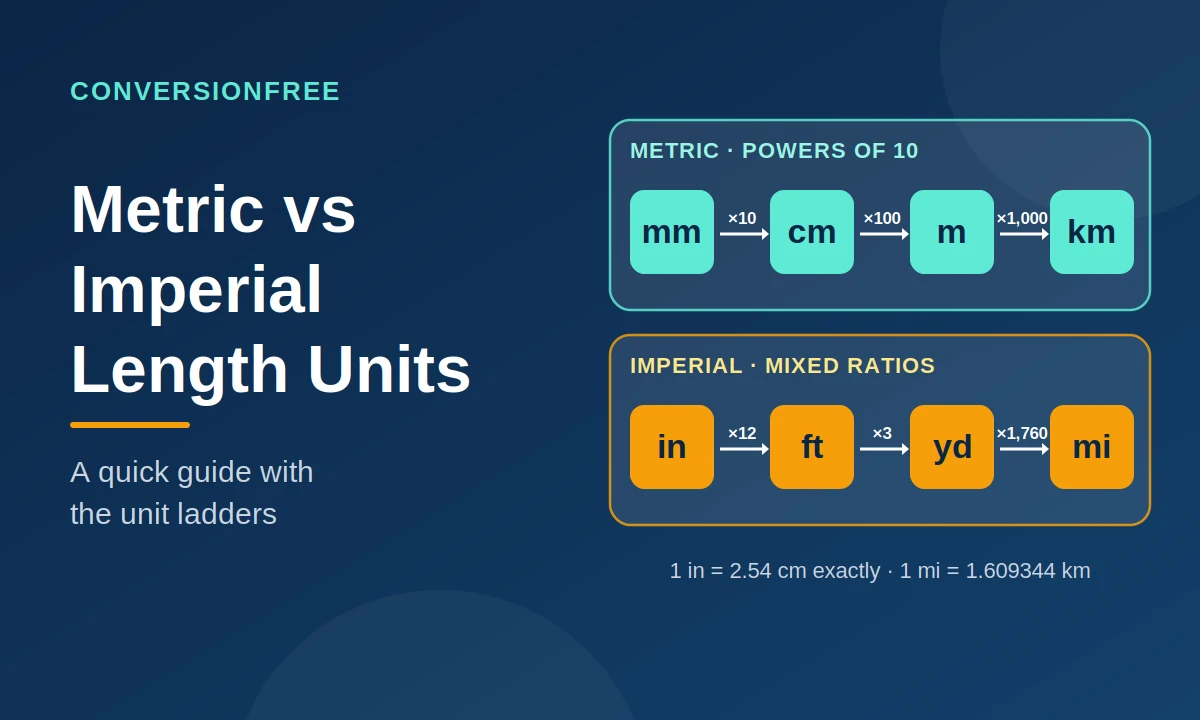
Quick answer: Metric length units (millimetre, centimetre, metre, kilometre) scale by powers of 10, so every step is ×10, ×100 or ×1,000. Imperial length units (inch, foot, yard, mile) scale by older, mixed ratios: 12 inches in a foot, 3 feet in a yard, 1,760 yards in a mile. The two systems are linked by one exact value: 1 inch = 2.54 centimetres.
Use the length converter when you want a number. Use this guide when you want to understand how the units fit together.
Key takeaways
- Metric = decimal ladder (×10, ×100, ×1,000). Imperial = mixed ladder (×12, ×3, ×1,760).
- Exact links: 1 in = 25.4 mm, 1 ft = 0.3048 m, 1 yd = 0.9144 m, 1 mi = 1,609.344 m.
- A metre is a little longer than a yard (1 m ≈ 1.094 yd).
- Area units follow the same ladders, but squared.
- For other measurements, the split between systems is much the same. See kilograms vs pounds for mass.
What Is the Difference Between Metric and Imperial Length?
The difference is how the units relate to each other.
- Metric units are built on one base unit, the metre, with prefixes that mean the same thing everywhere: milli (1/1,000), centi (1/100) and kilo (1,000).
- Imperial units grew out of older measures, so each step has its own ratio.
Both describe the same thing: distance along a line. What changes is how many steps it takes to move from small to large, and how easy the arithmetic is.
For the bigger picture, including history and which countries use which, see our guide to metric vs imperial systems.
The Metric Length Ladder
| Unit | Symbol | In metres | Steps |
|---|---|---|---|
| Millimetre | mm | 0.001 m | 10 mm = 1 cm |
| Centimetre | cm | 0.01 m | 100 cm = 1 m |
| Metre | m | 1 m | 1,000 m = 1 km |
| Kilometre | km | 1,000 m |
Everything moves by shifting the decimal point. 2.5 m is 250 cm is 2,500 mm. There’s nothing to memorise beyond the prefixes.
The Imperial Length Ladder
| Unit | Symbol | Steps |
|---|---|---|
| Inch | in | 12 in = 1 ft |
| Foot | ft | 3 ft = 1 yd |
| Yard | yd | 1,760 yd = 1 mi |
| Mile | mi | 5,280 ft = 1 mi |
So a mile is 1,760 yards, 5,280 feet or 63,360 inches. The numbers work, but you have to remember them. That’s the main practical difference.
Metric vs Imperial Length at a Glance
| Feature | Metric | Imperial |
|---|---|---|
| Common units | mm, cm, m, km | in, ft, yd, mi |
| Scaling | Powers of 10 | 12, 3, 1,760 |
| Base unit | Metre | Often the inch or foot, now defined from the metre |
| Small-to-large steps | Move the decimal | Multiply or divide by irregular numbers |
| Typical users | Most countries; science everywhere | United States for daily use; UK in a mix |
(Verify the “typical users” row against current sources before publishing. Usage is mixed in several countries.)
The Exact Link Between the Two Systems
The two ladders meet at one exact definition, set by an international agreement in 1959: 1 yard = 0.9144 metres. Everything else follows from the imperial ratios.
| Imperial unit | Exact metric value |
|---|---|
| 1 inch | 25.4 mm (2.54 cm) |
| 1 foot | 0.3048 m (30.48 cm) |
| 1 yard | 0.9144 m |
| 1 mile | 1,609.344 m (1.609344 km) |
This means imperial units are no longer independent. They’re defined from the metre, so converting between them involves no rounding unless you choose to round.
Metric to Imperial: A Quick Conversion Chart
| Metric | In inches | In feet | In yards | In miles |
|---|---|---|---|---|
| 1 mm | 0.03937 | |||
| 1 cm | 0.3937 | 0.0328 | ||
| 1 m | 39.37 | 3.2808 | 1.0936 | |
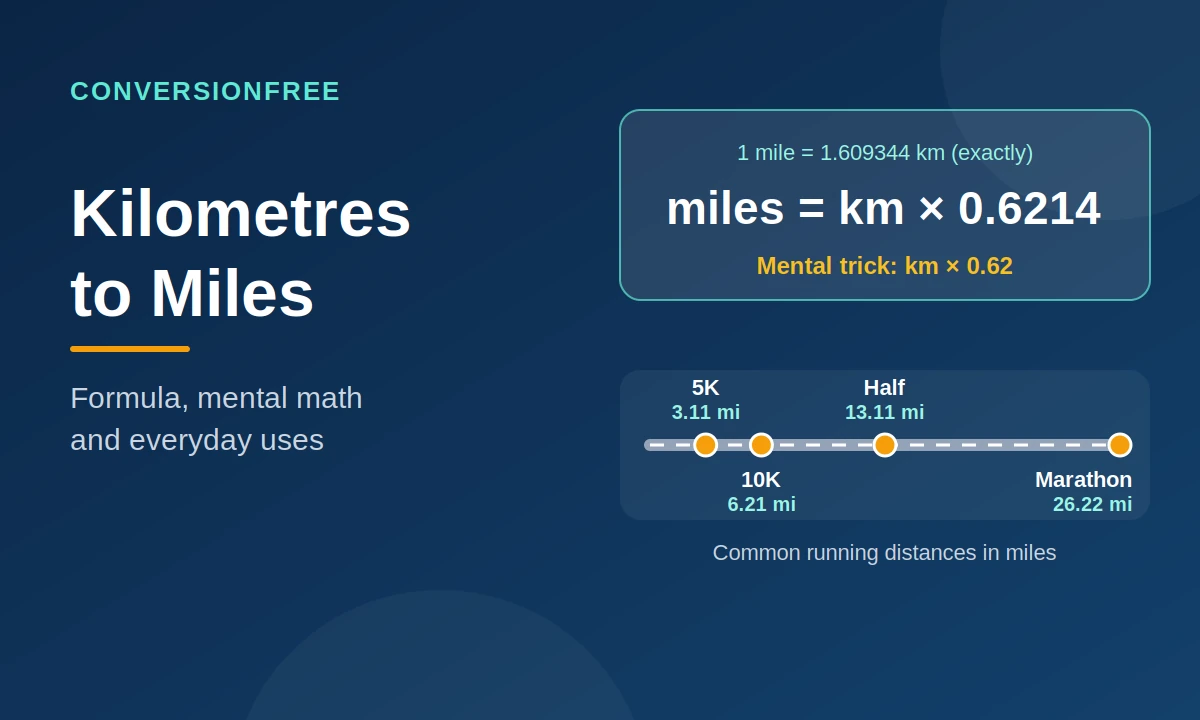
| 1 km | 39,370 | 3,280.84 | 1,093.61 | 0.6214 |
And the other direction:
| Imperial | In mm | In cm | In m | In km |
|---|---|---|---|---|
| 1 in | 25.4 | 2.54 | ||
| 1 ft | 304.8 | 30.48 | 0.3048 | |
| 1 yd | 914.4 | 91.44 | 0.9144 | |
| 1 mi | 1,609.344 | 1.609344 |
For a full, interactive length conversion chart that covers more units, use the converter. For worked methods, see how to convert cm to feet and inches and kilometres to miles.
Everyday Benchmarks: What Do These Units Look Like?
Numbers are easier to remember when you attach them to something familiar.
| Object | Metric | Imperial |
|---|---|---|
| A credit card’s width | 85.6 mm | about 3.37 in |
| A sheet of A4 paper | 297 × 210 mm | about 11.7 × 8.3 in |
| A US Letter sheet | 279.4 × 215.9 mm | 11 × 8.5 in |
| A running track lap | 400 m | about 437 yd |
| Distance between goal lines in American football | 91.44 m | 100 yd |
A handy benchmark: four laps of a 400 m track is 1,600 m, which is about 9 m short of a mile (1,609.344 m).
Other Imperial Length Units
Beyond inches, feet, yards and miles, you’ll meet a few other units in specialised settings.
| Unit | Equals | In metric |
|---|---|---|
| Hand (horse height) | 4 in | 101.6 mm |
| Fathom (water depth) | 6 ft | 1.8288 m |
| Chain | 22 yd | 20.1168 m |
| Furlong | 220 yd | 201.168 m |
| League | 3 mi | 4.828 km |
Another case is the nautical mile, used at sea and in the air. It’s a different unit from the mile in the table above, and we explain it in nautical mile vs statute mile.
Area Follows the Same Ladders, Squared
A square unit is a length unit multiplied by itself, so the ratios are squared too.
| Linear ladder | Area ladder |
|---|---|
| 100 cm = 1 m | 10,000 cm² = 1 m² |
| 12 in = 1 ft | 144 in² = 1 ft² |
| 3 ft = 1 yd | 9 ft² = 1 yd² |
That’s why you can’t use a length factor on an area directly. 1 m is about 3.28 ft, but 1 m² is about 10.76 ft². Our guide to converting area units covers this in detail.
Why Do Both Systems Still Exist?
Imperial units grew from older measures and were standardised in the 19th century in Britain. The metric system came out of France in the 1790s and spread widely. Many countries adopted it fully. The United States kept customary units for daily life, and the United Kingdom uses a mix, with miles on road signs.
Changing a measurement system affects signs, tools, packaging, building standards and habit, which is why both are still around. That’s the reason people regularly need to convert between them. (Verify historical dates before publishing.)
Common Mistakes with Length Units
- Using a length factor for area. Square the factor.
- Confusing the statute mile and the nautical mile. They differ by about 15%.
- Assuming 1 m = 1 yd. A metre is about 9.4% longer.
- Mixing mm and cm. There are 10 mm in a cm, not 100.
- Forgetting 5,280. A mile is 5,280 feet, not 5,000.
- Rounding too early in a multi-step conversion.
Metric vs Imperial Length: FAQs
Which is bigger, a metre or a yard?
A metre. 1 m = 1.0936 yd, and 1 yd = 0.9144 m.
How many inches are in a foot?
How many feet are in a mile?
5,280.
How many yards are in a mile?
1,760.
How many centimetres are in an inch?
2.54, exactly.
Is the imperial mile the same as the US mile?
For everyday use, yes. Both are 1,609.344 m. A few specialised surveying uses differ slightly, and that older “survey” version is being phased out. (Verify before publishing.)
Why is metric easier for calculations?
Because every step is a power of 10, you shift a decimal point instead of multiplying by 12, 3 or 1,760.
Which countries use imperial units?
The United States for most daily use, and the United Kingdom in some contexts such as road distances. Most other countries use metric.
Convert Between Metric and Imperial in Seconds
Now you know how the two ladders line up. To convert any value, use the ConversionFree length converter. You can also browse our unit converters, or visit the ConversionFree for other free tools.