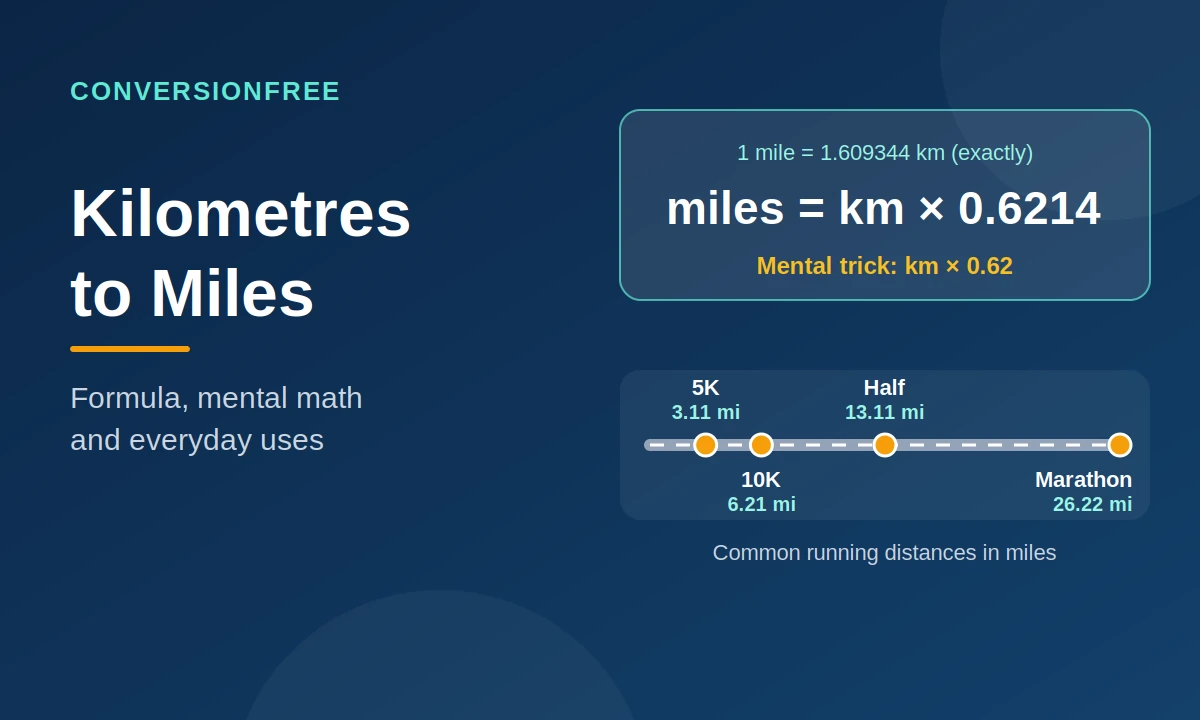
To convert kilometres to miles, multiply by 0.621371. For a quick mental estimate, multiply by 0.62. To go the other way, multiply miles by 1.609344, or by 1.6 for a rough answer. For example, 10 km = 6.21 miles, and a marathon of 42.195 km = 26.22 miles.
If you just need a number, a length converter will do the conversion instantly. This guide is for when you want to do it in your head, check an answer, or understand the distances you see on road signs and running apps.
Key takeaways
- 1 mile = 1.609344 km exactly. 1 km = 0.621371 miles.
- Mental trick: km × 0.62 (error about 0.2%). The popular “× 0.6” is off by about 3.4%.
- Miles to km: multiply by 1.6 (about 0.6% low).
- 5K = 3.11 mi, 10K = 6.21 mi, half marathon = 13.11 mi, marathon = 26.22 mi.
- The same factor converts speeds: 100 km/h = 62.1 mph.
The Formula: Kilometres to Miles
miles = kilometres × 0.621371
Or, equivalently, miles = kilometres ÷ 1.609344
The number 1.609344 is exact. The international mile is defined as 1,760 yards, and the international yard is defined as exactly 0.9144 metres, so 1,760 × 0.9144 = 1,609.344 metres.
Worked examples
| Kilometres | Calculation | Miles |
|---|---|---|
| 1 km | 1 × 0.621371 | 0.62 |
| 5 km | 5 × 0.621371 | 3.11 |
| 10 km | 10 × 0.621371 | 6.21 |
| 42.195 km | 42.195 × 0.621371 | 26.22 |
| 100 km | 100 × 0.621371 | 62.14 |
The Formula: Miles to Kilometres
kilometres = miles × 1.609344
| Miles | Calculation | Kilometres |
|---|---|---|
| 1 mi | 1 × 1.609344 | 1.61 |
| 5 mi | 5 × 1.609344 | 8.05 |
| 10 mi | 10 × 1.609344 | 16.09 |
| 26.2 mi | 26.2 × 1.609344 | 42.16 |
| 100 mi | 100 × 1.609344 | 160.93 |
Both directions use the same relationship. If you only remember one number, remember 1.6: it’s close enough for most everyday use.
Mental Math: How to Convert km to Miles in Your Head
You don’t always need a calculator. These methods trade a little accuracy for speed.
| Method | How | 42.195 km | Error |
|---|---|---|---|
| × 0.6 | multiply by 6, move the decimal | 25.3 mi | −3.4% |
| × 0.62 | multiply by 6, add 2% | 26.2 mi | −0.2% |
| ÷ 1.6 | divide by 1.6 | 26.4 mi | +0.6% |
| Exact | × 0.621371 | 26.22 mi | 0 |
Method 1: × 0.62 (best balance)
Multiply by 6, shift the decimal one place, then add about 2%.
Example: 50 km
- 50 × 0.6 = 30
- Add 2% of 50 (about 1) → 31 miles (exact: 31.07)
Method 2: Divide by 1.6
Halve the number, then adjust. Easier: multiply by 5, divide by 8.
Example: 80 km
- 80 × 5 = 400, ÷ 8 = 50 miles (exact: 49.7)
Method 3: The Fibonacci shortcut
Consecutive Fibonacci numbers (5, 8, 13, 21, 34, 55) have a ratio close to 1.6, which is close to the km-per-mile ratio. That means:
| Miles | ≈ Kilometres | Exact km | Error |
|---|---|---|---|
| 5 | 8 | 8.05 | −0.6% |
| 8 | 13 | 12.87 | +1.0% |
| 13 | 21 | 20.92 | +0.4% |
| 21 | 34 | 33.80 | +0.6% |
| 34 | 55 | 54.72 | +0.5% |
It only works for those specific numbers, but it’s a fun check: 13 miles is about 21 km, and 21 km is about 13 miles.
Which method to use?
- Road trip estimate: × 0.6 is fine, but know it understates by about 3%.
- Training plans or race times: use × 0.62 or the exact value.
- Anything official: use a conversion calculator for length, or the exact factor.
Running Distances in Kilometres and Miles
| Race | Kilometres | Miles |
|---|---|---|
| 5K | 5 | 3.11 |
| 10K | 10 | 6.21 |
| Half marathon | 21.0975 | 13.11 |
| Marathon | 42.195 | 26.22 |
| 50K ultra | 50 | 31.07 |
| 100K ultra | 100 | 62.14 |
The half marathon is 21.0975 km, which is 13.109 miles. People round it to 13.1 miles.
Converting running pace
Runners often need pace per mile instead of per kilometre, or the other way around.
per mile = per km × 1.609344
| Pace per km | Pace per mile |
|---|---|
| 4:30 | 7:14 |
| 5:00 | 8:03 |
| 5:30 | 8:51 |
| 6:00 | 9:39 |
| 6:30 | 10:28 |
And the other direction:
| Pace per mile | Pace per km |
|---|---|
| 7:00 | 4:21 |
| 8:00 | 4:58 |
| 9:00 | 5:36 |
| 10:00 | 6:13 |
Example: to finish a marathon in 4 hours, you need about 5:41 per km, or 9:09 per mile.
Kilometres and Miles on the Road
Road signs and speed limits use kilometres in most countries. The United Kingdom and the United States are the best-known places that use miles and mph on road signs.
Speed limits: km/h to mph
| km/h | mph |
|---|---|
| 30 | 18.6 |
| 50 | 31.1 |
| 80 | 49.7 |
| 100 | 62.1 |
| 120 | 74.6 |
| 130 | 80.8 |
mph to km/h
| mph | km/h |
|---|---|
| 30 | 48.3 |
| 50 | 80.5 |
| 60 | 96.6 |
| 70 | 112.7 |
The conversion factor is the same for speeds. For other speed units such as knots or metres per second, use the speed converter.
Driving abroad: fuel economy changes with the units too. Miles per gallon and litres per 100 km aren’t a simple multiplier, so use the fuel economy converter.
Why Do Some Countries Use Miles and Others Kilometres?
Most of the world adopted the metric system, where the kilometre is a thousand metres. The mile has older roots. The word comes from the Roman mille passus, “a thousand paces”, and it was later fixed at 5,280 feet in England.
The United States and the United Kingdom kept miles for road distances even as other measurements changed. Today, most countries use kilometres on signs, while a few keep miles. That’s why people who travel, study abroad or follow international sport often need to convert between them.
Today’s exact link between them was set by the 1959 international agreement on the yard and pound. Since then, the mile has been defined exactly in terms of the metre, so the factor 1.609344 involves no rounding.
Common Mistakes When Converting km to Miles
- Multiplying instead of dividing, or the other way round. Miles are longer than kilometres, so the mile number must be smaller.
- Using 0.6 for everything. It understates by about 3.4%, which is about 0.9 miles over a marathon.
- Mixing miles and nautical miles. A nautical mile is 1.852 km, not 1.609 km.
- Rounding the half marathon. It’s 21.0975 km, not 21 km.
- Forgetting that pace and speed convert the same way. But time per distance goes the opposite direction (a faster pace per km is a bigger number per mile).
- Mixing up the formula and its inverse. If your answer looks too big, you’ve likely flipped it.
Where Else Do You Need Length Conversions?
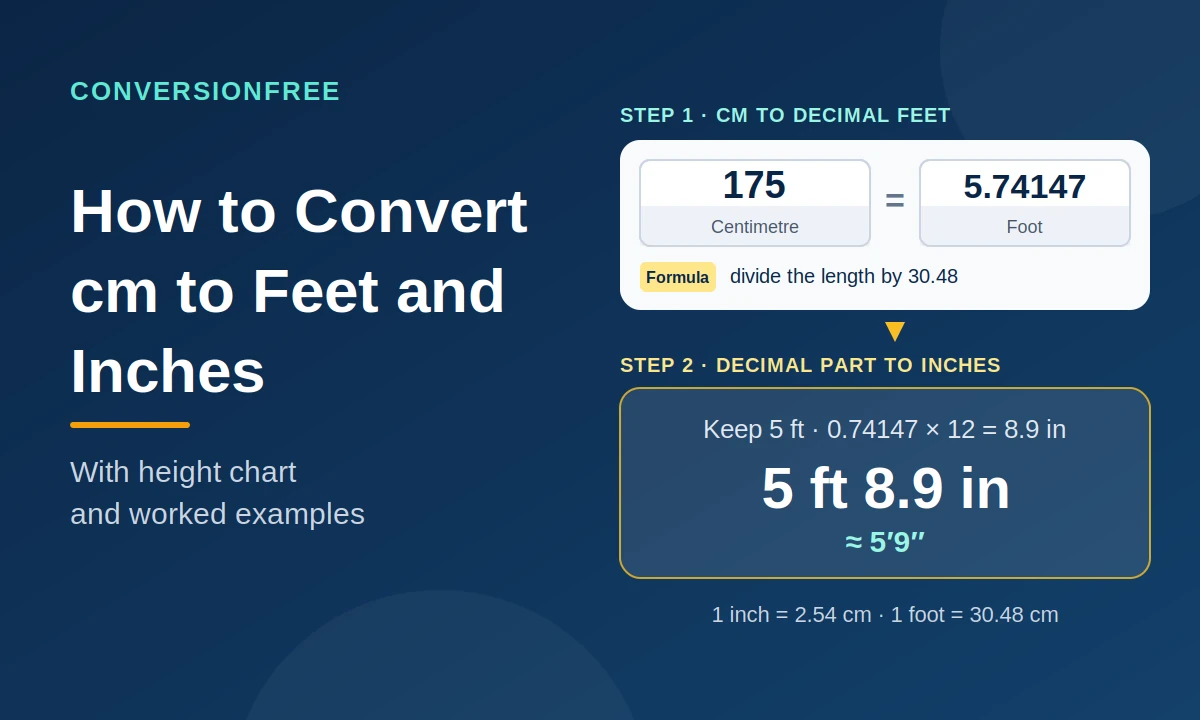
Distance is just one kind of conversion of length units. For smaller lengths, such as height, see our guide on converting cm to feet and inches. That’s also the place to look if you’re searching for centimeters to foot size in feet and inches. If you mean shoe size, use the shoe size converter.
For a bigger set of units, including millimetres, yards and nautical miles, the length converter covers them all, and its reference table works as a quick length conversion chart.
Kilometres to Miles: FAQs
How many miles is 1 km?
1 kilometre is 0.621371 miles, usually rounded to 0.62.
How many km is 1 mile?
1 mile is exactly 1.609344 km, usually rounded to 1.61.
How many miles is a 5K?
A 5K is 3.11 miles.
How many miles is a 10K?
A 10K is 6.21 miles.
How many miles is a marathon?
42.195 km is 26.22 miles, usually called 26.2.
How many miles is a half marathon?
21.0975 km is 13.11 miles, usually called 13.1.
What is the easiest way to convert km to miles?
Multiply by 0.62, or multiply by 6, move the decimal and add 2%.
Is it okay to just multiply by 0.6?
For rough road-trip estimates, yes, but it’s about 3.4% low. Use 0.62 for training or races.
How do I convert miles to km in my head?
Multiply by 1.6, which is the same as adding 60%. For 10 miles: 10 + 6 = 16 km (exact: 16.09).
Is a mile the same everywhere?
The international mile is. A nautical mile is different (1.852 km).
How do I convert km/h to mph?
Use the same factor: multiply km/h by 0.621371. 100 km/h = 62.1 mph.
Convert Any Distance in Seconds
Mental math is great for estimates. For exact results, use the free ConversionFree online length converter to convert between kilometres, miles, and many other units. You can also browse our online unit converters, or visit the ConversionFree for other free tools.