Kilograms and pounds both measure mass, but they come from two different measurement traditions. The kilogram (kg) is the base unit of mass in the metric system, formally called the International System of Units (SI). The pound (lb) belongs to the US customary and imperial systems. Because both are common in daily life, from grocery labels to airline baggage limits, many people need to move between them. Knowing how the units differ makes those conversions much easier to understand.
This guide explains what each unit is, where it came from, where it is used today, and how mass differs from weight.
What Is a Kilogram?
A kilogram is the SI base unit of mass. Its symbol is kg. One kilogram equals 1,000 grams, and the gram (g) is the smaller metric unit used for items like spices, medicine doses and food ingredients.
Since 2019, the kilogram has been defined using a fixed value of the Planck constant, a fundamental constant of physics, rather than a physical object. Before that, it was defined by a metal cylinder kept in France. For everyday purposes, you can think of a kilogram as roughly the mass of one liter of water.
Common uses include:
- body mass on medical records and scales in most countries
- groceries, such as rice, flour and fruit
- shipping, freight and baggage limits
- science, engineering and manufacturing
What Is a Pound?
A pound is a unit of mass used in the US customary and imperial systems. Its symbol is lb, which comes from libra, a Roman unit of weight. The "lb" abbreviation is a historical leftover, which is why it doesn't look like the word "pound."
The pound used in everyday measurement is the international avoirdupois pound. Avoirdupois is the traditional system used for ordinary goods, as opposed to precious metals. One pound equals 16 ounces (oz), and the ounce is the smaller unit used for items like food portions and postal weights.
Since 1959, the pound has been defined exactly in terms of the kilogram: 1 lb = 0.45359237 kg. That means the pound is not a separate standard anymore. It is an older unit tied to the metric one.
Kilogram vs Pound: Key Differences
Attribute | Kilogram | Pound |
| Symbol | kg | lb |
| Measurement system | SI / metric | US customary / imperial |
| Type | SI base unit of mass | Common unit of mass |
| Smaller related unit | Gram (1 kg = 1,000 g) | Ounce (1 lb = 16 oz) |
| Common usage | Most countries | United States, plus some everyday uses elsewhere |
| Conversion relationship | 1 kg ≈ 2.20462 lb | 1 lb ≈ 0.453592 kg |
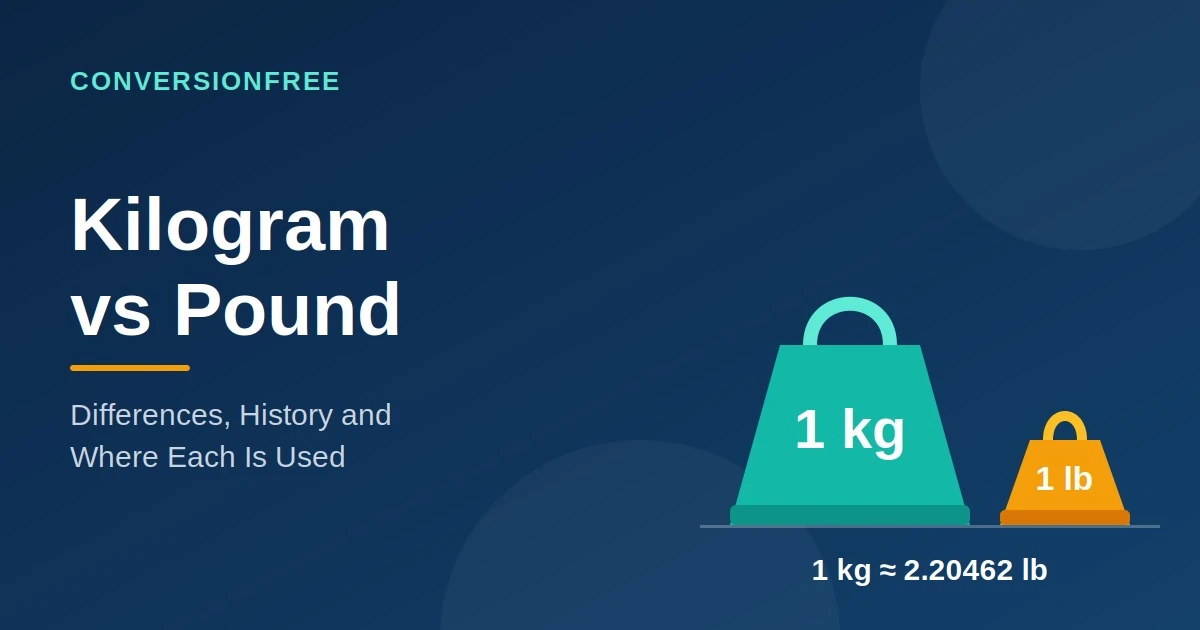
The biggest practical difference is size. A kilogram is heavier than a pound, by a little more than double. So the answer to "is 1 kg equal to 2 pounds?" is no. It is about 2.2 pounds, and that 10% gap matters. At 100 kg, using "2 pounds per kilogram" would understate the true value by about 20 lb.
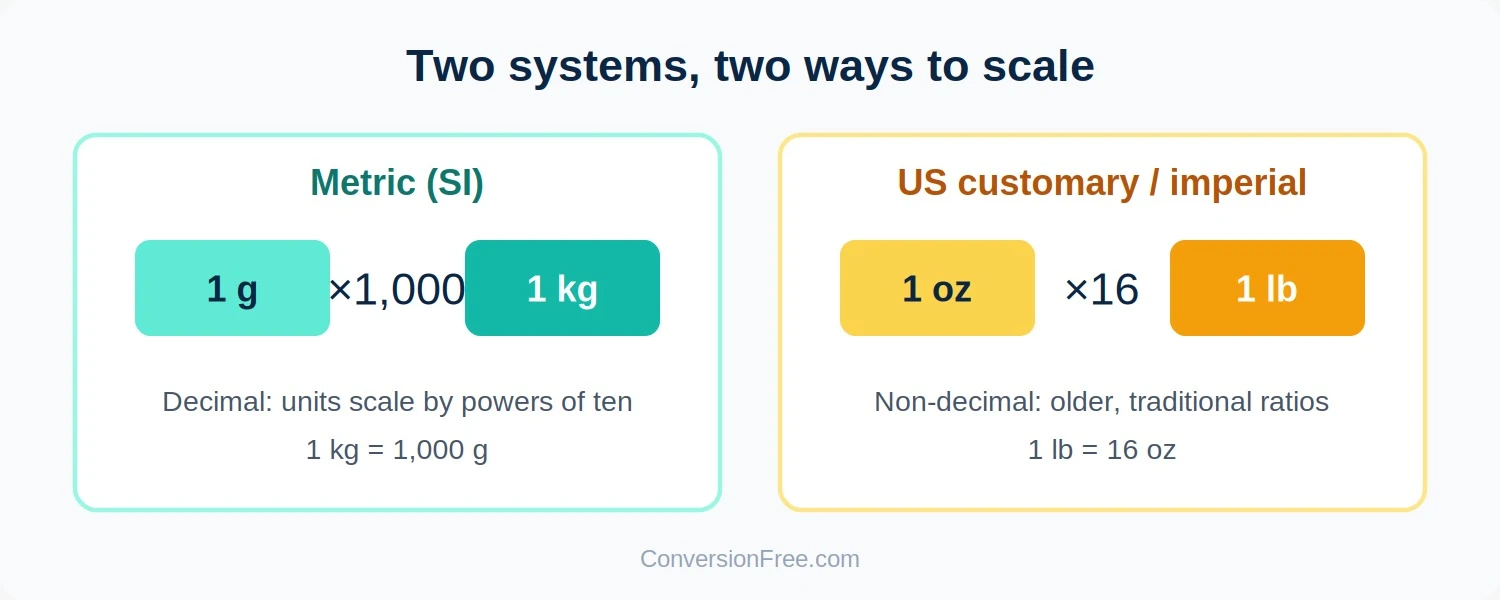
The second difference is structure. The metric system is decimal, so units scale by powers of ten (grams, kilograms, tonnes). Pounds and ounces use older, non-decimal relationships, such as 16 ounces per pound.
Kilogram vs Pound: A Short History
Origins of the kilogram
The metric system was developed in France in the 1790s, during a push to replace the many inconsistent local units with one logical system. The gram was originally tied to the mass of a volume of water, and the kilogram became the practical standard unit. In 1875, many countries signed the Metre Convention to coordinate measurement standards, and the modern SI was formally established in 1960. The 2019 redefinition made the kilogram depend on a constant of nature instead of a physical artifact.
Origins of the pound
The pound has much older roots. Its name and symbol trace back to the Roman libra, and different regions in Europe developed their own "pounds" over the centuries. These varied in size, which is one reason standardization became important. The modern international avoirdupois pound was fixed in 1959 by an agreement among the United States, the United Kingdom and other Commonwealth countries.
Why both are still used
Measurement systems grow out of trade, law and habit. Once a unit is built into packaging, recipes, regulations and everyday speech, changing it is slow and expensive. Most countries adopted the metric system, while the United States kept customary units for daily life. That is why people who shop internationally, travel, or follow fitness and cooking content from other countries still run into both.
Where Are Kilograms Used?
Kilograms are the standard unit of mass across Europe, Asia, Africa, Latin America and the Middle East, and in the scientific and industrial worlds everywhere, including the United States. In practice, that includes:
- Body mass: medical records and bathroom scales in most countries
- Food and commerce: packaged goods and market produce are sold by the kilogram or gram
- Shipping and freight: international cargo rates and parcel limits are usually set in kg
- Science and engineering: SI units are the global standard in research and manufacturing
- Fitness: gym weights are commonly labeled in kg outside the US, and in competitive weightlifting
Where Are Pounds Used?
Pounds are most common in the United States, where they appear in:
- Body weight: people usually state their weight in pounds
- Groceries: meat, produce and bulk food are priced per pound
- Fitness: gym plates and dumbbells are often marked in lb
- Shipping and product specs: package weights and appliance specs use pounds and ounces
Pounds also remain common in a few other places, though usage is mixed. In the United Kingdom, for example, people often give body weight in stones and pounds, while packaged food is labeled in metric units. Canada officially uses metric but still sees pounds in casual speech, especially for body weight and cooking.
So pounds are common in some contexts, not universal. Even in the US, science, medicine and most manufacturing use metric units.
Kilogram and Pound Examples
These pairs show how the units relate:
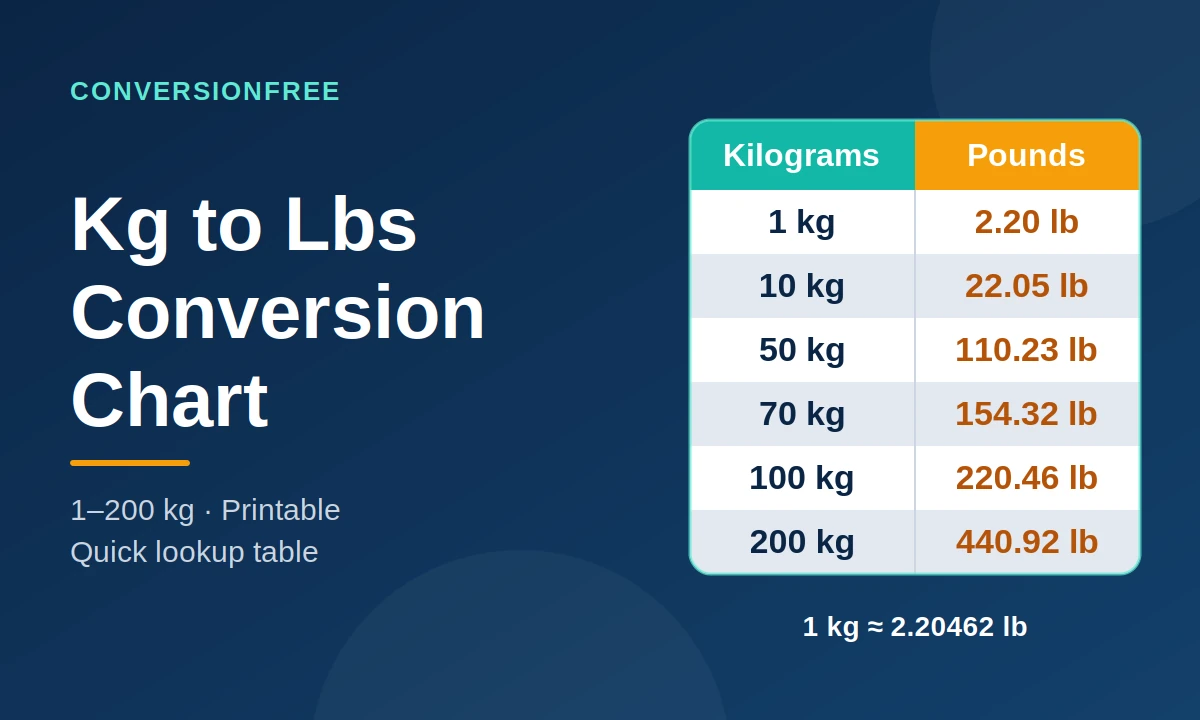
- 1 kg ≈ 2.20462 lb
- 5 kg ≈ 11.0231 lb
- 10 kg ≈ 22.0462 lb
- 1 lb ≈ 0.453592 kg
- 5 lb ≈ 2.26796 kg
- 10 lb ≈ 4.53592 kg
Notice the pattern: kilogram values get larger when expressed in pounds, and pound values get smaller when expressed in kilograms.
How Are Kilograms Converted to Pounds?
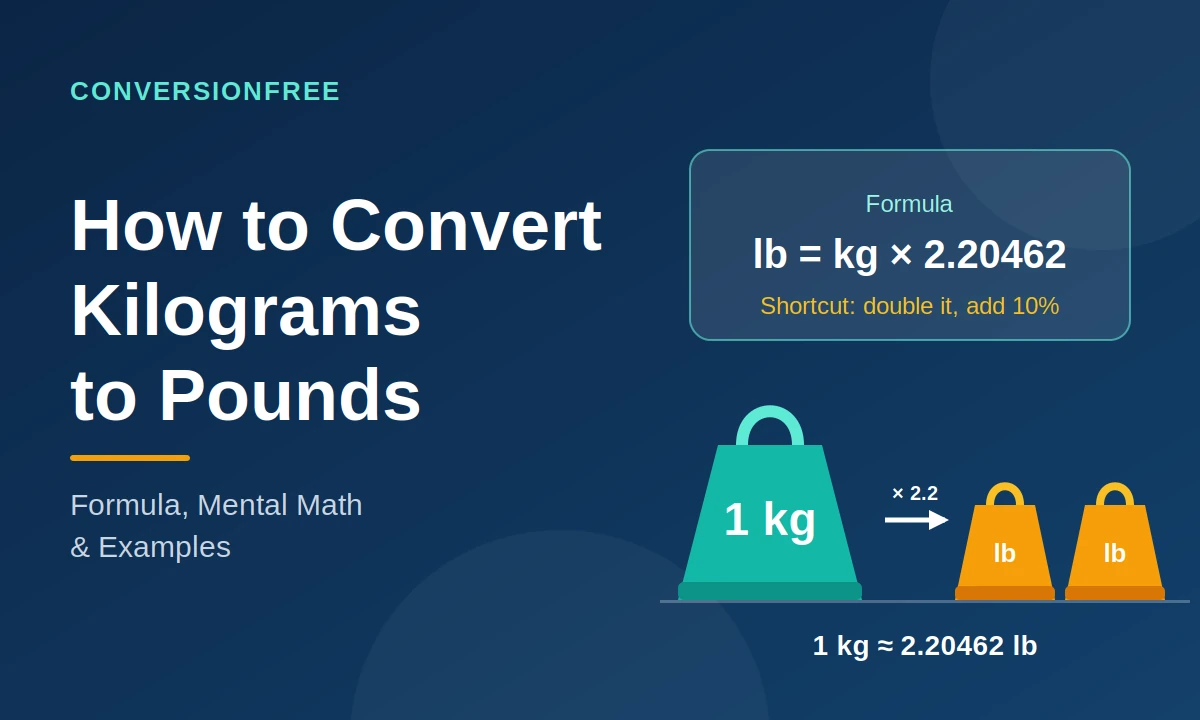
To convert kilograms to pounds, multiply by 2.20462:
pounds = kilograms × 2.20462
For example: 5 kg × 2.20462 = 11.0231 lb
The multiplier is an approximation of the exact relationship (1 lb = 0.45359237 kg), rounded to a convenient number of decimals. If you need to convert a specific value quickly, you can use the ConversionFree kg to pound converter, which handles the arithmetic and rounding for you.
How Are Pounds Converted to Kilograms?
To go the other way, multiply by 0.453592:
kilograms = pounds × 0.453592
For example: 10 lb × 0.453592 = 4.53592 kg
The two conversions are inverses: dividing pounds by 2.20462 gives the same result as multiplying by 0.453592.
Kilogram vs Pound in Everyday Life
You're most likely to meet both units in these situations:
- Body weight: a doctor's chart may show kg, while a friend in the US quotes pounds
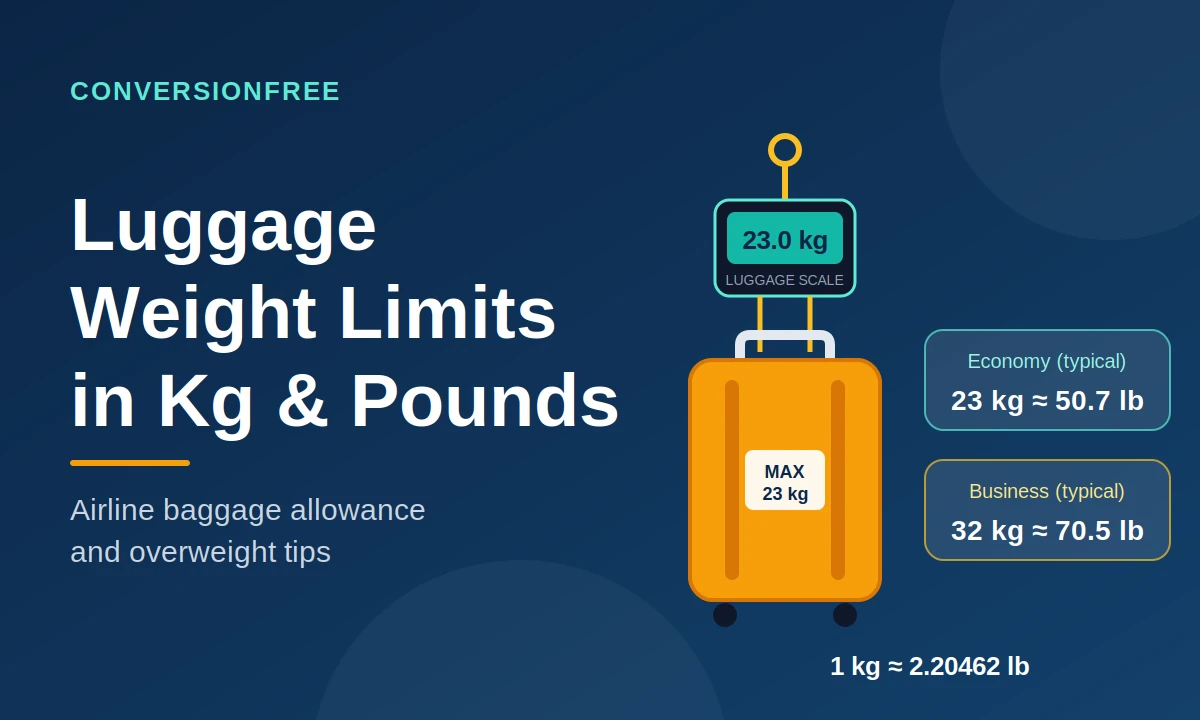
- Luggage: airlines in many countries set baggage limits in kg, while US-based sources may list them in pounds
- Food and recipes: an imported recipe may call for pounds of meat or flour while your scale reads in grams
- Gym equipment: barbell plates are marked in kg or lb depending on where they were made
- Shipping and product specs: international sellers often list both, but not always
- Online shopping: product weights on overseas sites may use whichever unit is standard there
If you regularly convert between systems, it can help to bookmark a set of unit conversion tools so you aren't searching each time.
Mass vs Weight: Are Kilograms and Pounds Weight Units?
In physics, mass is the amount of matter in an object. It stays the same wherever the object is. Weight is the force of gravity acting on that mass, and its SI unit is the newton (N).
On Earth, a 1 kg mass weighs about 9.81 N. On the Moon, the same mass would weigh much less, but its mass would still be 1 kg.
In everyday language, people use "weight" for what scales report, such as "I weigh 70 kg." That is why kilograms and pounds are commonly described as weight units even though, strictly speaking, they measure mass. In engineering you may also see the pound-force (lbf), a separate unit for force, which is why context matters.
For daily conversions, the distinction rarely changes the result, because both units are being used the same way.
Kilogram vs Pound FAQs
Is 1 kilogram equal to 2 pounds?
No. 1 kilogram is about 2.20462 pounds, so "2 pounds" understates it by roughly 10%.
Which is heavier, 1 kg or 1 lb?
1 kg is heavier. It is a little more than twice the mass of 1 lb.
How many pounds are in 1 kilogram?
About 2.20462 pounds.
How many kilograms are in 1 pound?
About 0.453592 kilograms (exactly 0.45359237 kg by definition).
Why does the US use pounds instead of kilograms?
Customary units were established before the metric system spread, and they became deeply built into trade, packaging and daily habits. The US has legally defined its customary units in terms of metric standards since the late 19th century, but daily use never fully switched.
Is a pound metric or imperial?
Neither is exactly right. The pound is a US customary and imperial unit, not a metric one, although its size is now defined using the kilogram.
Is a kilogram a unit of weight or mass?
Strictly, it is a unit of mass. In daily speech, people use it for weight.
What does lb mean?
"lb" is the abbreviation for pound, derived from the Latin libra.
What does kg mean?
"kg" is the abbreviation for kilogram.
Final Thoughts
Kilograms and pounds describe the same kind of quantity, mass, but belong to different measurement traditions: one decimal and global, the other historical and regional. Once you know that 1 kg is a little over 2.2 lb, and that the pound is now officially defined from the kilogram, the two units are easy to relate.
To convert a specific value, use the ConversionFree convert kilograms to pounds tool. If you work with other measurements as well, you can browse the full collection of measurement converters.